Endnotes introduction: October 17th was an exceptional day in the development of social struggles in France. Our intention is to collect and publish a number of perspectives on its significance. The following text provides an informative account of the day while also explaining the context for a non-French reader. However, one claim that we did not find persuasive was that the “rioting parts of the day were silent”, this from a perspective that a separate “we” has a ”task of making sense of these acts—identifying the class fraction at work, giving them slogans that match their aspirations, and so on”. Our impression of the day was that it was not silent but spoke fairly loudly and clearly, both implicitly—that on a day protesting the cost of living, people en masse took things without paying—and explicitly as participants articulated themselves in various ways. It seems the author overemphasises the contrast between October 17th and the more “chatty” yellow vests. It might be better to consider a longer history of the relation between the struggles of the inhabitants of the banlieue and that of other parts of French society. That relation has often been a hostile one of two separate worlds that have not known how to talk to each other. October 17th was a kind of breakthrough in the way the two groups came together creatively on the streets. Just as they had initiated the lycée struggle, the kids of the banlieue took the lead. These points of disagreement aside (or indeed precisely including these areas of disagreement) we think the text makes a useful contribution to a conversation about October 17th.
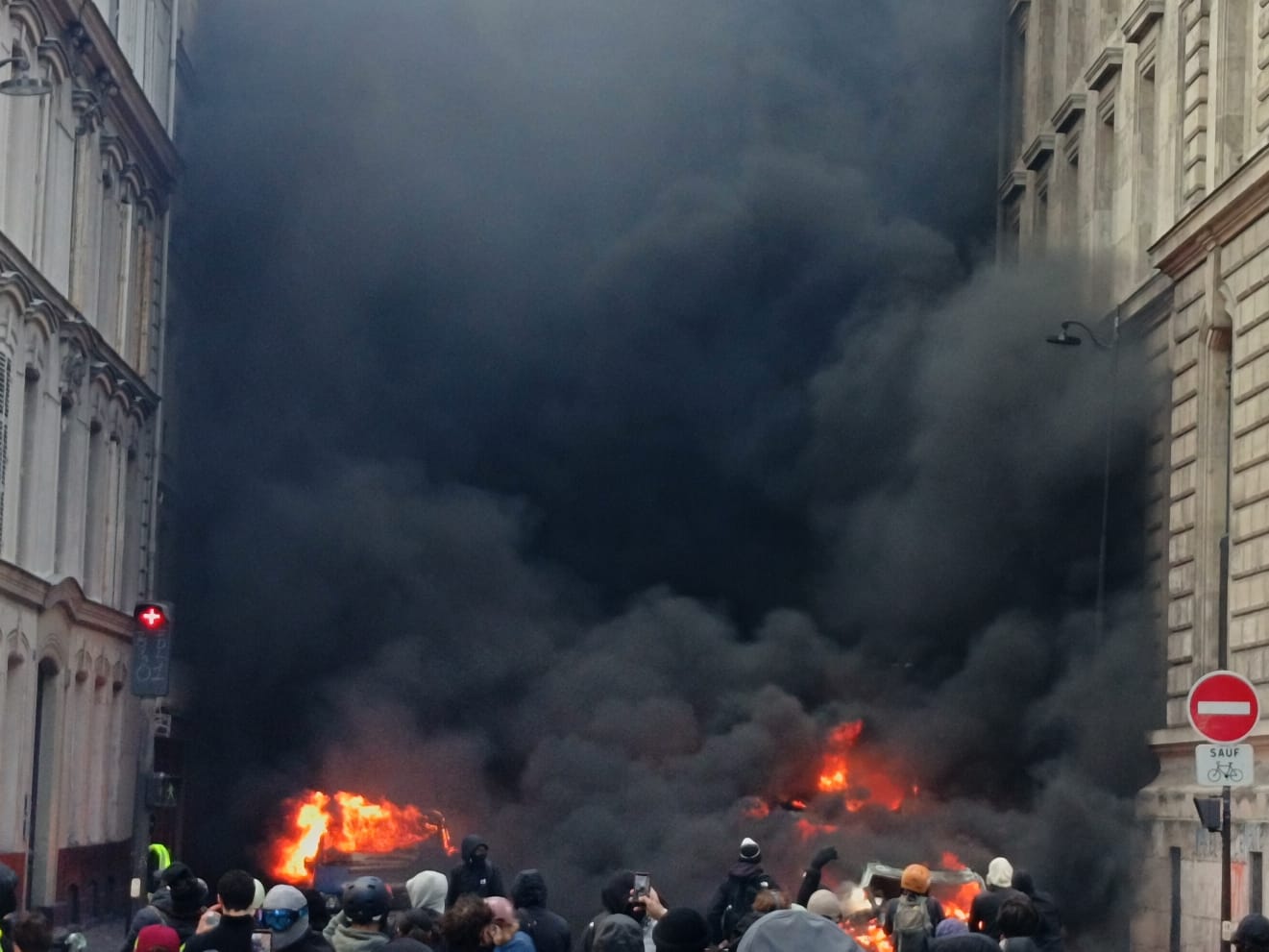
This is not a general account of what really happened in France on October 17th. It offers only a single point of view: immediate impressions and reflections on a day that went far beyond anything we had expected. It’s little more than an account of a flânerie through the riot in Paris.
Outside France, people can get a skewed idea of the scale and power of the protest movements here. The striking images in the international press hide a reality that is much more routine in its practices and limited in its outcomes. This image of strong protest movements over the last ten years fails to show that this level of contestation has won no substantial victories.
In France, it is possible to organize very large demonstrations that enjoy broad public sympathy. They are often rooted in unions that remain fairly left-wing and that, though nothing like what they were in the heyday of the workers’ movement, are still big enough to count. More than a million people in the streets in 2023 is significant. But these large demonstrations tend to centre on the defence of the welfare state, and can defend only a programme of redistribution. The 2023 movement against raising the pension age from 62 to 64 is the perfect example, in both its aims and its sheer scale.
It is precisely because they are defensive movements, organized around redistribution through the state, that they are so massive. This is what allows them to be cross-class movements that draw in a large part of the middle class. But this is also their weakness. They have little leverage through strikes. When strikes do happen, they are usually confined to the public sector. Public transport may be the only sector able to bring the country to a halt, and its workers tend to take on a “proxy strike” role, striking on behalf of the rest of the country. As a result, these movements cannot take the fight onto the terrain of wages. In the long run, this has also marginalized production, and the working class, within the French left.
So when the working class does return, it returns with a vengeance. Its political expressions find hardly any support in these cross-class movements, and they tend to find their slogans and forms of organization outside the left, even the radical left. In recent years this was made obvious by the yellow vest movement in 2018 and the riots after Nahel’s death in 2023.
October 17th brought together a number of these class fractions. But the passage from aggregation to unity is far from assured. If this day was exceptional, it is largely because it managed to break through a number of deadlocks, but also because it exposed the structural limits to the political unification of the proletariat in France.
Yesterday
That said, you cannot make sense of this experience without setting out how this day was anticipated, and what those expectations meant politically. The call for October 17th seems to have emerged in the second week of September, with one TikTok video in particular gaining traction. One striking feature of the call, or rather of several overlapping calls, was that no one could really say where it came from, who was behind it, or why. The video framed the call as a return of the yellow vests, but as it spread across platforms it became linked to wider cost-of-living demands and to the lycée blockades. Nor was it clear how this date, rather than any other, broke through into the mainstream. When the 17th rolled around, it was a date everyone had been waiting for, and waiting with some anxiety, since nobody knew whether the day would really come to anything.
The leftist groups, understood here in a very broad sense (from tiny communist sects to what’s left of the autonomous scene, from the unions to parties like La France insoumise, or LFI, Jean-Luc Mélenchon’s party), wait for social movements as one waits for the Messiah who will come to save them. They see the limits of the social movements of recent years, even the very large ones, but they cannot organize the rest of the proletariat, which their routine calls to mobilize fail to reach. So the left, again in a very broad sense, projects its own slogans, chiefly those centred on redistribution, onto the unpredictable upsurges of the working class, and often fails to understand that these working-class movements respond to a different kind of political appeal. Hence the left’s wait-and-see attitude in the run-up to the 17th.
That morning I and a small group of comrades were still asking ourselves the usual questions, about the second coming and about the false prophets: not just whether the date would come, but whether, if it came, it could help close, even a little, the gap that has opened up between the class struggle and the left, including the radical left. We were also hoping that if it did, it could push back the cross-class slogans and the disproportionate role the middle class has taken in class struggles.
Still, we wondered whether anything would really happen at all on the 17th, and if so, who would be there: a revival of the yellow vests? The high schoolers? The peuple de gauche (the traditional social base of the left: teachers, civil servants, the educated middle class, and their shared references)? The banlieues (the working-class outer suburbs and their housing estates)?
The call definitely had a younger feel than the routine statements of the old yellow vests. The slogan (if you can even call it a slogan) was quitter l’époque contemporaine, “leave the contemporary era”. In French school history, the “contemporary era” is the period that opens with the Revolution of 1789 and runs to the present day. Only high schoolers staring at a timeline in a history textbook could come up with a line like that, and only they would use it as a meme. It also has a faint situationist ring (“leaving the 20th century”), very likely accidental, which made it popular on the left.
That was a good sign.
But the line between meme and slogan hadn’t really been crossed.
Last year on September 10th, a similar scenario had already played out. A date had surfaced from the depths of Facebook and Telegram channels, with no way of really knowing where the call came from, which circles started it and which took it up, or why that date rather than another. The movement had found a name, “Bloquons tout” (“block everything”), which had the advantage of getting everyone on board: yellow vest in tone, but not so far off that LFI couldn’t make stickers out of it. But when the day came, it was only the leftist groups that showed up. A damp squib. You could see the difference between the two calls right away. September 10th borrowed its vocabulary from the left and maybe from the yellow vests, whereas October 17th was wrapped in a much thicker mystery.
This readiness to wait for a date that emerges, so to speak, out of nowhere is a reflex acquired in France since the stunned disbelief that the yellow vests created in 2018. Coming out of nowhere, they borrowed their “vocabulary” from no clear precedent. This readiness to wait for a date that emerges, so to speak, out of nowhere is a reflex acquired in France since 2018, and the stunned disbelief created by the yellow vests, who had themselves come out of nowhere and borrowed their vocabulary from no clear precedent. Part of their repertoire was even downright repellent to the left: the French flags, the sovereigntist1 streak, the determination to be neither left nor right, and so on. And the fact that it began as a movement against fuel prices marked it from birth with original sin: too rural, not green enough.
Although it was completely unconnected to the ultra-left and the French autonomous scene, the yellow vest movement nonetheless had exactly the form in which the remnants of the autonomous scene could have recognized themselves and been able to intervene. The absence of the mediations of the institutional left ought by rights to have made this movement the confirmation of the autonomist hypothesis: how a movement should start and grow. But in practice the resemblances were superficial and the autonomous scene played no role. More than that, it failed to distinguish itself very clearly from the broader left in its attitude towards the yellow vests. That inability to intervene and find a common idiom with the actually existing proletariat (or at least with the fraction that was, at that moment, the most combative) has been eating away at the autonomous scene ever since. It lost its self-confidence and its ability to be the provocative element in demonstrations and movements, and never recovered them. So much so that, eight years later, almost nothing is left of it. Every new date is now an occasion to avenge that failure.
A feeling of unfinished business had also been hanging in the air since the riots after Nahel’s death in 2023. On June 27th, 2023, Nahel Merzouk, aged 17, was killed by the police in Nanterre, in the Paris banlieue. His murder led to an explosion of anger. Demonstrations, rioting and looting followed for about a week. All of this came just as the movement against the pension age reform was dying out. Large demonstrations and looting movements, if they did not converge, followed each other in quick succession, and I remember hoping that maybe the rioting would revive the pension age movement, and bring together the anger and frustration directed at the government. These events are recent enough for today’s high school kids to remember.
Still, the 17th took off largely because it wasn’t just a return of the yellow vests. It didn’t present itself as the real thing at last, after yet another dress rehearsal. What made the 17th was the high school movement, which emerged after the call for the 17th had begun to circulate. Its demands were about the state of French schools: against crumbling buildings, against understaffing and unfilled posts, against the arbitrariness and opacity of Parcoursup (the national platform through which school students rank their choices and apply to university), and more generally against the dwindling prospects offered by higher education. The blockades (pupils barricading the entrances to their schools) were particularly fierce, with some schools trashed or even burned, first in the Paris suburbs, then in Paris itself and across the country.
This year, compared with the other attempts to rerun the yellow vests, such as September 10th, different class segments actually came together. On one side, those who feel that their upward mobility through school is blocked but who aspire to join the middle class; on the other, those who feel the school system has already condemned them to a life on minimum wage. I do not agree with the reading of the school movement in artifices’ “Leaving the Contemporary Era”, which treats the school burnings as a negation of the very condition of being a student. It misses the mood of the blockades. As for rejecting school as such, the fact that students sometimes set schools on fire doesn’t mean “burn down the school” was the content of this struggle. We're not in the sixties any more. The signs and the slogans were much more about equal opportunity, and should be taken seriously. Some of the immediate demands are redistributive: funding for schools and decent public services, with enough teachers and sound buildings. But the movement was also a revolt against school as it is, cut off from employment: not a rejection of the school's promise of upward mobility and of wages above the minimum, but anger at its failure to keep it.
Although the high school movement struggled, as might have been expected, to win support in the staff rooms, the marches were huge. We’re talking at least 450,000 marchers. That’s far more than the usual start-of-year march you get every year in Paris. But beyond the size of the marches, this rentrée (the return to school and work after the summer break, traditionally a season of protest) didn’t take a different form. République–Nation. Then everyone goes home.
With hindsight, everything was in place for all of France’s discontents to converge on the 17th. It was payback day for all the past dates that failed to materialize, all the struggles that came to nothing and were treated with contempt during Macron’s ten years, and for the high school movement, hard-hitting but stalled, with no clear prospect of substantial gains.
On top of that, the unions refused to fully back this date. They didn’t sign up to “leave the contemporary era”, a slogan completely alien to their worldview, and called for November 5th instead. Without the unions, there are no stewards and no militant infrastructure to give the day a route, a beginning, an end, and a repertoire of action. That overall absence of unions helped scatter the 17th geographically, and largely freed it from the routine of the demonstration-form.
Even if all these factors seem obvious after the fact, the day’s success was anything but a given. At a meeting just two days before, on the 15th, we were still doubting the date. “It’ll be a rerun of September 10th, only even more ridiculous.” “The 17th is a figment of the imagination.” “What counts, what’s real, is the high school movement, and all we can do is anti-repression work.”
Today
Even on the morning itself, we had our doubts. At Gare du Nord, a banned gathering: more riot cops than protesters, a few flags from communists we know. We ended up watching them get kettled. The BRAV-M (a quite terrifying and frankly hated motorcycle police unit, two officers to a bike: a driver and one armed with a rubber-bullet launcher) were still tearing around the city. A few hours passed in which we felt something like anxiety that nothing was going to happen, even less than on September 10th, in which case we would have had to face how wrong our hypotheses about the current state of the class struggle were.
Almost in resignation, we headed to Place de la République. We expected to find the same peuple de gauche as at the big marches that came before: the usual middle-class parade. September 10th all over again. But on the square, it was much younger. Lots of high schoolers. Very few signs, very few slogans. Lutte Ouvrière (LO), a Trotskyist party, was one of the few communist organizations on the square. All the organizations of the left, the parties, were at the entrance to Boulevard Magenta, ready to walk the route approved by the prefecture, noticeably off the square.
On the square, we found very young kids from the banlieues: a political subject that is very hard to define but that you recognize when you see it, and one the left makes itself about as ridiculous trying to address as the police do.
A feature quite new to the demos was the amount of cosplay: Narutos, loads of Spider-Men, Power Rangers, and so on. We saw some pretty astonishing scenes too. We saw teenage girls in hijabs handing out LO stickers they had just picked up. Another group of kids were surprised to see the hammers and sickles on those same stickers when we asked whether they knew they were handing out communist material. “But aren’t we all a bit communist here?”, they said.
Meanwhile, rocks were flying near Rue du Faubourg du Temple. The police answered with tear gas. This ebb and flow lasted from noon to 3 p.m.: a human tide charging at the police, throwing whatever it could find on the square. Tear gas volleys pushed the whole crowd back, and then it surged forward again. A car was wrecked. The square’s two newspaper kiosks burned.
An amusing routine played out on the square, and we saw it repeat several times during the day. The rioters start fires; the fire engines struggle through the crowd but get cheered; they put the fire out to loud applause; and the moment they’re gone, the fires start up again.
And, at one point, the police vanished from the square. And it seemed not just from the square: from the city. All the streets, at least around République, at least at that time, opened up. I would give a lot to know what happened at the Préfecture de police around 3 p.m. that day. I don’t know if the disappearance of the police presence was felt only at République, but it was a unique moment of limbo, the moment when we understood that something special and new was happening. Presumably, the police were stretched thin and could not make themselves felt everywhere at once.
We saw a Franprix supermarket get looted, Rue Yves Toudic on fire, cars burning on both sides of the street. Then we watched a small tabac (tobacconist, café and newsagent) get absolutely stripped. Sweets and cigarettes were handed out in the street. On the Grands Boulevards, we saw the first barricades. They were made of electric rental bikes, and they kept catching fire. As we moved on, we ran into a few charges by the CRS (riot police units, highly trained in crowd control) here and there, but they were always isolated and overwhelmed in a way I have rarely seen.
On the barricades there were lots of French flags. We heard few or no left-wing slogans. More surprising still, on a pile of burning bikes, people sang the Marseillaise. That symbols of the State and the Republic would be used at the very heart of the revolt against them might seem surprising, especially coming from people who are most likely high schoolers. But behind those symbols, I think, lie two things: on the one hand, a vague awareness of a revolutionary origin (the 1789 revolution against privilege, which no pupil in the French school system can completely ignore). On the other, a demand that the State honour its broken promises, the ones symbolized by school—liberty, equality (sometimes of opportunity), fraternity—and broken by that very same school.
By the time we got to Strasbourg-Saint-Denis, it was a proper riot. Supermarkets and fast-food restaurants trashed. There’s always a wandering anarchist around to tag the banks and the wrecked McDonald’s, which might give the impression of a left-wing crowd. But the looters and rioters that day weren’t the usual crowd at the fringes of demonstrations: they did not have the gear or take the usual precautions.
From there, one thing became obvious. We started to see tags: Rendez-vous à l’Élysée (“See you at the Élysée”, the presidential palace). The riot was heading west, into the posh neighbourhoods. At some point, we passed a group of six idle police vans with only their drivers inside, and two motorcycle cops. They let us through and nobody, neither we nor the rioters, thought of attacking them, or even of singing “Tout le monde déteste la police”(“Everyone hates the police”, a standard chant at demonstrations). It was a strange day, one we’d never seen. The one everyone had hoped for that morning, but one that, now it had come, was becoming bewildering.
We saw an Arc’teryx shop get looted near the Madeleine. A group of young people (high schoolers?) came out with an armful of €800 jackets. It didn’t even occur to them to take the price tags off in case the cops picked them up. On Rue Montorgueil, later in the evening, a group of rioters crossed the street. The cafés and bars were still open. Tourist Paris never stopped turning that day. Elegant people kept drinking wine and Spritzes while the gutted cash registers of the shops were being thrown into the street. We passed one rioter. He was hiding a perfume bottle in his pocket. We told him to take off his balaclava in case he ran into the police. It hadn’t even crossed his mind.
All day long we also kept getting news of the “official march”, the one that followed the declared route. That much more routine part of the day was committed to a very vocal non-violence. Mélenchon tweeted to distance himself from the rioting. But the official march was only a small part of what was going on that day. Nearly every street, from the Élysée to République, was packed with protesters. The relationship between the march and the riots was not obvious. Sometimes they were a street corner apart without merging, but their coexistence wasn’t accidental.
Obviously, the looting was the defining feature of the day. Within the rioting, you can tell apart two groups and two practices. First, left-wing groups, very much a minority, with flags (“autodéfense populaire”, popular self-defence, was one I saw) and highly recognizable signs. Their aim was above all to take on the police: Molotov cocktails and iron bars. They were very well prepared. The vast majority of rioters, though, were kids. They weren’t looking for a confrontation with the police, didn’t charge, and scattered much faster. They had no political markers at all. They looted pretty much anything they could lay their hands on.
Looting, it must be said, wasn’t a form that had taken on such importance in France’s social movements until now, even at the peak of the clashes with the yellow vests. This kind of looting had happened in 2023, though not on that scale in central Paris, during the uprising after Nahel Merzouk’s death. But the reason the looting happened at that time was clear to everyone: it was an antiracist struggle against police brutality. And it also happened at a time of great political frustration when the massive movements against the pension reform had led to no political gain.
The looting on October 17th had no such clear political framing, and no clear trigger. It didn’t go after symbolic targets. Nor did it confine itself to targets that the left finds easy to justify attacking, like banks, American fast-food chains, big retail, supermarkets etc. The unease grows when it’s small tabacs, owned by Chinese families, that get hit. Can the price of tobacco alone explain that? And the pharmacies? The price of condoms?
Despite what the media says, this was not organized crime we were dealing with. Looting necessarily has an opportunistic aspect, and a collective joy to it. But this was not a separate crowd taking advantage of the chaos. As far as I can tell, the looters were the same people as the crowd gathered on Place de la République earlier. Looting is the political form the riot takes, but it isn’t really about the loot. The looting happened on the day of action and was part of it. It was felt to be the right expression of anger on that day. Inflation obviously played a part in this day of looting. But when the yellow vest calls for the October 17th first spread this year, it was the price of oil that once again lit the fuse. And that night’s rioters were far too young to respond with this level of violence to fuel prices; in the Paris region, a car is much less of a necessity than elsewhere in France, and most of them are too young to drive anyway.
Supermarkets get looted, but their contents are redistributed right away. Chocolate and sweets for everybody today! These may be riots against the cost of living, but they are not hunger riots. The looting was fun and the kids were clearly enjoying it. They had a distinctive Gen Z humour and kept posting on Snapchat all day. For a night of “violence”, I saw no violence among the rioters themselves. It had a carnival quality to it. I think the kids joined the demonstration and the riots for political reasons, but were not willing to put them into words. My sense is that this is because they feel the middle-class-dominated cortèges are alien to them. The marchers’ slogans do not meet the kids’ needs, and their routine does not match the kids’ anger.
If we were to set ourselves the task of making sense of these acts—identifying the class fraction at work, giving them slogans that match their aspirations, and so on—we would find it surprisingly difficult: the rioting parts of this day were silent. The rioters do not owe me an explanation, but I do owe the riot an attempt to understand it. Among the kids, not one sign, not one slogan, not one piece of graffiti of their own, hardly a trace of right-wing or left-wing culture. And who would they be addressing? And to what end? In that sense, and only in that sense, the riot was apolitical: it had no political language. It seems that blazing anger is, for the moment, a content in its own right.
This day was first called for as a return of the yellow vests, yet the contrast with the yellow vests is striking. The first quality of a yellow vest, as an object, is that you can write on it. The yellow vests wanted to hold assemblies. They made signs. It was a profusion of slogans, platforms, and social, economic and democratic demands. In short, it was a particularly chatty movement.
We would have been keen to be chatty too on that day. But the riot was wordless. This day, which was supposed to let us sharpen our slogans and recalibrate them, is going to prove very hard to make sense of, and to turn into political proposals. Still, the absence of left-wing slogans, though a negative finding, tells us something. It is a sign that the kind of slogans repeated ad nauseam at marches find little echo outside the sectors that carry them. Defending the welfare state and redistribution doesn’t set barricades on fire; that much we can say for certain.
The looting went on late into the night. In the evening, around 11 p.m., after nearly ten hours of walking, we stopped at the last falafel place open on Rue du Temple. We saw looters go past the window, then tear gas drifting up. The owner pulled down the blinds. The smell filled the whole restaurant. The falafel tasted of mustard. Not entirely unpleasant. With the restaurant staff, we ended up taking refuge in the back courtyard. There, a man with a torch was hunting for leftists or looters who might be hiding in his alleyway. He calmed down pretty quickly. He’d been afraid the building would catch fire after the looting of a thrift store on the ground floor.
So, was this a day of convergence of struggles, where different segments of the proletariat finally found each other? Far from certain. Since the call brought together between 550,000 (according to Interior Ministry) and 800,000 people (according to unions), it must have spoken to more than one fraction of the proletariat. But on the ground, they didn’t converge, and as a result that day’s geography reproduced the segregation of Parisian life: banlieue kids looting the posh bits of town, and the Parisian peuple de gauche, if not well-off then relatively better-off, although less and less so, marching along politely. Two things stand in the way of convergence. First, the electoral left, starting with LFI, can only go so far in its support for a riot movement. Second, it is not obvious how willing or able the kids are to be used as pawns in this convergence.
This day is also the breaking point in a lasting crisis of the demonstration. Everyone had known for a while that République–Bastille–Nation (the three squares between which most demonstrations happen in Paris) was a losing strategy. But now that the floodgates have burst, nobody really knows yet how to give what has burst through a form, or how to talk to it.
Postscript: Tomorrow
On October 17th we were somewhat speechless at the scale of the day. The question of what came next arose immediately, and a new date was called for the 24th, with, again, no clear idea of who was behind it.
The police’s lack of preparation on the 17th pushed the government to ban most demonstrations in the following days, and to allow only the unions to organize the ones it authorized. A curfew was imposed in the few parts of the city where most of the looting had taken place. This time there was no pretence of “dialogue”, unlike during the yellow vests. These bans and curfews were very unpopular, if the left is to be believed, but they were widely supported by Paris shopkeepers. The march was banned from Bastille, which introduced the regulars of these marches to a new route in the south of Paris. A very small change to the routine indeed.
As far as I can tell, which is to say from one part of the march in Paris, the 24th was disappointing and rainy. Above all, it was not at all the same crowd. The kids weren’t there. Some were preemptively arrested that day, but other factors mattered too: the weather was horrible; the route ran along the périphérique in the south of Paris, a rather depressing corridor with few escape routes and barely anything to loot; and while I doubt that enough kids go away for the holidays to explain their absence, the holidays probably make organizing more difficult. What we got was students and the peuple de gauche, with the same slogans as at every other march. The unions didn’t even bother to show up en masse. No smashing this time, and no looting.
However, this curious movement isn’t necessarily dead.
The government cannot make any concessions for the moment. For one thing, no demand clear enough to allow for symbolic but popular concessions has emerged. The abolition of Parcoursup announced on the 26th may buy the government time, but it is likely to be too little, too late. For another, the French state’s finances have been in a very poor shape for several years: public debt has kept climbing since the yellow vests, and at the moment France is borrowing at rates unheard of since the euro crisis that followed 2008, which would make subsidising more substantial measures (such as help with fuel costs) prohibitively expensive.
A draw, then. But movements of this kind are extremely volatile, and the reasons this one appeared are still there. The high schoolers are on holiday, and who knows what state of mind they’ll be in when they come back after the break. The next date, on the 31st, might be just as strong. On the last weekend before the rentrée, and Halloween; angry kids cosplaying might be just what kickstarts this movement again. Wait and see again..