Reflections on the Ongoing High School Movement
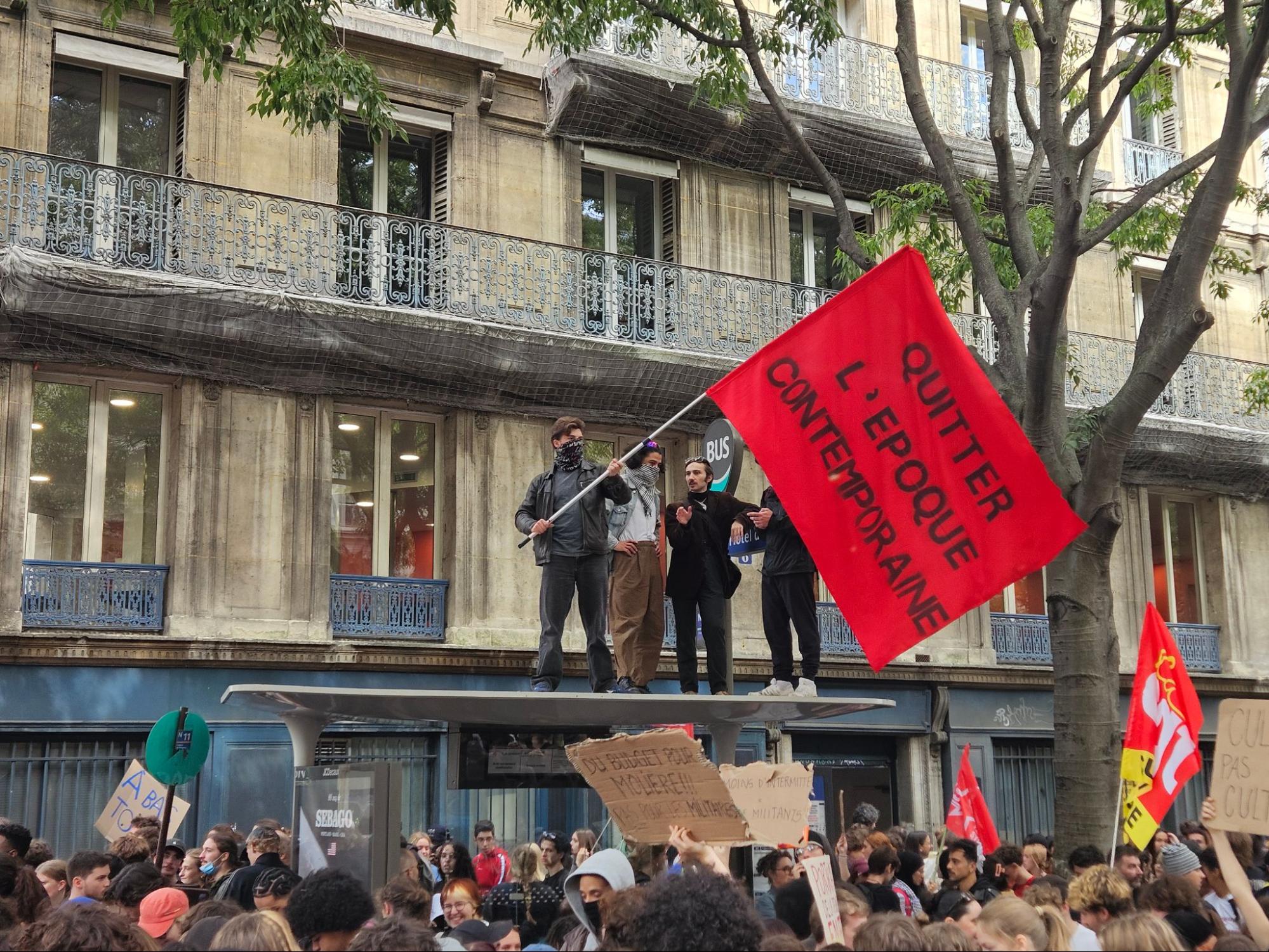
Photo: Arno Bertina
Since the 18th of September, a wave of blockades has been blossoming in the high schools of the banlieues of Île-de-France (the greater Paris region).1 Born from complaints over the lack of resources in these high schools, but soon spreading across the whole country, the movement quickly reached an unprecedented scale, one that would only intensify over the following days with the usual start-of-year mobilisation day for public-sector workers on September 29th. At the same time, the high school students have increasingly turned to rioting: burning bins, firing fireworks at the cops when they are not simply burning down their own schools.2
From the first days, police repression was especially brutal, with students losing eyes, having jaws fractured, even a hand torn off, to name only the most spectacular cases of unrestrained state violence. But this repression also runs through an exceptional judicial apparatus. To date, in just a few weeks, more than 2,300 criminal prosecutions have been opened. These figures recall the repressive record of the riots following Nahel’s death in 2023, with more than 2,100 prosecutions (the majority resulting in convictions) and of the Yellow Vests, with roughly 5,300 referrals to the prosecutor spread over six months of mobilisation.
That said, the high school students’ mobilisation cannot be reduced to deploring repression. While most of the left — even the “far”, “radical” or “déter” (“determined”) left — seems unable to do anything but dwell on this aspect, we think it necessary to return to a few other elements. It is never easy to analyse a movement that is still under way. But it is possible to draw out a few interpretive keys by building on the latest sequences of class struggle in the French context.
“Hands Off My Kid!”3
There is of course no question here of minimising the abject response of the police and judiciary. But we must ask why a reading centered on victimhood is so pervasively imposed on a movement that is so far from the ordinary. High school students are acting politically, and the state represses them precisely for that reason. It is about time that exhausted generations of activists stop investing themselves with the duty of patronising them. The circulation of practices between generations (anti-repression know-how, ways of dodging and confronting the police apparatus) is valuable, and is itself part of what gives the movement its vitality. But to suppose that adults have more to teach these young rebels than the other way around would be a serious error, one that amounts in practice to a sterile paternalism. Keep your sermons, preachings and pieties: high school students don’t need your rhetoric to produce a radical critique of this world.
This paternalistic outlook culminated on Tuesday the 6th of October, when, in the name of “convergence”, the left set about channeling the movement into a trade-union demonstration, to the government’s great delight.4 At the call of Jean-Luc Mélenchon, a collection of elected officials, activists and trade unionists — responsible adults, in short — wearing white helmets, tried to interpose themselves between a line of riot police and the high school students. Their aim was “to steward the young people’s demonstration, to protect them against being blinded and against the gas.”5 Much to their surprise, the students were not especially grateful, and simply went past the line to engage the cops directly. Faced with the discourse of victimhood, the only possible answer was the one given in practice.
In the same vein, we might question the recurring comparison of the movement with the Yellow Vests. Likening the high school students to the roundabout occupations allows always-late-to-the-party leftists to legitimise and smooth over the movement, to lend it a “political” consistency — the same consistency they had already tried to instill into the Yellow Vests with their perennial general assemblies. The effect is to present what is happening solely as a social movement demanding more resources for public services. This comparison is all the more questionable given that one can observe, perhaps, more unavowable similarities with the riots that followed Nahel’s death.6 We already noted this at the time7 , but we can only register a refusal to think the riots of summer 2023 (like those of today) politically, and to recognise them as class struggles.
The high school movement springs, first and foremost, from the anger of banlieue youth, and to speak only of innocent children in need of protection is a form of silencing, a pacification of the movement. It also serves to push into the background the questions of class and race that run through and fracture the movement. Let the leftists keep quiet and make themselves accomplices of the students’ formidable surge,8 which has rendered any talk of apathy obsolete, instead of smothering every initiative under their gloomy advice as experts in defeated mobilisation.
Interclassism and Demands
Less caricatural, a number of criticisms are beginning to emerge concerning the centrality (in media coverage, at least) given to Parisian bourgeois high schools. Certainly, the high school movement is, by definition, interclassist. But once that has been said, we are not much further along, since the class composition of contemporary struggles has never been remarkably “pure”. The question should rather be which fraction of the movement will gain the upper hand. If bourgeois schools and high schools in Paris are foregrounded and their spokespeople treated as representative of the movement as a whole, it is too early to declare their hegemony established. And in any case, it is impossible to judge the internal balance of forces within a movement on the sole basis of media visibility.
As for demands, the movement began with a set of slogans concerning students’ learning conditions. The shortage of staff, the overcrowding of classrooms, and the run-down facilities evoked the tearing of a promised Republican school.9 With the generalisation of the movement and the repression that followed, other demands10 emerged and took on tones more marked by the absence of any prospects for a youth promised a future of nothing but unemployment, war, and an October at 25°C (77°F).11 While it is too early to speak of the disappearance of demands made in the name of a more egalitarian school, we can already observe the retreat of such Republican discourse. And for good reason: this discourse cannot withstand the real functioning of an institution tasked with sorting the children of proletarians from the children of the bourgeoisie.12 Since the 1980s, the only major change has been workers’ children gaining access to secondary education, where previously they would have been sent straight to the factory floor. If school appears to be in crisis, it is because the meritocratic veneer that used to smooth over its normal functioning no longer convinces anyone.13
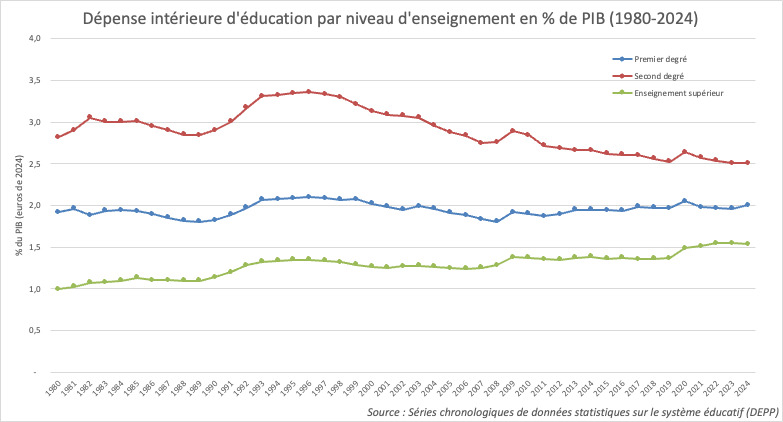
Source: Time series: statistical data on the education system (DEPP, French Ministry of Education)14
Beyond the overall role of the education system in the reproduction of the capitalist mode of production, the current sequence has its source in a series of political measures (Parcoursup15 , etc.) but also in a long-term trend. Indeed, the state has been chronically cutting the secondary-education budget since the 1990s.16 What is being so forcefully denounced today is therefore nothing new. It is the expression of the management of social reproduction through schooling under restructured capitalism. School no longer has to produce individuals skilled for specific tasks in industry, but rather individuals who are flexibly disposable according to demand in other sectors. A reform of the school capable of delivering the promised Republican equality is of course impossible, in that this was never its role to begin with. But even mere adjustments in that direction can only be wishful thinking, whatever the left may say. For decades, struggles have been structured by the impossibility of making demands.17 Faced with this impossibility, demands are replaced by a confused anger and by a refusal of one’s own condition. From the school fires of 2023 to those of the high schools in 2026, what is being negated in deeds is, in part, the very condition of being a student.
As we said above, we cannot set aside the movement’s heterogeneity, with its numerous contradictions and conflicting class interests. Several realities thus coexist: the (positive) demand for more resources in national education as the original spark, but also a far more negative posture among many young people, who are well aware of having already lost out in the deal (vocational high schools, youth who have dropped out of school, etc.).
Convergence of Struggles?
Where calls for convergence usually serve as a band-aid over the absence of any political perspective, today they appear quite clearly as a form of counterinsurgency apparatus. The point is to pacify the movement by folding it into traditional forms of struggle: a peaceful blockade in the morning, giving way to an organised march in the afternoon. Beyond the sheer impossibility of convergence (what, really, does a master’s student at the EHESS [an elite university] have in common with a student at a vocational high school?), what is happening here is the dilution of the actions of banlieue youth into the stagnating routine of trade-union and organized student movements. Here again, everything proceeds as if the call for convergence had no other aim than to silence the least presentable elements of the movement — that is, high school students from working-class neighbourhoods throwing rocks at and beating up the cops.
Unlike the entire left, the state does not treat this movement as a high school movement, but handles it as urban riots to be crushed. Police brutality thus makes sense above all as an expression of the entire apparatus for controlling working-class neighbourhoods,18 far more than as a “weakness” or “fear” on the government’s part. All of the left’s analyses and calls to widen the high school students’ struggle are therefore, in effect, directed against the rioting fraction, and so against whatever is most radical in the movement. To put it plainly: between proletarian youth who know they will never even attain the shitty living conditions of their parents, and those for whom access to higher education remains possible, the left has made its choice.
As during the Yellow Vests, and even more so in the summer of 2023 [the riots following the killing of Nahel M.], the struggle is grounded in an impossibility of reproducing one’s own conditions of existence. This episode of class struggle therefore belongs directly to the generalised crisis of reproduction that keeps triggering uprisings across the world, and that we have seen deepening in recent times.19 There is no longer any possibility of winning as a high school student, a worker, or a university student, when no sectoral improvement of living conditions is possible.20 The “urban riot” form imposes itself as the only way left to exist and to address the matter, for all parties: high school students who see no future, and a state that has nothing to offer. Faced with such a crisis of reproduction, nothing remains but riot against what constitutes and determines us within this society, or else a sterile social movement struggling to play its pacifying role, when capital no longer bothers even to concede crumbs.
And Now?
Having said all this, it is time to (not) answer a series of pending questions. The first is where the movement is heading. At this stage, it is impossible to know whether the school holidays, the government’s symbolic retreats, and the distant date of 17 October [tn: the first day of the holidays, the present text was written in early October] will be enough to deflate the dynamic. The closure of high schools, announced and then cancelled, seems to have favoured the blockades continuing for the rest of the week. Likewise, the mobilisation of student organisations can be read as the movement orienting toward an utterly conventional social-movement form.
Nevertheless, concluding too quickly in favour of this bleak prospect may mean underestimating the youngest participants’ creativity, as well as dreading an outcome that seems to have already proven its historical obsolescence — given how clearly we have seen that the way out through “dialogue”, the very condition for a social movement to exist at all, has been denied by the state for years now. Furthermore, it appears that the mobilisation is spreading like a contagion to other European countries, a trend that, should it be confirmed, would represent a rather spectacular novelty among contemporary movements.21 Perhaps that is where the only possible “convergence” lies in what is currently unfolding: in the ruthless critique of this world by those who, no longer even promised a world to win, have nothing left to lose in fighting the one they are in.
It is customary, for in media res analyses, to conclude with platitudes and hollow injunctions about where a movement is heading: a pre-cooked “What Is to Be Done?” addressed to readers of leftist texts, as though the will of activists could redirect the dynamic of a riot. We will spare ourselves this futile exercise. It falls to proletarian high school students to go on tracing their insolent lines of flight; they do it better than activists do. Before any real balance sheet of the movement can be drawn, all that remains for us is to actively support them, to join them as far as possible in their struggles without substituting ourselves for them. This is not a matter of support from a distance, applauding passively while high school students get their faces smashed in on the front line, but of being with them, taking blows side by side, and standing in solidarity against the repression.
Freedom for the arrested high school students! / Glory to the guilty! / May every school burn!