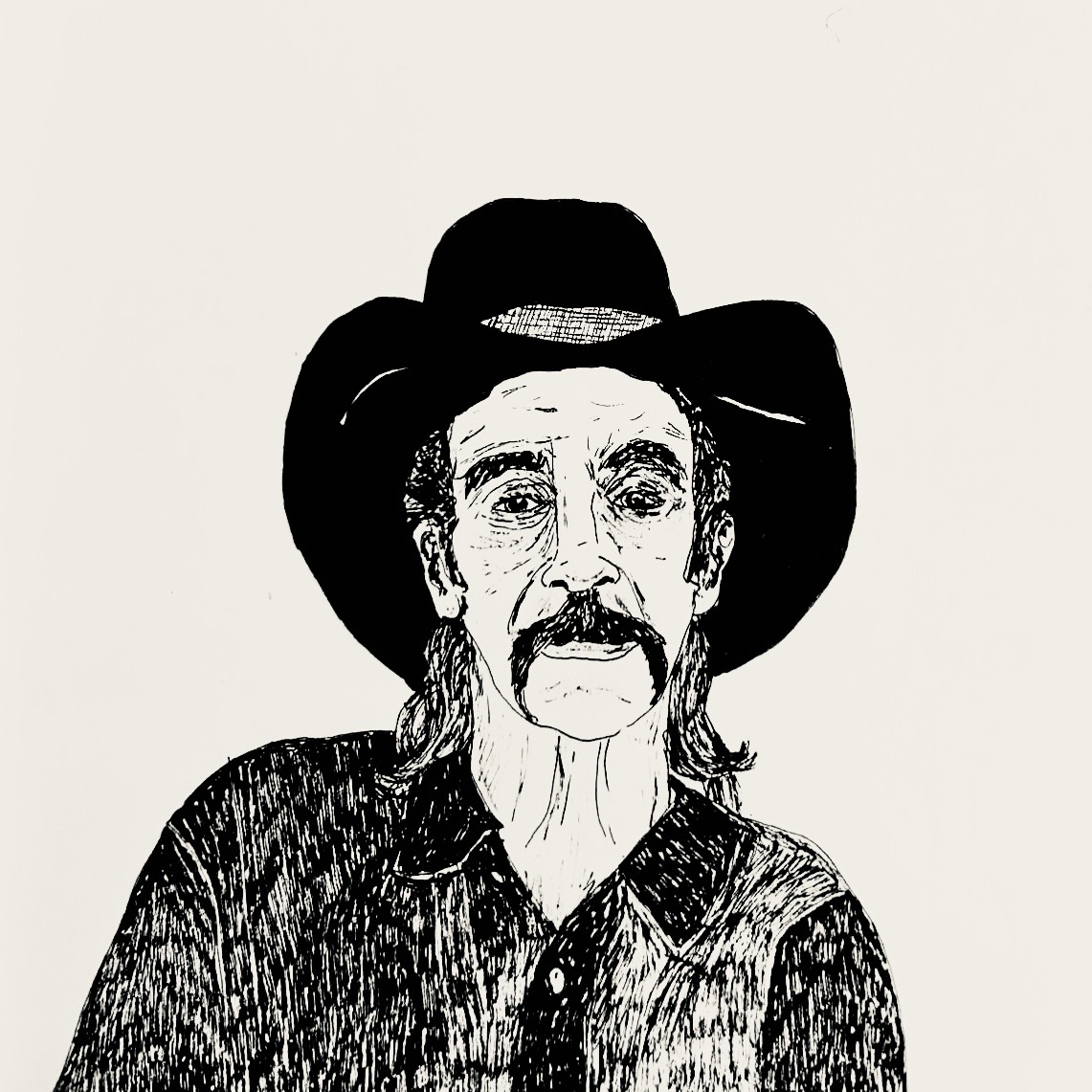
Upon Ben Morea’s death, my first impulse was to recount his legend—a cinematic, almost implausible succession of adventures, a counter-history of postwar America, a long ode to the indomitable spirit of certain souls. The first draft of this text attempted that song, written from memory, a euphoric outburst that would demand a commensurate emotional response from the reader. I stopped halfway through; the proper elegy demanded something else, not entirely overshadowed by its own narrative.
I met Ben in 2010 when I spent a year working in New York. I had read Osha Neumann’s book about the Motherfuckers, which ends with Ben’s disappearance into the Colorado mountains, and I asked around if someone knew anything about him. Eventually, a friend told me that he had returned to New York some years earlier and had reconnected with part of the city’s anarchist milieu.
At a Red Channels meeting, the collective run by that friend, someone revealed that they had found, in the Andy Warhol Foundation’s archives, Valerie Solanas’s long-lost play—allegedly the basis for the conflict that led her to shoot Warhol. Legend has it that Solanas, a close friend of Ben’s, had promised him he would be the last man to be killed in the coming feminist revolution. In her honor, we organized a full reading of the play in front of where Warhol’s Factory once stood and invited Ben.
The Spanish publisher La Felguera had recently published an anthology of Black Mask, Ben’s magazine from the 1960s, and I thought that Edições Antipáticas, our tiny publishing house, could do the same. I introduced myself, told him about the plan, and suggested a tour of Portugal and Spain, organized with La Felguera and the Barcelona Anarchist Book Fair. Ben agreed immediately: “If you tell me I can leave and come back with the same five-dollar bill in my pocket, I’ll go.” Over the following months, I visited him several times at his small apartment in Hell’s Kitchen, which also served as a gallery. Ben made a meager living buying art objects at various markets in New York and reselling them to his contacts in the art world. He loved hosting younger people, who hung on every word of the stories he told repeatedly.
Back in Lisbon, we held countless benefit dinners at RDA69 to fund the trip. When Ben landed, a dinner was waiting for him at the social center. He was moved, saying it was the first time he’d seen the same kind of atmosphere that had been so familiar to him on the Lower East Side. We spent the next two weeks traveling, many hours driving, others just drifting, filled with lots of conversation but above all with those knowing silences in which friendships take shape. That friendship lasted until he passed away, despite the distance and the long intervals between our meetings. I remember the last time I saw him, one exact year before he died, in New Mexico, the two of us in silence, leaning against a car while one of his adopted grandchildren played with a plastic gun surrounded by horses and the desert. One day I told him he’d had a more interesting life than any of us, and he replied that yes, but that we were smarter. I don’t think that’s true, but that exchange cemented what was familiar in our relationship—something born of that “partisan” love between people who do not share a time, an origin, a language, or blood, but share an intense and ineffable certainty upon which they have built a way of living. That was what Ben’s “armed love” truly meant.
---
The story of the Motherfuckers is relatively well known. A gang of outlaws, artists, and revolutionaries who spread chaos in New York during the second half of the 1960s. Their true outlaw spirit, their proto-punk ethos, and their territorial presence set them apart from a host of similar groups. The Motherfuckers supported dozens of people through money collected from local businesses, fought for control of the neighborhood against the state and the mafia, and practiced an armed Dadaism. The orphans of an America traumatized by its own brutality descended upon the city in search of the Aquarian revolution and transformed into werewolves thirsting for revenge.
Militant theorists would spend the following decades attempting to articulate what was being rehearsed there. The political ontology underlying the Motherfuckers was simple: The totalization of capitalist social relations fosters the proliferation of secessionist practices. The clash between the civilization of capital and these forms of life is a zero-sum game. These forms are composed of relationships. What are these relationships capable of? Are they mediated by money, ideology, and the state, or by their dissolution through a spiritual affinity made of care and antagonism?
What remains of Ben’s charismatic leadership, for better or for worse, is his intransigence. All confrontation was meant to be escalated to its maximum intensity, because that was where antagonism could become a spiritual condition. In the theatricality and excess of the Motherfuckers’ use of violence there is an indecision between pantomime and the aspiration for it to become mythical, primordial, and cosmogonic, but unlike what happens elsewhere, this insurrectionary power did not degenerate into clandestine armed struggle. It found an escape route in the ruins of American expansion. When the confrontation with the police and the mafia became untenable, the Motherfuckers began their New Mexico exodus, the scene of territorial disputes between the federal government and local Native American tribes. The group’s dissolution into desperado banditry and rival factions (the infamous “Pancho Villa syndrome”) points to the limit of a pure ontology of civil war: beyond the metropolis, it risks degenerating into mere autophagy.
But it was within this collapse that Ben freed himself from the role of charismatic leader. What remains for the revolutionaries when certainty of an impending revolution crumbles? The narcissistic racket? The management of a residual legacy? The incessant generational renewal of the milieu? Ben Morea could have died a martyr or survived an icon, but he chose to disappear. He spent five years on horseback with his partner Joan, riding through the mountains and forests, hunting and foraging, drawing close to the Native communities, by whom he was adopted and initiated. He settled on the border between Colorado and New Mexico and spent the following decades conducting rituals and ceremonies across the country, adopting dozens of lost children, some for a few months, others for decades.
There is a tangible continuity between these moments. Psychedelic culture becomes ceremonial; insurrectionary care becomes communal. But there is something less obvious that persists in this transformation from revolutionary leader to spiritual leader. Ben wouldn’t like the terms I choose to describe it, but I’ll use them because using other words to speak of what he spoke of is the most honest tribute I can pay him. Between his “family” on the Lower East Side and his family in the American Southwest, a communist anthropology endures, however fragile, ephemeral, or situated it may be. It is not accessible to us as such. None of these forms is repeatable or appropriable, but in them remains the intuition of a possible autonomy of the communist (and anarchist) question from the crisis of revolutionary subjectivities. When the revolution ends—won or lost—the revolutionary who wishes to remain faithful to its ethics must find another way to renew her commitment and testimony, lest she be devoured by her ghosts or possessed by her demons.
That is why Ben’s hesitant return is so unique. He did not return to enlighten the bewildered revolutionaries of the 21st century or to claim the dividends of the past. On the contrary, he returned to offer a testimony of something that seems impossible today: the possibility of a good life. There is nothing hagiographic about this statement. Anyone who knew him knows how capricious, hot-tempered, and self-centered he could be, but there was not a shred of cynicism, disbelief, or resentment in that man. Ben was an antidote to our contemporary malaise, dismantling the fairy-tale masculinity of the revolutionary figure.
The mythical fusion of art and life arises from a crypto-aristocratic narcissism fixated on its own reflection. Ben departed from that avant-garde program and transcended it. Of that ’68er pantheon slipping through our fingers, he is perhaps the only one who was not a philosopher or a writer. The saints we have left are those who, in the face of the psychic, corporeal, and existential shattering of modern subjectivities, managed to maintain a sensitive integrity. This integrity is neither pious nor neurotic; on the contrary, it is excessive, violent, and somewhat monastic. It bears a chthonic, earthy, dusty, and distant grace. Ben lived so that, even as everything around us burns, it remains possible to imagine a good life within that conflagration.