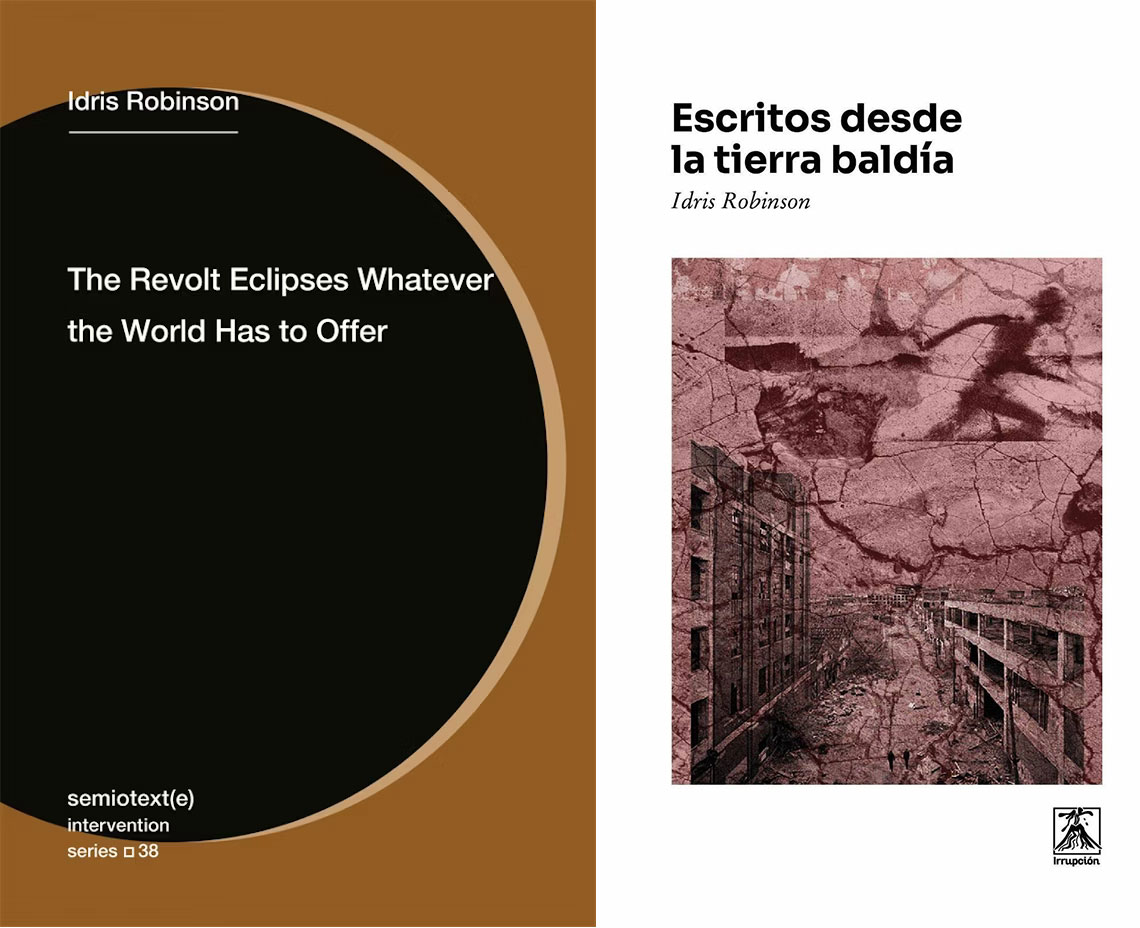
To mark the publication of Idris Robinson’s The Revolt Eclipses Whatever the World Has to Offer (Semiotext(e) 2025) we below publish translations of the accompanying texts of the book’s Spanish edition, Escritos desde la tierra baldía [Writings from the Wasteland]1 along with a recent statement by Robinson on the “third red scare”.
Remarks for the presentation of Idris Robinson’s Writings from the Wasteland at UMCE, Santiago de Chile. October 2025.
by Gerardo Muñoz
It is no longer my place to say much more about Idris Robinson’s book: Escritos desde la tierra baldia (Irrupción Ediciones, 2025), which precedes the English publication at the end of the year by Semiotext(e) under another title: The Revolt Eclipses Whatever the World Has to Offer. The English title actually has a Chilean affinity, which refers to a conversation I had with Idris in the months following the George Floyd Uprising, and was published in the (now defunct) Revista Disenso. We are talking about the Spring of 2021. That means it’s been almost five years since then. I believe we are both very grateful for not only the welcome we have received in the Irrupciones Ediciones catalog, but also for the constant collaboration of thought that has made everything a little more bearable and inspiring. In this commentary, I simply want to convey three points that could contribute to a conversation today regarding the position from which Idris is writing.
First, I believe the reader will see once they dive into the pages of Escritos that what first grabs your attention is what one might characterize as a certain immediacy and necessity in the book’s language. I emphasize this point because not enough attention has been paid, it seems to me, to the relationship between the event of revolt and the place of language. Although this problem was thematized by Willy Thayer with some emphasis in a discussion on the “minor constitution” in an issue of Papel Máquina in the Fall of 2021. Idris is a thinker of sparse, restrained, and subtle writing; and nevertheless in those “American hot summer” 2020 months his voice overflowed the written word. An overflow that has nothing to do with reporting the facts, though of course still including them, but more so with the very same possibility of “speaking” in the heat of a temporary instance that disrupts and animates. If there are moments of “linguistic blows/coups” isn’t the event of revolt an instance where something like pure language makes its presence felt?
And since we are talking about presence, in the Escritos, there is a zigzagging tone that gives way to the presence of African American existence; of letting it act in the theatre of experience without further ado. What does this mean? I remember a few years ago the New Jersey regional train, the NJTransit, had many technical problems and so at the end of the month, they allowed people to ride the train without paying. And during those days, those of us who took the train all of a sudden saw something surprising and unprecedented: groups of young African Americans—some as young as junior high schoolers—in pure excitement and with complete happiness on their faces, concocting plans for the coming days. I say this because the “social death” against African American existence, of which George Floyd's murder is only the most extreme expression, is not reducible to ju a face-to-face encounter with the police, but is pitted against the entire world of social circulation. At that moment where the relationship between price and mobility is suspended, the raw violence that underlies the mediation between fare and wage is repeatedly abolished. I mention this because it seems to me that Idris’s writing seeks to decompress that social violence against presence, and that is why his writing indexes the texture of experience. And this is his difference from the two other trends of African American / Black thought in the United States: political representation (Black Lives Matter) and Afro-pressimism, which is a metatheory of dissolving archipolitics though still certainly very committed to autographical practices. It seems to me that reading Idris from here helps us refine his differences from those other two options of contemporary critical thought.
Finally, though our friends at Irrupción will be in a better position to say more about the following decision: the choice of the title refers to a concept—“the wasteland”—which recurs at various points in the book, which evokes but does not directly reference the famous poem by T.S. Eliot. For Eliot, the wasteland was the advancing horizon of Protestant modernity to which he reacted from his reactionary Catholicism; for Idris, on the other hand, the wasteland is what we already inhabit, the tortuous and sinister space of interconnectivity, of metropolitan infrastructures, of domesticated and regulated exposure. As banal as it may seem, I think it is important to place the emphasis on the wasteland, because part of the epochal collapse underway has to do with the conquest and usurpation of space; not the space of the stars where Musk and the other Silicon Valley characters want to install colonies, but the very earth that we inhabit, which now we can only feel as a filthy place lacking any sense of ‘region’; in the sense of the distance that allows contact in space to take place.
Thinking today involves thinking about space from within it, making space to open up the non-space that returns dignity against all domination. Modernity was the era of temporality, of the philosophy of history and messianism. Today, with Idris, we can open up the question of thinking in a region that has priority with regard to organization and political economy. Escritos desde la tierra baldía gives us this and more.
Preface to Idris Robinson’s Writings from the Wasteland (Irrupción Ediciones, 2025)
by Gerardo Muñoz
The first time I spoke with Idris Robinson at an American dinner in Queens, he said something unforgettable to me: “I have been a riot chaser.” From that moment on, our friendship blossomed, but only because in that statement there was a whole sensitive plot and a secret repertoire that came from long before. Everything that is within us is always revealed to us in the heat of an encounter, where the bond weaves a serene melody. Robinson is a young African-American thinker whose reflections delve into the night of events in a country ravaged by civil war on multiple fronts. Everything is broken and beyond repair, as is obvious to any attentive and honest observer who contemplates the fierce nightmare of relentless self-destruction without respite. Indeed, welcome to the American wasteland.
There was a turning point, at least for the purposes of this book. The appearance of the text “How it might should be done” in July 2020, in the midst of the pandemic, clarified many things raised by the brutal murder of George Floyd, the repressive intensification of Donald Trump’s government, the widespread forms of protest in the territories, the expansion of the “hinterland” (that no man’s land between cities and rural communities), and the new technical-spatial hegemony of large metropolises. In that text, endowed with unbridled conviction and analytical passion, Robinson invited us to think about what remains open today: what does the outcome of a civil war that leaves behind the old political paradigms of civil society entail?
In this interstice, the question of destitution and new forms of exodus in preparation for a possible ethical life emerged. Since then, we have continued to think with Idris Robinson’s texts within the dark moments of the North American wasteland. In addition to being a riot chaser, Robinson is a philosopher by profession—a specialist in Wittgenstein’s logic and analogical reasoning like that of Enzo Melandri. In this work, however, he synthesizes in a series of decisive texts the meaning and scope of schism in the social sphere after the assassination of George Floyd. These are the texts we have compiled for the first time in Spanish in this short volume published by Irrupción Ediciones. Some of these texts were published throughout the George Floyd Uprising in journals such as Ill Will, Endnotes, Revista Disenso, or on platforms such as Red May. For the purposes of publishing in a book format, my job has been to polish some of the spoken dialogue. I am, of course, grateful for the suggestions made by Idris himself, as well as by the editors and friends at Irrupción Ediciones, though any shortcoming or inaccuracies are my sole responsibility. We are grateful to publications such as Ill Will and Endnotes for allowing us to publish some of the essays that make up some of the chapters of this book.
I must add one final thing. It is undeniable that the backbone of Escitos desde la tierra bladia is a cycle of revolt whose loop is inseparable from the state of pandemic emergency, police brutality, and the tone of pain (evident in the memory of the dead) that runs through the end of our entire civilizational epoch. In a way, revolt is also a musical disposition in the face of ruins. As Kenneth Rexroth saw in the 1950s, jazz constitutes a form of revolt in the candor of human relations; and a revolution in the form of relations within the human species is no small matter, but rather the sensitive core on which we prepare the possibilities of thought and the mysticism of turning pain into a transfiguring escape. Idris’ equalizing writing is a score in a sonic outpouring that, to this day, continues to leave its mark.
Vital Mediation: Epilogue to Idris Robinson’s Writings from the Wasteland (Irrupción Ediciones, 2025)
by Rodrigo Karmy Bolton
Perhaps an experiment or a lost flash of lighting, Escritos desde la tierra baldia by Idris Robinson is not a simple book but the singularity of a place where the entirety of the planet explodes. A writing indistinguishable from insurrection, writing that, therefore, thinks because it experiences the present; words that carry life in the midst of a dead country, lines that cry out for potentialities in the exhausted field of force. A dead country that could be the United States—perhaps the most moribund country of all—but could be any in which experiences find similarities in different parts of what remains of the world.
For Robinson there are at least two issues at stake: first, a progressivism that denies the violent dimension of insurrection and a right wring that accepts it only at the price of its criminalization; second, the way in which George Floyd made visible the civil war and racism as two axis of the United States. Robinson replies: the revolt that occurred was violent. But such violence constitutes a line of escape from both the progressive interpretation that pacifies it and the right-wing reading that criminalizes it: the violence of the revolt, which sets streets on fire, loots shops, and kills police officers, is a violence of the oppressed, irreducible to the violence of the oppressors, a violence that assaults the wasteland, transforming it into a garden in which squares, streets, and walls once again find color, use, and a rhythm of a musicality that once again becomes imbued with the popular heartbeat.
A violence, Robinson argues, that acts above all as a defense in the sense that Walter Benjamin proposes when he establishes the distinction between “law” and “command.” We could say that such violence constitutes a placeless place where human beings despair for a garden to inhabit. Such a place, which Monica Ferrando could offer under her genealogy of Arcadia2 , possibly cannot be of this world (John 18:36) although it nevertheless provides the world with its texture. It is not an ideal, abstract world that is outside but a world that only exists to the extent that it does not, that can only offer happiness on earth to the extent that it lies hidden behind all the antechambers of the territories.
This is, perhaps, the most decisive indication of any revolt: the conquest that the modern state has sought over the territory though its colonial processes is, from now on, a complete abstraction under which one can barely breathe. We could say that the revolt reveals that the nomos of the earth that the entire State rigorously claims is a nomos for the territory much closer to the abstraction analyzed by Marx in Capital than the uses with which we inhabit the earth. Until now, there has been no nomos of the land, but only a nomos of the territory in which the Capital-State machine has been deployed and expanded without reservation. Robinson perfectly understands the distinction at stake: Escritos desda la teirra balda is precisely a gesture that erupts in the midst of a devastated land, one habitability depopulated by urbanization and its ferocious metropolitan assemblies.
Escritos is not proposed as a finished, systematic, or complete theory of the revolt. Rather, it is not “theory” but notes, fragments, small thoughts that run counter to the dominant discourses that condition the narrative of the uprising. In this sense, the work of Escritos crystallizes the ongoing insurrectionary moment characterized by the fact that every revolt acts as an operator of imagination capable of exposing in broad daylight the “trick” [truco] of the machine and its structural contradiction. As in the ancient gnoseological theory developed by Averroism, according to which imagination acted as the “motor” of the intelligible, in revolt imagination allows the intelligible to “pass into action” and everyone to contemplate the machine, naked, ruined, turned into wasteland. What once seemed impregnable becomes vulnerable, what seemed invariant—e.g. racism—experiences an implosion; an eternity that does not fit with the invariant nor the immobile, but with a burst of imagination, with an untimely past, which erupts in a potentiality that dazzles us and embraces us to resurrect us from death. Because death is our world.
Paradoxically, we live in it. Our dead—martyrs—joyfully await us to accompany us in decisive moments and whisper little hymns in our ears to stir us. Our martyrs are our companions, ghosts who burst forth in the moment of danger to distance us from all sacrifice. Within an uprising, Robinson tells us that it is martyrdom that is at stake and not any 'abstract humanitarian life': martyrdom is an ethical life that embraces an Earth stripped of any form of territory, removed from the sacrificial machinery of sovereignty. It is precisely through the characterization of the revolt as the revelation of the present that Robinson manages to understand the experience that the United States is going through: the specter of civil war and, therefore, the irresolvable contradiction between the sovereign form of the nation-state (katēchon) and the biopolitical deployment of security (imperium) without restraint or limit at the global level, seems to be opening a breach, a crack that widens day by day and allows us to contemplate a civil war that emerges as a specter from which multiple gardens have begun to sprout.
This was instanced when a "multiethnic" multitude was able to begin destroying the factual divisions of race and thereby abandon the racialized coding imposed on it by the American apparatus. We must pay attention to the radical nature of this gesture: racism is not just another form of discrimination in the United States but, we could say, the core mechanism that keeps nation-state sovereignty and its imperial biopolitical deployment in the same machine. Precisely to the extent that the muder of George Floyd motivates a proliferating “national” insurrection, it is the possibility of such articulation that is threatened.
For Robinson, the “racial” fissure opened up by the revolt must be radicalized. It is not a matter of obliterating the harsh fact that we are already in the midst of civil war, but at the same time, of thinking of a way to go beyond it. In this sense, it will not be the revitalization of the katēchon over the civil war or its deepening, but rather the emergence of the messiah, the destituent potential that could destroy it. Because civil war is nothing more than the flip side of the same bourgeois order that has been stripped of mediations. And it is precisely at that moment that another strategy, no longer katechóntic but messianic, can ultimately overturn its fatal destiny.
In this context, a dialectic emerges that has renounced the "reconciliation" of opposites because it is in this outlined dialectic where, it seems to me, Robinson poses a strategic and absolutely decisive question that runs through the cheerful pages of his Escritos: how to think of a “vital mediation” between civil war and destituent potential? In the Chilean situation, not only have the katechóntic discourses (progressive and conservative) been replicated, denying the disruptive nature of the violence at play in the revolt, but also the question that Robinson poses is more than relevant to the strategic scenario we live in: what could this “vital mediation” offer? Note that the adjective “vital” is key: because it is not about bourgeois mediation inscribed in the regime of representation.
This is another kind of “mediation” that must be brokered in the midst of the revolt, as part of its potential that bursts forth as an encounter of bodies. “Mediation” designates an embrace of improper passivity, the irruption of a potentiality that makes the revolt capable of surviving beyond itself. Barricades, pamphlets, massages, projected images, proliferated poems, songs, articulated organizations, rhythmic coordination between diverse groups, common affection capable of breaking down the divisions established by neocolonial ghettos, all of this emerges as an intensification of a burst of imagination capable of organizing pessimism and catapult the revolt beyond itself. But that "beyond" must be thought out carefully if its communism is to be realized: “(...) it is not a state that must be established, an ideal to which reality must be subjected. We call communism the real movement that annuls and overcomes the current state of affairs.” An Arcadian potentiality, if you will, a place of a chôra that coincides with the very becoming of reality and that does not admit to be established in a “state” or simply followed as an “ideal”, but rather survives in the materiality of this world that will never admit to being its own.
What is a “revolt” if not the place (neither a “state” nor an “ideal”) where all “vital mediation” is possible, where communism erupts not as a doctrine but as the movement of the oppressed? The way in which such mediation can gain strength or not determines the course of the uprising. Whether it grows or dies, whether it finds spaces for joy or succumbs to sadness. The truth is that the struggle is hard and ongoing. Even when the uprising seems defeated, finished, silenced, she is still there like that Arcadian potentiality about to explode.
Preemptive Statement for a Third Red Scare (Acid Horizon podcast, November 2025)
by Idris Robinson
Before I say anything, I want to read off this disclaimer in case any fragile, impotent politician, spineless bureaucrat, or general hater might have a problem with what I’m trying to say:
I will be speaking here on various matters of public concern.
However, if you don’t think I should be granted the privileges and entitlements of a private citizen, then you should at least have the decency to be as upfront as Justice Roger Taney once was, and therefore be explicit in claiming that black people have “no rights which the white man is bound to respect.”3
Also, since we’ve entered the third Red Scare, I feel the need to testify.
Why put off the inevitable when you can get right to marking it off your to-do list.
Furthermore, given that what I say here might be cut up into soundbites, uploaded out of context, and then judged in the court of fascist opinion, I want these statements to ring through, loud and clear.
To start: yes, I was, I am, and I always will be a member of the Communist Party.
In fact, I was one of its principal founders.
Considering that the accusers always know so little about history, you might as well assume I was there with Lenin and Rosa at Zimmerwald.
Better, I have been, and currently am, a Russian spy.
In fact, the Rosenbergs were my godparents.
I exist in order to wholly fulfill my Aunt Ethel and Uncle Julius’s life’s mission.
Added to that, Sacco and Vanzetti were my cousins.
Unfortunately, they are, at the moment, being detained by ICE without due process—and any day now they’ll be shipped off to Eswatini.
When I see something, I tend to not say something.
It simply requires too much effort to become a dirty snitching rat.
I must admit that, sometimes, I even let the terrorists win.
This is because, after their victory, they are no longer called “terrorists,” but instead “freedom fighters.”
My first name is Muslim—and you should probably hold that against me (if you haven’t already).
I’d also like to point out that every Red Scare goes along with a Black Scare and a Lavender Scare.
But since you can’t stop the shine, it turns out the best poet that this country ever produced was a black gay communist by the name of Langston Hughes.
The McCarthy Committee was particularly upset about these few lines he once wrote:
"Put one more s in the U.S.A.
To make it Soviet…
The U.S.A., when we take control
Will be the U.S.S.A. then."4
(Get it)
What’s more, the best prose writer that this country ever produced was a black gay socialist named James Baldwin.
The State was so perturbed by his existence that they were following him into bathrooms far before any discussion about their gender-neutral variant.
The rest of the white guys that make up the canon of so-called American literature are the actual DEI hires in this country.
In comparison to Hughes and Baldwin, they are about as illiterate as the current administration.
“Have you no decency, sir…?”
Of course they don’t – we’re talking about the same State that is wholly complicit in an ongoing genocide against children.
They’ve already come for the undocumented and the documented.
Now they are going after the left.
And you can try to fool yourself all you want, but whichever way you cut it, you’re next, so take my advice here, it’s probably best you jump into the tussle before it’s too late.