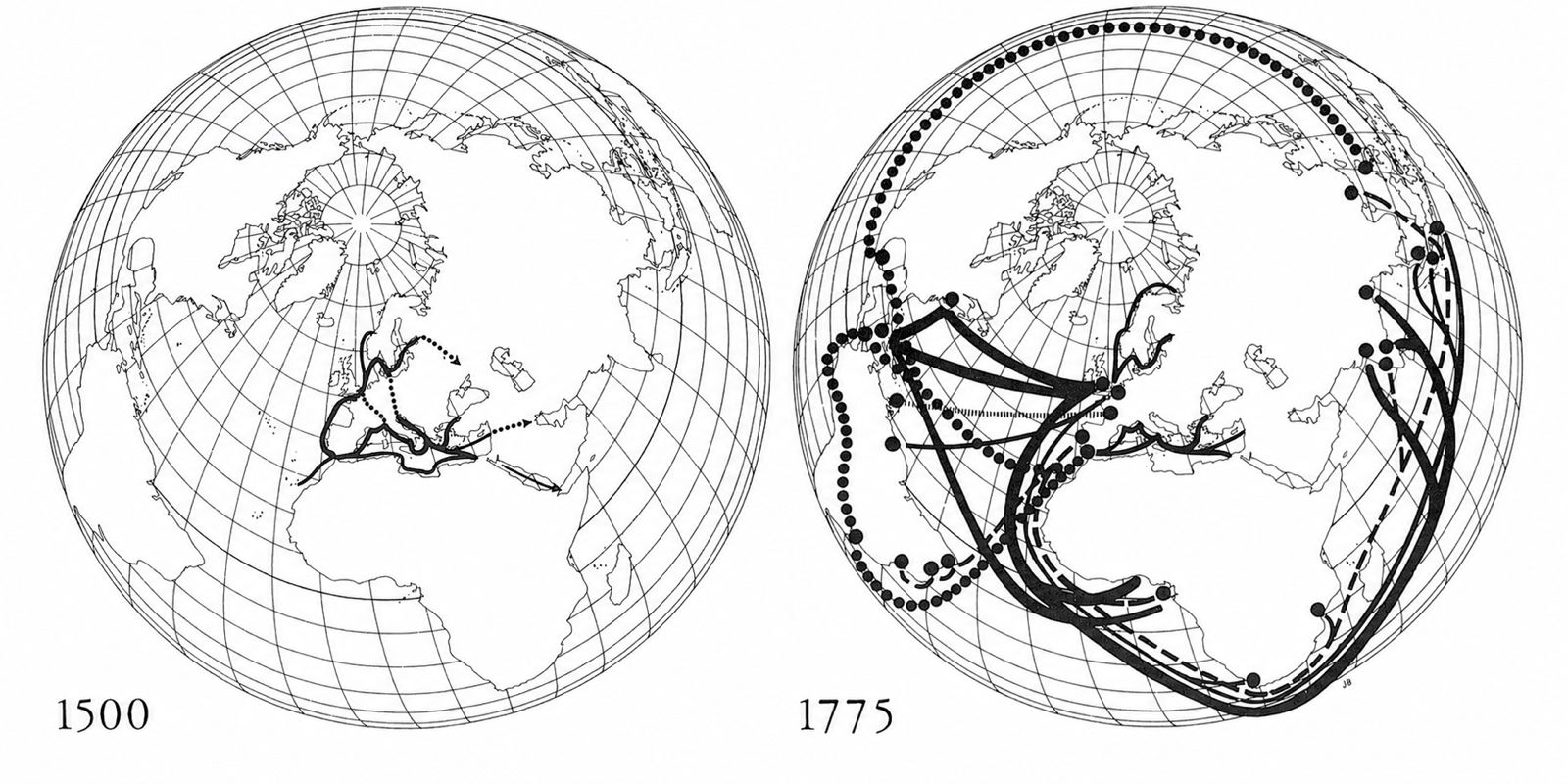
“Will I be able to convince all my readers? Hardly. But at least I have found one unparalleled advantage in this dialectical approach: it has enabled me, by taking a new, and somewhat more peaceful route, to avoid and by-pass the passionate disputes which the explosive word capitalism always arouses.”
– Fernand Braudel1
Capitalism needs no introduction. Since its emergence hundreds of years ago, it has become an increasingly important aspect of human life, such that at the present date it is difficult to find any aspect of modern existence that is not affected by it. Sven Beckert is the latest author to attempt the formidable feat of producing a comprehensive history of capitalism. His new book Capitalism: A Global History2 draws on a “career studying capitalism” (xiv) as the author and editor of many books on related subjects, to assemble a volume which wagers that capitalism’s “history—all of it—might be understood, if not wholly contained, between two book covers.” (xiv)
Beckert’s approach is distinguished by his attention to peripheral geographical areas of capitalism and the influence they exercised on shaping the economic system’s trajectory. Asserting that capitalism “can only be understood globally,” (xv) Beckert opines that “The story of capitalism is often made from its margins, not its centers.” (1066) Such an approach avoids the pitfalls, Beckert believes, of a “Eurocentric” “‘victor’s history’—one in which much of the world features as a ‘failure’ whose missteps amplified European accomplishments.” (11)
In his approach to capitalism, Beckert also emphasizes description more than theoretical exactitude. He avoids the “goal of offering another impossibly fine-tuned definition of capitalism’s essence” in favor of tracing what he calls “capitalism in action.” (21) This neo-Braudelian elevation of illustration over precision fundamentally informs the history he provides. On the one hand, it empowers Beckert to scour the globe through a broad span of history for relatively obscure manifestations of “capitalism.” On the other hand, the book is haunted by his persistent uncertainty about what “capitalism” really is.3
---
Beckert’s declared (24) theoretical inspiration is Fernand Braudel’s Civilization & Capitalism trilogy,4 and its retrospective companion volume Afterthoughts on Material Civilization and Capitalism,5 which are some of the most well-cited works throughout the text. Braudel’s trilogy details the economic history of the world from the fifteenth through the eighteenth century, emphasizing the contribution of merchants to the global economy’s development.
Each Civilization & Capitalism book clocks in at around six hundred pages, within which one can find a deluge of detail about the history of trade in this four century period. Braudel’s admirers have lauded his encyclopedic knowledge of early modern commercial activities, conversational writing style and incorporation of lavish visuals to adorn his texts.
However, reading Civilization & Capitalism remains a frustrating experience, and not solely for the endurance demanded to traverse nearly two thousand pages of economic history. Braudel is persistently ambiguous in his use of terminology; readers can finish the series and still be unclear on what Braudel believes the titular subjects denote. This unclarity is not simply carelessness but a declared strategy to circumvent definitional controversies. But counterposing clarity to historical detail analytically cripples Braudel’s project. Since Braudel is slippery with his concepts, his tripartite division of the economy into material life, market economy, and capitalism remains inscrutable. Braudel’s casual prose, too, can be more distracting than endearing. Rhetorical questions, aimless musings, and rapid pivots in subject matter prove disorienting.
Beckert’s revival of Braudel imparts both strengths and weaknesses to Capitalism. On the one hand, Beckert has, like Braudel, consumed an astounding amount of literature in around a dozen languages on global economic history to produce the book. Ranging across an even more expansive chronology than Braudel, Beckert has acquainted himself with historical developments in both more familiar centers of economic activity as well as many times and places not conventionally associated with the history of capitalism. He also, to his credit, displays a familiarity with various intellectual traditions in economic historiography, including radical and Marxist currents.
On the other hand, Braudel’s shortcomings are also manifest in Beckert’s tome. Beckert also floods the reader with detail, placing less emphasis on conceptual clarity. Although he does not punt analytical questions to the degree which Braudel does, other critics have noted that Capitalism suffers from amorphous definitions of capitalism, among other key terms.6 Beckert’s emphasis on merchants also dominates his explanation of the origins of capitalism, marginalizing other forces which are ultimately key to understanding capitalism’s emergence.
Whenever Beckert departs from Braudel’s legacy, it is for the better. Capitalism’s over one thousand pages are, while still a marathon, twice as manageable as Capitalism & Civilization’s heft. Beckert also utilizes a more conventional linear historical narrative, foregoing Braudel’s curious tripartite organization. Finally, Beckert’s prose is thankfully less diversionary than Braudel’s trademark wanderings.
---
Beckert begins his narrative of the history of capitalism at the novel starting point of Aden in 1150 C.E. There, the world’s “earliest capitalists—merchants” (27) brokered long-distance trade between the Arab world and India. Their “banal activities, performed intensively, showed qualitatively new, emergent abilities—early, scattered sparks of the revolution to come.” (32) Essentially, the multiplying and thickening trade links between Aden and other locales stitched together a “capitalist archipelago” (39) which would, in time, expand to cover the entire globe.
Even though Beckert begins his historical narrative in medieval Aden, he doesn’t seem terribly committed to it as a conceptual starting point. After all, why privilege the merchants of Aden when merchants in other areas were performing similar activities, and such trade existed millennia before the twelfth century? Beckert recognizes this problem: “Capitalism did not ‘break out’ in Aden in 1150, but the city was one among a number of notable places that linked together to form the stream that became the river and ultimately the flood.” (30) Beckert insists that “something new emerged around the turn of the millennium,” (41) but then gives a scattered and perfunctory justification of this supposed qualitative shift: increased agricultural productivity, the emergence of manufacturing and climate change are all mentioned as contributory factors. In any event, Beckert does not dwell long on this important claim, regarding the timing of capitalism’s emergence as, surprisingly, unknowable: “It is impossible to pinpoint an exact place or moment when capitalism began.” (29)
However, these medieval merchants were, for Beckert, “capitalists without capitalism,” (73) only developing the trademark techniques of capitalism — accounting, bills of exchange, banking, and so forth — in the interstices of a non-capitalist order. What ultimately transformed this disparate collection of merchants into a capitalist system proper was the “great connecting” (107) of 1450-1650. And the state was ultimately necessary to midwife this new economic system.
The European voyages of discovery in this epoch mark the transcendence of a non-capitalist order and an entry into capitalism per se. Merchants play the essential role in Beckert’s narrative of transformation, both because they bring the remainder of the world into the already-established network of trade, transferring the wealth of the New World to the Old in the process, and because merchants embedded themselves as important players in the apparatuses of European states. “Columbus and his imitators,” Beckert writes, provided “a breakthrough moment if ever there was one.” (122)
Why didn’t other, non-European areas, so adept in trade in previous eras, experience the same qualitative transformation that the European trade network did? Beckert’s explanation for this divergence reduces to the difference in state forms. While European states incorporated and empowered their merchants, China, for instance, suffocated its merchants’ energies with its bureaucratic centralization. (150) It is a great irony of Beckert’s book that, while he frames his work as a broadside against Eurocentrism, its explanation for the origin of capitalism enshrines the unique advantages of Western institutions and the daring of European merchant-adventurers.
But, Beckert hedges, the story of capitalism’s emergence is not so simple: “any search for a monocausal and monolocational explanation for this great breakthrough moment of capitalism is futile.” (290) Following this perspective, Beckert in subsequent chapters introduces other putative components of this breakthrough to capitalism. The fifth chapter reviews the history of proto-industrialization, i.e. pre-capitalist manufacturing efforts. It is a strange choice, as the consensus of scholars who have studied proto-industrialization is that these concerns did not, in general, transform into sites of capitalist industrialization.7 That is, so-called “proto”-industrialization did not presage industrialization but instead receded and disappeared with the emergence of industrialization. Broadly speaking, industrial ventures appeared using different laborers, different financing, different production practices and in different locations than their proto-industrial predecessors. Industrialization represented a break with artisanal manufacturing forms rather than a continuity.
So what is a review of proto-industrialization doing in a history of capitalism? Beckert, aware of the issue, concedes that “the relationship between early intensified manufacturing and later large-scale industrialization is not as straightforward as it may initially seem” and that “in most cases, industrialization did not follow in situ” (280) but nevertheless attempts to salvage the chapter by reckoning that proto-industrialization expresses “the revolutionary potential of capital, best expressed by its fungibility" (281) due to proto-industrialization, in some cases, exemplifying his protagonist merchants subsidizing manufacturing production.
Merchant activities also dominate the fourth chapter, entitled "Transforming the Countryside, 1550-1750.” (177) This merchant “revolutionary vanguard of capitalism” (182) profited off of various kinds of unfree labor that emerged in the early modern world, and Beckert puts special emphasis on Caribbean slave plantations: “The crucial moment in Barbadian history—and the history of capitalism—came in the 1640s, when an assortment of planters [...] began to focus on sugar.” (179) These plantations, Beckert asserts, constituted “arguably the first modern industry. It was yet another mode of the transition to agrarian capitalism.” (197) The chapter includes discussion of other agrarian economies that would be difficult to call capitalist at this time: the serf-based economies of east-Elbian Europe, the mining activities of New Spain (now Mexico), the Ottoman-controlled Albanian peasant lands, and many others. Even in Beckert’s marquee case of Caribbean slave plantations, it remains controversial whether its prevailing mode of production can properly be considered capitalist.8 Unlike employers of wage labor, owners of slave plantations could not easily shed labor by adopting productivity-enhancing techniques (due to their legal ownership of their laborers), and outside of the post-1732 British Caribbean creditors could not seize slaves from insolvent estates, such that there were fewer competitive constraints on production.9
The sum of all the above processes, Beckert avers, created a “perfect storm” (283) which brought industrial capitalism into existence. Beckert summarizes his view on the origins of industrialization by writing: “these [economic] links owed their transformational and self-propelling dynamism to the simultaneity of the great connecting, the transformation of the countryside, and the intensification of industry, all further propelled and enabled by the expansion of state power. It was a multidimensional feedback loop; a capital-driven unfolding of circulation, production, and consumption; a multilayered and globally made social process.” (289) Thus, according to Beckert, was modern capitalism born. It seemed to require everything but the kitchen sink.
---
Beckert begins Capitalism by assuring the reader that he is interested in neither celebrating nor condemning capitalism, but rather only strives to understand it. Since he is “not interested in contributing to the debit and credit columns of the opposing stories,” (5) Beckert instead suggests he is aiming for a value-neutral perspective on capitalism. However, a reader who perseveres to the end of the book — or even surrenders to its page count long before — will be under no illusions about Beckert’s harshly negative attitude towards what he considers capitalism and its attendant social ills. At many points Beckert seems insistent at hammering home to the reader, using examples both conventional and unfamiliar, of the “barbarism” (311) that capitalism has introduced to the world.
Much of this injustice in the crucible of capitalism’s formation came as a result of what Beckert calls “war capitalism.” This term, borrowed from his earlier work, is somewhat of an unfortunate construction in that it refers to activities that neither necessarily involve interstate war nor capitalism proper. Rather, it refers to the often destructive activities merchants were engaging in during the early modern period: slave trading, colonizing new lands, killing and dispossessing native inhabitants, raiding other merchants, setting up plantations, and so forth.10 The depredations of war capitalism were so egregious, Beckert writes, that in the case of slavery, it may be considered a case of “genocide for profit.” (220) Much of Beckert’s tacit condemnation of capitalism in the early phase of the book hinges on its association with slave-trading and plantation slavery.
However, a theme of the book as it progresses is how the human depredations of capitalism, whether slavery, otherwise coerced labor or dispossession, persisted well into the modern period. Here Beckert takes us on the “dizzying ride” (xv) around the globe promised in the preface, with stops made at Haiti, Cuba, Guyana, Java, Brazil, Senegal, China, India, Peru, Ireland… and these are only some of the locations mentioned in a single (the eighth) chapter. Further chapters take us to the more recent frontiers of colonialism, whether in Hokkaido, Réunion, or Congo — there seems to be no outpost of “capitalist” misdeeds that escapes Beckert’s gaze. One wonders, however, if many of the injustices for which Beckert indicts capitalism might more properly be seen as downstream of politics, whether in colonialist or imperialist form. For Beckert, however, who doesn’t care to precisely distinguish between capitalism and state action, such a point is moot. On this matter, he invokes Braudel: “capitalism only triumphs when it becomes identified with the state, when it is the state.” (145)11
A further objection could be raised that Beckert often spills ink in Capitalism detailing depredations in societies that are difficult to conceptualize as capitalist. When writing of the “extraordinary degree of violence deployed by states and merchants to further the capitalist revolution in the countryside,” (226) Beckert curiously invokes a number of societies that were not experiencing the kind of economic dynamism associated with a capitalist economy, such as the the fifteenth-century Gujarat Sultanate and the sixteenth-century Ottoman Empire. (226-228) Readers might well accept that capitalism brings repressive violence in train as it expands outward, however it is a more difficult case to make that the mechanisms of capitalism had truly ensnared, say, the Indian countryside of the 1400s.
As the book nears its conclusion, Beckert bemoans capitalism’s penetration into, and commodification of, every realm of human existence. Hookup culture, surrogacy, internet dating sites – Beckert tallies these, alongside slavery, as the consequences of capitalist intrusion. (1041) Environmental concerns also become more frequent towards the end, sometimes adorned with an unfortunate guilt trip (“the destruction of the Brazilian rainforest literally props up your retirement portfolio” (1057)). In the epilogue of the book, Beckert strikes an almost theological tone when he wonders if future historians “may struggle to grasp why we made sacrifices to a human-created god that threatened our species’ very existence.” (1087) Whatever else may be said of Beckert’s attitude towards capitalism, this is hardly the impartiality the reader was promised in the introduction.
A critical disposition towards capitalism, of course, would hardly be a vice. Many of the most renowned works on capitalism have taken a reproving, even strident, attitude towards it. But mounting a critique presupposes a firm conception of the subject of criticism, and a description of capitalism so expansive that it lays nearly every transgression of the past thousand years at capitalism’s doorstep leaves the reader wondering if capitalism isn’t being, at least in part, unfairly impugned.
---
Beckert’s commitment to telling a story of capitalism emerging as an often predatory merchant-driven effort of global interconnection leads him to marginalize some basic facts of capitalism’s accepted history. Tellingly, England’s emergence as the first capitalist economy, and its rapid increase in prosperity above and beyond other non-capitalist economies, is unmentioned. Since Beckert believes it is futile to locate the origins of capitalism in time and space, the reader gets very little sense of Europe’s uneven development in the epoch of capitalism’s emergence.
Capitalism’s neglect of England’s early capitalist transition means that the arrival of the first Industrial Revolution, in the same country, is surprising and unexplained. “No single factor can explain the origins of the Industrial Revolution,” Beckert writes, “frustrating the search for one decisive cause.” (335) However, Beckert could have located its origins by following the logic of the next paragraph, in which he states, correctly, that “The Industrial Revolution [...] was not the ‘cause’ of capitalism but its consequence.” (335) But because Beckert is committed to an omni-geographical capitalist origin story, he cannot accept the more straightforward proposition that the Industrial Revolution first emerged in the particular location where capitalism first developed precisely because of the forces capitalism unleashed. Instead, Beckert casts the Industrial Revolution as a “world event” which once again confirms that “capitalism cannot be understood in local, regional, or national terms.” (336) The primacy of both the English capitalist transition and British industrialization is thereby obscured.
Beckert also gives the reader little sense of what makes capitalism a uniquely productive economic system. Capitalism’s competitive market pressures, its incentive structures for producers to constantly revolutionize the means of production, its breakneck introduction of new industrial processes and technologies, its rapid productivity improvements and output growth—all these internal dynamics are passed over very quickly. In the introduction Beckert writes that “Capitalism rested [...] not just on productivity gains but on enormous appropriations—dispossessions, really—ranging from land to labor to lives to technical knowledge.” (18) However, the book’s emphasis is overwhelmingly on the latter rather than the former.
Indeed, the general sense that the reader gets from Beckert’s account of capitalism is that its strength and endurance rests not on its internal dynamics but on its extractive relationship to the rest of the world. There are a number of ways Beckert conveys this, not only in his intensive focus on the “margins” of capitalism’s reach, but also in his choice of theoretical inspiration. Dadabhai Naoroji’s “Drain theory,” (716) Samir Amin’s notion of “unequal development,” (872) and Eric Williams’s thesis regarding slavery’s contribution to British economic growth12 (205) are among the ideas invoked to convey Europe’s exploitative relationship with the periphery. In the epilogue, Beckert states that Rosa Luxemburg’s theory that capitalism required the continuous spatial expansion of itself13 was only “half right” (1060) – capitalism also needs to invade our minds and bodies.
Beckert’s globetrotting conveys a decent descriptive account of capitalism’s geographical spread, but theoretically the explanation for where and why it originated and expanded is weak. To wit, there are a number of contradictions in Beckert’s account which he struggles to resolve. If, as Luxemburg’s theory stipulates, capitalism depends on spatially expanding into the non-capitalist world to survive, why has capitalism, at this late date when it has encompassed the entire world, not imploded? If merchants are the motor force propelling capitalism forward, why has the development of capitalism advanced in recent centuries while merchants have been relegated to a subsidiary function?14 If the countries of Europe collectively exploit the rest of the world, why did European countries experience such drastically different levels of development prior to the twentieth century? To truly resolve these questions, one needs to resort to an alternate explanation of capitalism’s history, and the viewpoint most well-equipped to address them is the perspective that Beckert most explicitly opposes in the book.
---
Beckert’s mentions of other thinkers in Capitalism are ecumenical, and he rarely has a critical word to say about any of them. However, there is one glaring exception: the “political Marxist” (189n38) tradition of Robert Brenner and his cothinkers. Brenner’s error, according to Beckert, in line with Brenner’s predecessor Maurice Dobb, was to discount merchants as a conservative, parasitic and non-capitalist force. “But this reading overlooks the crucial links between the intensification of trade,” Beckert objects, “and the less understood merchant-led transformation of the countryside.” Beckert adds: “At a minimum, this lacuna in the history of capitalism is Eurocentric, missing the import of merchants’ drastic recasting of the countryside in the Americas.” (209)
It is true that there is a profound disagreement here about the historical role of merchants.15 Contrary to Beckert’s view of merchants providing an ongoing developmental spur to the world economy, Brenner and cothinkers see merchants as only able to survive in a world where the state guarantees the monopoly privileges which are the necessary preconditions of their existence. However, as the state liberalizes and free markets come to predominate with the spread of capitalism, the monopoly privileges of merchants were progressively eroded, undermining the basis for their continuation and eventually ensuring their marginalization. And indeed this broadly describes the historical fate of the merchant companies. The golden era of the likes of the Dutch East India Company and British East India Company is long past. Furthermore, as Beckert recognizes in the beginning of his book, merchants feature more prominently in economic history in the pre-capitalist era than the capitalist one.
The Eurocentrism accusation, on the other hand, has always been something of a canard. The geographical focus of one’s study of capitalism will logically follow from one’s theory of how capitalism emerged. In Beckert’s case, with his narrative of capitalism emerging from global trade, he is bequeathed a mandate to study the entire world. Brenner’s origin story, on the other hand, locates the first emergence of capitalism in the English countryside. So, first of all, Brenner is more guilty of Anglocentrism than Eurocentrism. But, more importantly, it’s puzzling to see how it would be considered improper or shameful in an account of the origins of capitalism to train one’s focus on a country where, by all econometric evidence,16 capitalism seems to have first appeared.
But if the charge of Eurocentrism is to mean (and it is often unclear what, exactly, is meant by this term) that Brenner’s account relies on some notion of European cultural superiority, nothing could be further from the truth. Brenner narrates the origins of capitalism as emerging unintentionally from a class struggle between English lords and peasants, nothing requiring an appeal to European or English chauvinism. As noted above, however, Beckert is somewhat more vulnerable to this charge, as the particular configuration of the European state is a crucial hinge in his argument about why Europe came to dominate the world.
Yet such unfounded charges of Eurocentrism against “political Marxism” are not original to Beckert. Brenner’s cothinker Ellen Wood penned a remarkable essay17 on the subject of Eurocentrism decades ago that, for the substitution of some details, reads as though it could have been written in response to Beckert’s Capitalism today. Beckert indulges in a variant of what Wood calls the “commercialization model” of development, in which capitalism is presumed to have emerged from an efflorescence of trade. This posture, she argues, relies on the Eurocentric assumptions its adherents are supposedly railing against: that, had the rest of the world not been burdened with irrational obstacles to free exchange, they, too, would have inevitably arrived at the endpoint of capitalism. It was only the failure of non-Europeans to be as enterprising and enlightened as their European counterparts which prevented them from achieving this outcome. Political Marxists, by contrast, have “dealt a fatal blow to the most Eurocentric principle of all: that the European path of development culminating in industrial capitalism is the natural order of things and that non-European civilizations that did not take that path, or faltered somewhere along the way, failed because they were somehow fatally flawed.” The Political Marxist account of the origins of capitalism stresses that capitalism emerged in a region that, by the standards of the time, was a developmental backwater, and it is this rapid transformation from laggard to leader which was surprising rather than foreordained.
Finally, it is supremely ironic that Beckert castigates Brenner for failing to take the countryside seriously. If there is any scholar of capitalism who has made the changes in social relations in rural areas the center of his analysis, it is Brenner. One could more easily reverse the charge and claim that Beckert has not fully appreciated the importance of the (English) countryside to the origin and spread of capitalism.
---
Beckert narrates the English agrarian transformation as one of many dispossessions of subaltern land that were transpiring in the “long sixteenth century.” (209-212) However, subsuming the English experience into an undifferentiated history of rapacious thrusts into the countryside misses the world-historical distinctiveness of the result of the English transition. It was there that a class struggle over the terms of tenancy uniquely produced a rural population newly subjected to competitive leases on their landholdings or proletarianized and compelled to work on commercial farms to survive.18 The landlord-tenant-worker class structure implanted in rural England departed from other European arrangements where peasantries were, in one way or another, preserved.
The different class structures (or, as Brenner would put it, “social-property relations”) which prevailed in various areas ultimately explain the different developmental paths that these economies respectively followed. Because of England’s adoption of capitalist social-property relations, it managed to power through an agricultural revolution and into an industrial revolution. The competitive pressures introduced by capitalism meant that, in order to survive, producers had to continuously revolutionize the means of production, introducing the most efficient technology and process improvements across every facet of their business. The aggregate effect of these innovations was an explosion of productivity and output.
The implantation of capitalism in England is at the root of the divergence between it and the non-capitalist world in the early modern period. The prosperity of capitalist countries, at base, rests on the internal dynamism of capitalism itself, not through interchange – however problematic – with external economies. This insight dispenses with Luxemburgist ideas of a capitalist need for continuous spatial expansion, or a requirement for merchants to serve as indispensable actors propelling capitalism forward.
Beckert recognizes a “Great Divergence”19 (335) in prosperity between European and non-European countries over the early modern period, but cannot see that England was separating itself from other European areas like Poland, Greece and Sweden as much as it was from China and India in this regard. This is not to say that elites in these extra-English areas did not accumulate various degrees of wealth, nor to say that they did not transfer some of it from peripheral areas they were ravaging. However, the uniqueness of capitalism is the imperative to channel accumulated wealth into productive uses, rather than squandering it on non-productive activities. It is no coincidence that, for instance, as the James Watt steam engine was revolutionizing mining and factory work in England, the first one sold in France was used to power the water fountains in the estate gardens of the Duke of Orléans.20
It is an inconvenient fact for Beckert’s explanatory framework that there is basically no relationship between the degree of developmental success a country experiences and the amount of violence in its history. Had inflicting conquest, slavery, or genocide been an admission ticket to prosperity, many more European and non-European powers would have experienced a similar developmental trajectory to England. But, of course, they did not.21 (Naturally, this is not to say that the English transformation was free of coercion or injustice — former peasants did not enjoy the experience of being proletarianized or having their revolts quelled.) The great empires of Spain and Portugal, for instance, did not ensure their metropole countries prosperity in the centuries after they established claims over the “New World.” Rather, their economies were enfeebled by an ongoing inflationary “price revolution,” as mere plunder could not provide the same level of growth as a productive and innovative capitalist economy.22 Tellingly, there is less frequent mention of the Iberian powers as Capitalism’s narrative progresses beyond the “long sixteenth century,” as they can be easily written into a history of imperialism or colonialism but less easily incorporated into a history of capitalism.
Beckert’s reluctance to precisely specify what he means by “capitalism” leads him to replicate the analysis of capitalism pioneered by previous generations of what Brenner called “neo-Smithian Marxists.”23 Essentially, these writers followed in the tradition of Adam Smith, believing that there exists a natural tendency of humans to engage in trade. Capitalism, in this view, is just the unfolding of human nature without the restrictive pre-capitalist blockages to this activity, such as feudal restrictions on trade. There is no qualitative “transition” to capitalism in this view of history, only a quantitative increase in commerce, from Aden to the present.
Because Beckert is unwilling to detail the necessary processes and relations of capitalism, forgoing an approach he sees as “essentializing” and “excessively abstract,” (9) his notion of capitalism defaults to the Smithian one of production for the market. Capitalism, in this telling, has no real origin, only a timeless existence which resides in the human nature to truck and barter. For those who might desire to find a pathway to an existence beyond capitalism, this ahistorical and naturalizing conception of capitalism is a council of despair.
---
Some previous writers, most notably Karl Marx (another figure Beckert pans as “Eurocentric” (11n21)), viewed capitalism in a somewhat different light than Beckert. While recognizing the tremendous suffering that capitalism introduced into the lives of those who were compelled to submit to its logic, Marx saw that capitalism also brought enormous potential. It was precisely capitalism’s awesome productive powers which Marx envisioned as providing the material basis for the possibility of building another, more just economic and social system in capitalism’s wake. According to this vision, capitalism would be only one historically transient step on the path to a more enlightened future. Part of the urgency of studying capitalism for Marxists is the potential of discovering how to tread this fateful path.
Beckert spends only a couple final pages on entertaining the prospect of a post-capitalist order. He mentions a variety of possibilities, none to which he seems terribly beholden. Restarting artisanal agriculture, expanding noncommodified public spaces like libraries, prioritizing local production — none of these activities he invokes even approaches the monumental historical task of overthrowing the capitalist system. But Beckert’s sense of environmental crisis weighs heavily on these concluding pages, and he seems almost resigned to the likelihood of human extinction from its own ecological undoing. If Beckert suggests in the introduction that Capitalism “provides you with tools to think about possible futures,” (26) then this is a meager toolbox indeed.
Part of Beckert’s limited sense of alternatives no doubt stems from his rendering of capitalism as an unstoppable consuming force. Despite gestures made in the introduction to a desire to restore “agency and indeterminacy” to the history of capitalism and to present an “actor-centered history,” (16) Beckert seems not terribly interested in exploring how capitalism might have been transcended. The Russian Revolution, for instance, is allotted two paragraphs. (745-746) The Swedish Meidner Plan, too, gets only a passing mention. (959) The Spanish Civil War, for its part, goes completely undiscussed. To be sure, at various points there are different episodes of “resistance” that Beckert retells, but all of them are steamrolled by capitalism’s expansionary drive.
Without a sense of the possibility of alternatives to capitalism, and lacking an appreciation of the political possibilities that capitalism’s dynamics produce, Beckert’s history of capitalism instead resembles one prolonged lamentation of capitalism's ills. Beckert writes that capitalism’s victims were subjected to “an astounding amount of coercion and violence,” (17) and he relays much of that tragedy over the course of the book. But there is little here to suggest that a brighter future may result in the wake of the terrible human toll that capitalism has wracked.
---
Within Capitalism there is a glaring mismatch between what is advertised in the opening pages and what Beckert actually delivers. The introduction promises a neutral look at capitalism but yields to an extended condemnatory narrative. Pitched as an anti-Eurocentric history, the book falls prey to the very affirmation of European institutions that it supposedly stands against. Framed as a story of contingency and agency, the reader is treated to a capitalism that ineluctably devours all that stands before it. There are various suggestions, including in the introduction, that Capitalism will assist in envisioning a potential postcapitalist future, but the book neglects to explore historically any potential departures from capitalism. A close look at Beckert’s book, in other words, reveals a work in considerable tension with itself.
The greatest sin of Beckert’s book, however, is not that its beginning fails to accurately describe the contents of the text in various respects. Rather, it is that the book fails in its most basic task: to provide a history of capitalism that explains how such an economic system could emerge, sustain itself, and spread throughout the globe, displacing all other previously-existing economic systems. Undoubtedly this is intertwined with the problem of Beckert’s protean conception of capitalism being undifferentiated from various forms of the state. In an unfortunate similarity to Braudel, readers who manage to complete the book will likely be uncertain, after more than a thousand pages, what Beckert believes capitalism even is.
In truth, Capitalism is not even a history of capitalism. Since the narrative ranges outside of the temporal, spatial and conceptual bounds of what could reasonably be considered capitalism, the book functions more as a general economic history or, perhaps in its later phases, a history of the modern world. The most generous remark one can offer about Capitalism is that the enormous amount of research that went into the book has produced a useful extended bibliography of economic history over the past millennium, and that Beckert has brought attention to the economic and political history of a plethora of marginal locales.
It would be helpful to possess a reliable work narrating the global history of capitalism. Such a work would not only be able to explain the fundamental facts of capitalism’s origin and spread, but also pinpoint the specificities of capitalism which have allowed it to triumph where other systems have failed. This would not only be conceptually clarifying, but would point the way to how such an economic system itself could be transcended. Despite some useful groundwork that has been laid by various scholars,24 that book is yet unwritten.