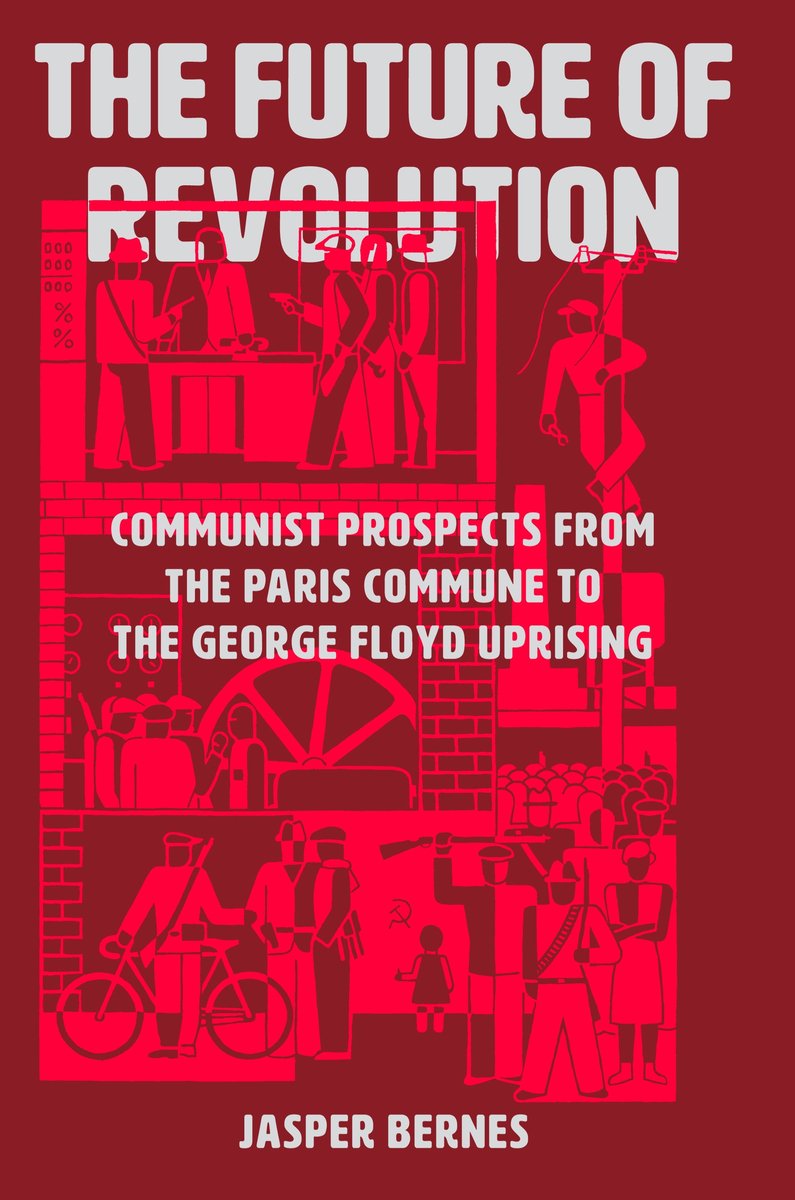
How are we to organize and bring about communism when proletarian struggle is increasingly located outside the sphere of production, and when production itself is dispersed across global logistics chains? It may seem paradoxical, in this context, to insist on the revolutionary potential of an idea firmly rooted inside the sphere of production, namely, the workers’ council. Yet this is precisely what Jasper Bernes does in The Future of Revolution, which describes the history of the idea of the workers’ council from its beginning in the nineteenth century in the Paris Commune to its afterlife in our own time. But make no mistake, this is not a book of sentimental workerism. On the contrary, Bernes anticipates a future communist movement that will require what he calls, after Théorie Communiste, a “swerve”: a diagonal movement “from inside to outside and from outside to inside.”
The Future of Revolution draws on what Bernes calls a theory of the revolutionary example, by which he means “action, which, as example, as idea, finds its meaning in further action, in extension, intensification, and self-reflexive refinement, convoking the vast proletarian majority to participate in the abolition of class society and the establishment of classless human community.” What this might look like is impossible to say in advance. Hence, there lies at the heart of The Future of Revolution a lacuna, or what Bernes names, again after Théorie Communiste, a “rift,” between proletarian struggles and the sphere of production, which only the “swerve” of communist reproduction can overcome. In the absence, but anticipation, of such a swerve, Bernes draws “less a common plan than a plan for a common plan,” something like a map “from which a blueprint might be constructed.”
Following Fredric Jameson’s call for cognitive maps that represent the capitalist totality from the standpoint of its overcoming, Bernes uses the council as a revolutionary heuristic to outline, in negative, the logically necessary conditions of a future communizing process. Jan Appel, a participant in the German councils of 1918 and whose thought is something of the book’s lodestar, puts it like this: “Communists must act now to form themselves into a nucleus and a framework that the proletariat can fit into when the conditions draw it into struggle.” Appel is addressing the Comintern here on behalf of the KAPD (Communist Workers’ Party of Germany) in 1921, and is drawing a distinction between what we might call “council communism” and “Bolshevik communism.” Of Appel’s Fundamental Principles of Communist Production and Distribution, which provides a vision of communism by way of workers' councils, Bernes says: “The text is a theoretical clarification and refinement not only of his own experience but of a generational experience of communist struggle” (73). “The goal of such texts,” he continues, “is to conserve the clarity already achieved by past revolutions” (73). In like manner, The Future of Revolution should also be read as a theoretical reflection in the context of the cycle of struggles since the 2008 financial crisis: the global “movement of the squares”— in particular, the Occupy movement, the Arab Spring, Ferguson, Baltimore, #NoDAPL, the Estallido Social in Chile, the Gilets Jaunes movement, and, finally, the George Floyd Uprising, to which I will return.
But first, what, exactly, does the term “council” mean? Bernes was particularly influenced by A New Institute for Social Research’s “Theses on the Council Concept,” which defines the council as “essentially self-reflexive responsivity to natural and social conditions in the process of their collective transformation by individuals.” For Bernes, what is essential about the council—as with the commune, of which it is a reflexive refinement—is the way it moves diagonally across distinctions, such as those between the political and economic, form and content, spontaneity and organization, employed and unemployed, autonomy and universality, to say nothing of anarchism and Marxism. For Bernes, the communist movement must overcome all such oppositions—it must, in fact, be the process of overcoming them. He thus argues that “solutions … can emerge only through antagonism diagonal to these categories.”
The catalyst behind such a revolutionary process is to be the proletariat itself, as “a class that can emancipate itself only by abolishing itself as a class and all classes.” This emerges as the central problem of the commune: namely, the need for proletarian self-organization to transform itself into the reorganization of reproduction toward universal need. The proletariat must “organize for and by themselves … but most importantly against their already existing organization by and for capital.” The proletariat is thus, Bernes tells us, always some fraction or section of the proletariat, which, through its action, convokes the possibilities of self-overcoming in world communism. What the Paris Commune has shown—“as both rallying cry and thing itself,” as Kristin Ross put it—is precisely what Karl Korsch argued, namely that through its working existence, a “working class government” gives way to real human community. What is crucially important for Bernes was the Commune’s composition as a working-class body organized by universally distributed participation, functioning via a revocable delegate structure. It is these conditions that make the commune form “thoroughly-expansive” (in Marx’s words) and capable of absorbing the majority of humanity.
The revolutionary example of the workers’ council gives rise to the theory of communization. Bernes explains communization as “an internal critique of the concept of the council by true believers who found it lacking in the face of what May ’68 revealed and the decade of struggle in the 1970s confirmed”—namely, that labour can no longer affirm itself as the polar opposite to capital and, as a consequence, the notion of a revolutionary conciliar power emerging from the mass strike appears less and less plausible. That said, could it perhaps be possible for revolutionary councils to emerge from spaces outside of production? This is the dilemma of what Bernes calls the “long 1968.”
The first chapter of the book, “The Workers’ Council and the Communist Prospect,” charts the prehistory of the council from the Paris Commune to WW2, paying special attention to the revolutionary wave of 1917-1923. The chapter defines the workers’ council and outlines what would need to be achieved to produce communism. Being neither a political party nor a trade union, but rather a specifically proletarian, communist third thing, the council is conceived as a “political-economic amphibian, overcoming the distinction between the political and economic through political decentralization and economic coordination.” Furthermore, unlike a party or a union, the council is oriented not toward negotiation but toward “the organization of insurrection and the direct production of communism.” Nowhere was this achieved, however; nowhere was the council able to negotiate the transition from the fires of the mass strike to general insurrection to full socialization and the coordination of communist production and distribution.
Two other concepts that are central to Bernes’ characterization of communism are intensivity and extension. The council must be developed as a political power (extension) which cannot be independent of economic power (intensification). As he puts it:
If a factory is manufacturing weapons used to kill you, it is not merely the concern of its workers. But, for the workers, those capitals are the means of survival—their ethical claim is real, though pertinent only to capital. If you keep them from work and bankrupt their company, they will starve absent other means to reproduce themselves.
Solutions to this dilemma, Bernes argues, can emerge only through the diagonal movement of communism: the expansion and spread of proletarian self-organization until it gives rise to “the with-other-organization of the universal commune.” Workers must be able to organize not only for themselves, collectivizing their workplace, but must organize on behalf of all. The importance of the council, Bernes underscores, was that it was recognized by the workers themselves as the natural mechanism for bringing about communism. It is impossible to say, Bernes writes, what new and “thoroughly expansive” forms of self-organization adequate to a stagnating capitalism will look like, but we can say “what they will not look like” and we can identify their necessary tasks.
Bernes tells us that “the point of the critique of political economy … is an illumination of existing conditions in light of their practical collapse.” In an era that lacks Marx’s certainty, in an era marked by deindustrialization and the decline of the workers’ movement, what is needed now is an “explicit description of classless society, that common horizon,” or at least its negative outline. The future of revolution requires a kind of reconstruction of Marx. It requires us to see that “the concept of value is as much a descriptive concept as a revolutionary hieroglyphic, a critical heuristic designed to focus those who would overthrow capitalism on the essential.” Even in Marx’s most esoteric moments, Bernes argues, “the concept of value is directly connected to the objectives of communism.” Marx, he says, “offers more than a description of capitalism, but one in which key predicates of communism become visible.” Bernes’ calls for a “critical science fiction of value”—a complement to what Phil Neel and Nick Chavez identify as a “science fiction of communism,” that offers an anti-anti-utopian “practical fiction rooted in negative critique.” The critical science fiction of value outlines “the course a revolution must take by delineating certain logical points of failure, certain guardrails”—in other words, by outlining not what can happen, but rather what must and what cannot happen.
Setting out to sympathetically clarify and refine the critique of council communism by Gilles Dauvé, Bernes constructs what he calls “the test of communism,” which aims to clarify the “test of value,” that is to say, clarify what value is and isn’t, as well as what communism is and isn’t. Many communists have made the mistake of thinking that communism can be logically derived from capitalism, or that the overcoming of the differentia specifica of capitalism—viz., value—is identical to communism. He writes that when Marx “imagines conscious decision, free association, deliberate calculation, choice,” the abolition of value constitutes merely one necessary condition for these social arrangements. It is only in light of free association that the fetishism of commodities is rendered visible. Bernes reads moments in Marx’s later writings where “speculation about communism is recruited in order to highlight elements of capitalism” but also adds that “the speculative relationship can work the other way, too.” What this means is that Marx’s speculative deductions on value (not to be mistaken for historical narration) can be used to illuminate the key elements of communism, i.e., a society that is classless, moneyless, stateless, comprehensible and tractable to all. Bernes emphasizes that “the test of value requires speculation and imagination, not just analytical acuity,” and he makes recourse to a fictitious future communism to disentangle value from communism. Likewise, the concept of communism calls for speculation: “not just how does this work but how could it work. A communist looks at a power plant, a factory, a supermarket, a fleet of buses, or a farm always with an eye to what it could be in communism, which is not at all what it is in capitalism.”
The third chapter, “Inquiry, Organization, and the Long 1968,” addresses the epistemological counterpart to proletarian self-activity: “workers’ inquiry.” It deals with the question of who exactly the “self” of revolutionary self-organization is. During “the long arc of 1968,” workers’ inquiry became an increasingly important part of the activities of dissident or anti-Bolshevik communists. The chapter narrates the subterranean history of council communist ideas that spontaneously reappear in the postwar period in the form of workers’ inquiry, with the Johnson-Forest Tendency (JFT) in the USA, Socialisme ou Barbarie and Informations et Correspondances Ouvrières (ICO) in France, and the Quaderni Rossi in Italy. Inquiry becomes the form of the “party” or communist organization, that is not oriented to “vanguard action, to leadership, and to acts of agitation and politicization.” The function of inquiry is to represent workers’ self-organization “in order to further it, to communicate possible tactics and methods to other workers.” Inquiry also provided the answers that different communists came up with of what to do in a period that was not simply non-revolutionary, but for which, as C.L.R. James had put it already in his 1947 Notes on Dialectics: “there is nothing more to organize…The task today is to call for, to teach, to illustrate, to develop spontaneity — the free creative activity of the proletariat.” The answer that Informations et Correspondances Ouvrières came up with was to: “establish resonances, networks, and correspondences among the most revolutionary members of the class; pay attention, in order to discover the sources of class conflict, follow the new contours of class struggle, and anticipate the shape of coming self-activity.” The Situationist International would develop these council communist ideas further, conceiving of itself, in Bernes’s words, as a “catalytic instrument in a larger process of mass self-organization.”
In a period of stagnating capitalism, the underlying arrangement of communism (i.e., free association) must find a new form of revolutionary self-reflexive organization; a form that harks back to the “double swerve” mentioned earlier. The content of communism might remain invariant, as the Italian communist Amadeo Bordiga claimed, but the forms that emerge with historical development necessarily change. What Bordiga lacked, Bernes argues, was a theory of crisis, which is to say, attention to the “changing nature of the production process and everyday life.” In spite of this, Bernes wagers that Bordiga’s definition of the proletariat as those “without reserves”—as the dispossessed, rather than the exploited—might be the basis for thinking about the form communist universality may take in the future. In the twenty-first century, it is the dispossessed that point toward the future of revolution, even as their eccentricity to spaces of production is their fatal weakness. We might say then, following the New Institute for Social Research, that the council as “self-reflexive responsivity to natural and social conditions in the process of their collective transformation by individuals” hails from the future of communist revolution, even as the council as historical form that the proletariat itself, spontaneously, chooses in the process of abolishing itself, is unlikely given the global recomposition of labor. Thus, the council as form may be better suited for an industrializing nation, even as its content remains essential. The idea of the council, therefore, will have to be reappropriated and refashioned in the course of a future communist revolution.
A key lesson of the council is that communism must involve the control and appropriation of the total wealth of society. And this lesson is even more crucial in our current era of surplus rebellions. It is for precisely this reason that The Future of Revolution calls for “inquiry into the social and technical conditions of capitalist reproduction undertaken in order to dismantle and transform those conditions into communism. The test of communism, says Bernes, only “tells us what but not how.” And he gives us an exceptionally clear and concise account of what communist revolution must accomplish:
It must be armed; it must break the armed power of the state; it must be proletarian, drawing the vast majority of society into voluntary associations laying direct claim to the totality of social wealth; it must be communist, provisioning for common use according to a common plan without legal regulation or exchange; it must overcome the divisions between people and places cemented into the division of labor and the structure of the enterprise; it must be transparent, comprehensible to all, and tractable, allowing people to participate in decisions that concern them through structures of recallable, mandated delegation committed to the reproduction of classless, moneyless, stateless society.
But how? That’s the question. We now know what the content of communism is, but what will be the thoroughly expansive form that “sets fire to fire” (to borrow Joshua Clover’s phrase from Red Epic) and spreads across the entire globe? According to Bernes, “What is needed is less a specific plan than a plan for a plan, an orientation toward action in common that can turn the chaos of the insurrectionary moment into a self-reproducing communism.” It’s a statement that rings true now more than ever, given that the volatile character of our present will likely only continue in the years and decades to come, and given that global insurrectionary moments will likely continue to accumulate.
The Future of Revolution concludes with Bernes’ thoughts on “abolition”—its limits and speculative possibilities—seen from the perspective of the revolutionary example of the George Floyd Uprising, and what he calls its “objective correlative”: namely, the burning of the third precinct police station in Minneapolis. “One must work with the terms which the proletariat has already chosen,” he says, and the rallying cry that defines our era is “abolition.” “But,” he continues, “abolition has not yet found its form, whether arson or autonomous zone or something else.” Abolition is a fragment of some form of communism not yet established. Bernes contributes to the discourse of abolitionist communism by postulating a “heuristic fiction” called the “abolition committee,” which, he says, is “a placeholder, a name for a form that has not emerged.” Abolition committees could amplify and reflect the revolution unfolding. The founding question to deal with, says Bernes, is “What would you do if state power vanished today?” The abolition committees, he adds, would engage not only in practical problems but also in speculative ones, such as: “What would abolition look like? What would it require? What would you do if all the prisons burned?”
The critical science fiction of value—as the extension of proletarian self-activity through inquiry viewed from the standpoint of a future communist revolution—imagines “a geographical, communal body with roots in workplaces but not identical to them, reorganizing reproduction in line with communal and extra-communal need.” As “self-reflexive responsivity to natural and social conditions in the process of their collective transformation by individuals,” abolition committees could coordinate and reorganize production alongside riots, occupations, blockades, sabotage, and expropriation.
In “A Sick Planet,” Guy Debord wrote that: “The slogan “Revolution or Death!” is no longer the lyrical expression of consciousness in revolt: rather, it is the last word of the scientific thought of our century.” Bernes develops a critical science fiction of value where the options are, in Debord’s words, revolution or death. The goal of Bernes’ book is to conserve and transmit the clarity already achieved by past revolutions. As he says: “Communism is an open book whose readers write it freely—the greatest story not yet told.” Hence, the book is incomplete by design. Bernes clarifies communism as a series of logical requirements to be navigated. The book is multiple things: map, lecture, principia, councilist historiography, science fiction, and amplification and reflection of twenty-first century proletarian struggle. This is also what makes it the groundwork for the future of communist inquiry.