Epidemiology of Revolt
For years, the local news in Los Angeles, KTLA, has been covering what it calls “the retail theft epidemic in Los Angeles.” On any given night of the week, any Los Angeles resident with a television set can flip to the local news station and watch headline after headline reporting on mass criminality marauding throughout the city. Owners of businesses grew fed up with the crime, reports stated, and the police promised to crack down. In late 2023, California awarded $267 million to law enforcement and prosecutors statewide to fight organized retail and property crime, and in 2024 Proposition 36 was passed to prosecute retail theft more aggressively. From the standpoint of broken-windows policing, such local disorder is read as a sign of wider social decay.
The specter of rioting and looting—and of the unruly, racialized surplus populations—is a nightmare from which Trump is yet to awake. In an article titled “LA Riots 2020,” Ryan Lee describes how, as the 2020 riots in Los Angeles attenuated, they metamorphosed into a crime wave: “What remained after the widespread demonstrations and riots was an indivisible remainder, the persistence of a practice that had found its place within the topology of struggle, but now appearing as an involution of black identity struggle to its most operative term: organized looting.”1 This real (though by historical standards comparatively small) uptick in criminality continues to haunt Los Angeles’s civil society as the ghostly image of the George Floyd Rebellion. It’s similar in other major metropolises in California, not only in places like Oakland or San Francisco, but also in Bakersfield, which like many cities has seen a sharp rise of motor vehicle theft.2
The fact that crime also rose in Republican towns made it easy to convince voters that things were even worse in Democratic cities, where the homelessness crisis is more visible. But we cannot disavow the reality of organized crime just because the ruling class uses it as a subterfuge to stoke fear that, in turn, justifies ramping up policing. Crime is a real symptom of ongoing economic stagnation, and a rational response to declining legitimate opportunities for those with fewer resources. People turn to crime when the expected rewards of breaking the law outweigh those of obeying it. As Dave Chappelle once remarked, Donald Trump is an honest liar—despite the malevolent intent that drives Trump’s rhetoric on crime, some American cities have truly become anarchic.
The George Floyd rebellion punctured the veneer of the final nine months of Trump’s first term, at one point sending the president himself into hiding in a bunker as protests encroached upon the White House. The riots were a real castration for Trump—signaling by all accounts a dismal conclusion to his rule, plummeting his approval ratings to an all-time nadir, thwarting his re-election. Instead, he was subject to a highly politicized trial and convicted of 34 felonies for paying hush money to porn star Stormy Daniels. The spectacle surrounding the most intimate details of his sex life—that he was convicted not for how he governed, but for his relationships with women, even more striking today in light of the Epstein scandal—is symptomatic of the nakedness with which he wields sovereign power. Shorn of legitimacy, even legality, Trump still has one resource left: the raw power of the state.
The rhetoric driving Trump’s second term is premised on neutralizing what he casts as the major symbols of counterpower in American society, dividing these enemies into two broad, overlapping categories: the criminal and the ideological. This explains why targeting gangs like MS-13 has become something of an obsession of his, and why, on the other hand, he slashed federal funding for major universities such as Columbia. Latino gangs stand in for the supposed menace of uncontrolled immigration, a stain on an otherwise beautiful country. Columbia appears as a domestic incubator of “left-wing ideology,” a place where some of the country’s most elite students sympathize more with guerilla fighters in Gaza than with any American political figure. Trump is more optimistic than many on today’s left in the sense that he’s correct to see these figures—gangs, insurgents at elite universities, Antifa—as real threats to his jingoistic agenda. But by recasting opaque criminal and political networks as something more coherent than they actually are, he has created imaginary enemies that are primed for expulsion from the body politic, placed within the state’s domain of control yet outside the protections it claims to offer. As such they can be rounded up en masse and slapped with RICO or terrorist charges. Hence the proliferation of Narco-Terrorists, Antifa-Terrorists, Hamas Supporters—figures that must be constructed so that the sovereign can accumulate political capital by staging their annihilation. The fragile trajectory of contemporary sovereignty entails the incessant production of criminals and terrorists.
So it was not surprising that when ICE began its operations in Los Angeles, its first target was a Home Depot in Westlake, a densely populated, low-income, predominantly Latino neighborhood just a few blocks from MacArthur Park—a sprawling tangle of street vendors, homeless encampments, and the infamous Yoshinoya Alley,3 colloquially known as Fentanyl Lane. One journalist describes the park as a “troubled public square in Westlake [that] has seen gang shootings, rampant drug use, discarded syringes, homelessness, people experiencing mental health crises, and an ‘open air market’ of stolen goods.”4 An LA Times columnist, Steve Lopez, has been obsessed with MacArthur Park for the last two years, publishing article after article cataloguing the situation, including one in which he sat down with longtime business owner Norm Langer,5 who said he was considering closing his iconic Langer’s deli—open since 1947—after complaining about street vendors and the area’s worsening conditions.
Los Angeles Mayor Karen Bass even made a token pilgrimage to the deli herself to profess her commitment to “cleaning up” the park, yet for Lopez the promised transformation never arrived.6 On 7 July 2025, a massive ICE operation was staged at MacArthur Park as part of “Operation Excalibur,” a homeland-security mission involving several federal agencies as well as National Guard in what internal documents openly described as a “show of presence.”7 Briefings described the park as a site of “historic lawlessness” and even the “founding location of MS-13.” The shambolic operation lasted only 24 minutes: the convoy arrived late, soldiers never exited their trucks, and no arrests were made. Because local officials had already identified the park as a site of persistent disorder, ICE could frame its intervention as compensating for the failure of local politicians and police, and thereby present itself as the sole agent capable of effective action As of October 2025, city officials have proposed constructing a $2.3-million perimeter fence around the park.8
Crime is both an alleged threat to civil society and an indication of the broader lack of ideological homogeneity—or the persistence of heresy—within the nation. At the same time, much of what is labeled “criminal” hardly deviates from American values but appears as their most extreme manifestation: conniving thieves, gangsters and guns, and real or alleged rackets serve as a sort of Doppelgänger of the American legal order.
The specter of communism has shape-shifted since McCarthyism, and among today’s leading threats to the fragile ruling order is ‘wokeness,’ or anti-racism. Despite the relative weakness of ‘Antifa’ or ‘wokeness,’ as an organized oppositional force in the US, the renewed targeting of the left shows that weakness can manifest itself, paradoxically, as a strength The very existence of such vaguely communistic (today, antifascist) sympathies threatens the homogeneity required for the legal order to function in the first place. Legality can thus be cast aside to pursue a crusade against such existential enemies.
The deportation of Kilmar Abrego Garcia, a Salvadoran citizen sent back in defiance of a U.S. court order, demonstrated Trump’s willingness to sidestep the law to project power. This was part of a deal he struck with El Salvador’s crypto-dictator Nayib Bukele, who agreed to take deportees in exchange for U.S. payments. Bukele, eager to please, absorbed them into CECOT, a massive high-security prison notorious for its harsh conditions and media spectacles that flaunt state force.
It was the deportation of Abrego Garcia that led conservative Judge Harvie Wilkinson—who was appointed by Reagan—to challenge Trump on habeas corpus for handing detainees over to foreign prisons, warning that ignoring courts in this way would “reduce the rule of law to lawlessness.” This lawlessness is a deliberate strategy aimed at ravaging the authority of the judiciary and supplanting it with the domination of a master, or a leader. The disinterested sobriety of the judge is supplanted by the “sudden caprices of a continually changing storm of emotions.”9 The gutted judiciary can subsequently be brought into alignment with the executive.
The American constitution is imagined to be an eternal order based on fixed values of life, liberty, the pursuit of happiness. Trump is attempting some sort of radical schism with this order—although exactly what he’s doing does seem to escape the man himself. Trump is truly in some sense a ‘revolutionary’: rather than the past, he looks to the future, that’s why ingratiating himself with Musk made sense politically. Trump doesn’t do politics, or law, he does deals. The authority of the past, of tradition, written in the constitution but embodied by the judge, is cast aside and replaced with an authority based upon some new project. Build the wall, invade Greenland, annex Canada, Gaza Riviera etc.
Trump is recalibrating the very meaning of sovereignty—not by enforcing the law, but by redefining what counts as law, and who counts as its source. This Caeseristic aspect of Trump’s rule equates law not only with his actions, but with his very being, his style. Friend-enemy lines are drawn around loyalists and those who oppose his dictatorial aspirations.
By “flooding the zone” Trump and his allies are attempting to suspend, as much as possible, the separation of powers, dismantle the remaining bastions of liberal institutional power, and rule by the sheer force of mythic violence. They are trying to refashion a sense of legitimacy which—if established—could serve as the basis for a new order. If the existing legal and political institutions fail to uphold order, a claim of legitimacy can stand in for it. But for the moment, even the spectacle of legitimacy remains something beyond Trump’s grasp.
This explains the constant challenges to the legality of Trump’s acts—and why even conservative judges are accusing him of conflating law with lawlessness. The sovereign emerges as the embodiment of the arbitrary core of state power—its disjunction with law and justice. And conversely, despite having turned law into pure force, detached from any normative framework, the sovereign can try to win legitimacy with claims to purge all that is criminal from civil society through summary justice and emergency decrees. Thus, as one commentator explains, “The normative aspect of the law can be contradicted with impunity by a governmental violence which nevertheless still claims to be applying the law.”10
It was the German-Jewish lawyer Ernst Fraenkel who theorized the notion of the “dual state” to characterize a bifurcation introduced by the Third Reich. This dual state consisted, on the one hand of the normative state, which adhered to the laws of a constitutional order set up to ensure the accumulation of capital, and on the other hand the prerogative state, which violates those same laws. If the former is normative, the latter is transgressive. The political formations of the prerogative state—and ICE definitely shows traits of some such structure—are not bound by any laws, their jurisdiction is limitless, and their political aims triumph over the norms of the legal order. For Fraenkel, the prerogative state became important in infiltrating and suppressing worker’s organizations and strikes. It was thus designed to depoliticize society by force, destroy political enemies, and create a social cohesion founded in shared values and the identity of the Aryan race.
More recently, measures resembling those of Fraenkel’s prerogative state were normalized during the pandemic. There is always some crisis—yesterday it was a virus, today it’s crime, tomorrow the environment—which is said to threaten the existence of the state, and thus requires the suspension of the order represented by the normative state.
The anarchic aspect of Trump’s prerogative state is no accident, and is likely to be an invariant of his tenure. In his book Behemoth, legal theorist Franz Neumann used Hobbes’s image of the prehistoric monster to describe the National Socialist system as “a non-state, a chaos, a rule of lawlessness and anarchy.” Neumann’s thesis—that the National Socialist state dismantled the state’s unity and replaced it with a system of competing power blocs—supports his claim that the regime had become a quasi-stateless dictatorship founded on violence and propaganda. In this configuration, chaos and lawlessness constitute the deliberate operational logic of totalitarian rule. In the same way, Trump’s prerogative state functions by dissolving its own administrative and legal restraints—producing a new order founded upon disorder. In a world that has truly been flipped on its head, an inversion of Marx and Engels’s dialectic takes place: Trump comes to embody the party of anarchy, thereby positioning his opponents (even “communists”) as the true party of order.
Trump 2.0 is a counterrevolution avenging the George Floyd rebellion. The symmetry is deliberate: the liberal demand to defund the police has returned, inverted, as Trump’s crusade to defund the organizations he accuses of harboring antifa. With no utopian horizon save pandering to a collective delirium around the disintegrating grandeur of the American nation, the order the administration pays lip service to has no orientation whatsoever—it is purely annihilative and destructive. Domestically, it aims only to purge a virus—the criminal gangs of MS-13s, or the institutions and organizations upholding the Hamas Support Network described in Project Esther—from civil society and to re-establish the social conditions upon which capital can continue to eke out an existence.
The point is not to cast 2020 as some heroic, revolutionary event, even if it had elements of that, but to make sense of the crisis the concussive waves of protests indicate for the American empire. What these protests demonstrate, above all, is the lack of authority of those in power. In his short book On the Notion of Authority, written in Marseille while the author fled the fall of France to the Nazis, Alexander Kojeve made a key distinction between force and authority. When political authorities have to rely on force to carry out their policies—that is, in transitioning from a constitutional state to a police state—they do not demonstrate authority. Kojeve’s claim is that authority is mutually exclusive with the use of violence.11 Authority is realized when the slave renounces, by his own free will, the possibility of disobeying the master. So the persistence of crime, riots and uprisings indexes the lack of authority wielded by the American state and the larger crisis of legitimacy.
Understood in this context, Trump’s counterrevolution is a revolt against the authority and legitimacy of the institutions that lie at the base of America’s democracy. That’s why Tom Homan, Trump’s “border czar,” stated “I don’t care what the judges think.” Any and all oversight or expertise of Trump’s cabinet is rejected: Kash Patel heads the FBI, while RFK Jr. is put in charge of health care, and Musk was tasked with eviscerating the administrative state. That is not to say that such force is not dangerous, or devastating in its effects, despite its lack of authority. It is instead to point out that Trump’s policies don’t have to be effective or practical or popular, or anything else for that matter, except traumatic and fear inducing.
Without any political horizon to orient it, Trump’s order is thoroughly nihilistic. The paradox of a suicidal state like the American one today is that despite the power it holds, nothing seems to work out for Trump. That’s why he hesitated in sending the national guard to San Francisco. The tariffs, the promises of peace deals, they all end up being flops. Even with the right at its strongest, both electorally and culturally, it is remarkably weak and incompetent.
If, following Kojeve, we can consider the current Trump regime as anti-authoritarian in nature, despite its totalitarian aspirations, then the main mechanism it has at its disposal is force. This is of course, also the terrain that today’s most fierce resistance movements occupy. That is to say that rioting and clashing with police also rely on force as their primary means of implementing their politics. In such a situation of polarization, both sides will grow stronger. The question thus becomes how the popular movements fighting for liberation could win some authority—some symbolic efficacy within the political—without lapsing into the dead-ends of democratic reformism, or the swamp of municipal politics, into which Zohran Mamdani is likely to sink. The question of organization begins not with mobilizing more protests—the bad infinity of insurrectionism—but with winning symbolic power that is recognized by American residents as indicating some orientation towards real transformation, towards revolution.
The Crisis of Assimilation
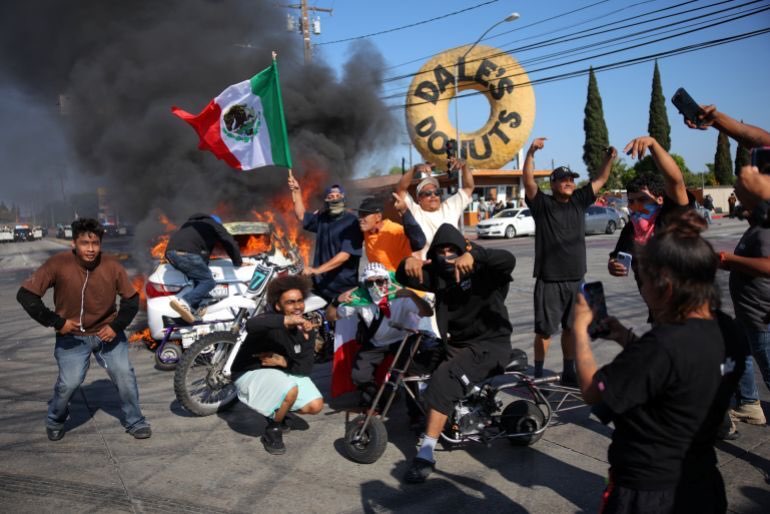
Will there be a war over North America in the 21st century? If the presence of ICE in Los Angeles aimed to construct a new spatial ordering in the country’s largest county—one in which the sprawling infrastructure of informal life, from food trucks and day-labor corners to car washes, was rearranged—then a similar spatial reordering is undoubtedly a part of Trump’s foreign policy as well.
In 1997, President Ernesto Zedillo stated: “The Mexican nation exists beyond the territory defined by its borders, and emigrants are a very important part of it.” Today 37 million Mexicans live in America—10% of the population of the US. Without drawing a one-to-one correspondence between identity and ethics, the existence of such a large segment of the population appears to present a crisis for American patriots, especially when, in moments of revolt, that demographic protests by flying the flag of another country on American soil. It is difficult today to disagree with the speculation that “the growth of the Latinx proletariat” will mark “the greatest demographic difference between the first civil war and the second [hypothetical] civil war.”12
Take a second to watch this video of an ICE supporter getting slapped at an ICE raid in Camarillo, just outside of LA: it tells you a lot, especially the commentary by the man narrating the video, who describes protesters “waving a Mexican flag in his face as they walk through America.” The protests against ICE in LA go far beyond merely an attempt to secure a wage relation, they are a defiance of American hegemony within America. What is on display is an open pride for a culture and a way of life. Hence a popular sign at the protests in Los Angeles: “MAGA: Mexicans Ain’t Going Anywhere.”
The protests in Los Angeles have been protests, yes, but in a certain sense what some of the bigger protests have resembled is Latino pride parades—this was especially true of the June 14th No Kings protest, despite being astroturfed nationally by resistance libs—which were intergenerational, family oriented, defiant, unafraid. The protests have something Trump does not, namely, a clear orientation: they are aimed at defending migrant families. Another popular sign at the June 14th protests deserves mention: “My parents fought for my future, now I’m going to fight for theirs.”
Latino culture has massive hegemonic power in Southern California. Not necessarily at an institutional or political level, but at an ethical level. The sheer scale of the mobilizations against ICE in Los Angeles demonstrates that a huge portion of the city’s residents are willing to fight to defend a form of life that has been declared—and in large parts is—illegal. Then there’s the fact that migrant labor in Los Angeles provides many of the only affordable options for everyday necessities like food, childcare, and of course, manual labor. Insofar as there is no oppositional political party in the US, protest movements are more likely to identify with ethnic and racial minorities than with any political position. That’s why the last three nationwide uprisings in the US have taken place in defense of black, Palestinian, and Latino populations.
The myth of a so-called ‘white genocide’ underway is of course a lie. But like every effective lie, it points to something real. As they did during the George Floyd rebellion, large parts of America’s white population are disavowing their culture, their heritage, their politicians, entire ways of life, and siding with undocumented immigrants. Meanwhile, twenty-year-old Mormon furries are making high-profile assassinations of major ‘America First’ figures. Of course, this is an incredibly contradictory process, with many confused motivations. Yet still, it is incontestable that some kind of war, for and against whiteness, is underway in America in a highly pointed fashion.
Jean-Luc Mélenchon, during a recent visit to the United States, may have struck, by accident, on a powerful truth when he flippantly suggested that by the end of the century, America will no longer exist. He grounded this claim in another one of those lies that reveal something true: the claim that in California, Spanish is more widely spoken than English. For what is true, as Melenchon points out, is that “a huge proportion of the US population now speaks Spanish at home, and this part of the population is mostly Catholic, in contrast with the ‘enlightened’ Protestants who founded the country.”13
Italian political commentator Dario Fabbri has taken up similar issues in an article titled “La Cina libera.”14 He argues that according to official US propaganda, Mexico is an exotic vacation destination or a failed narco-state. Despite the stigma, Mexico is actually a power on the rise. It has a young and growing population—from 25 million in 1950 to 131 million today—that has been raised on a deep-rooted, syncretic Catholic tradition which incorporates elements of indigenous culture. It repeatedly repels Washington’s evangelical efforts and celebrates its own identity. The American way of life fails to permeate past the border, which is why baseball was such a flop in Mexico. Moreover, unlike the vassal states of Europe, Fabbri argues that Mexico lacks an inferiority complex with respect to the US.
Mexico poses a crisis for the US in two major ways: Firstly, China is Mexico’s number two trading partner. Huawei has grow fivefold in Mexico since 2022, while other Chinese firms have invested heavily in Mexican manufacturing, energy, and transport. Together, these moves give China a growing industrial and strategic foothold on the US’s southern border, eroding Washington’s economic leverage in its own hemisphere, thus indirectly threatening the sanctity of the Monroe Doctrine.
It’s not only that Mexico is flooding the United States with immigrants, but also, as the British once did to China, Mexico is accused of weakening the U.S. population through fentanyl, counting on Beijing’s cooperation—which may be seen as the latter’s belated revenge for the opium wars.
In this light, Melenchon’s quip begins to appear more prescient. If we take his prediction of a balkanization of the US seriously, what could this mean for southern California? The US-Mexico border represents a matrix of power and violence perhaps unparalleled anywhere else in the world. If that border were to somehow be compromised, what would become of California? Could it become the seat of a new way of life, one where the Protestantism of American hegemony gives way to a tradition rooted in indigenous customs and illegal street life, one in which English is no longer the lingua franca?
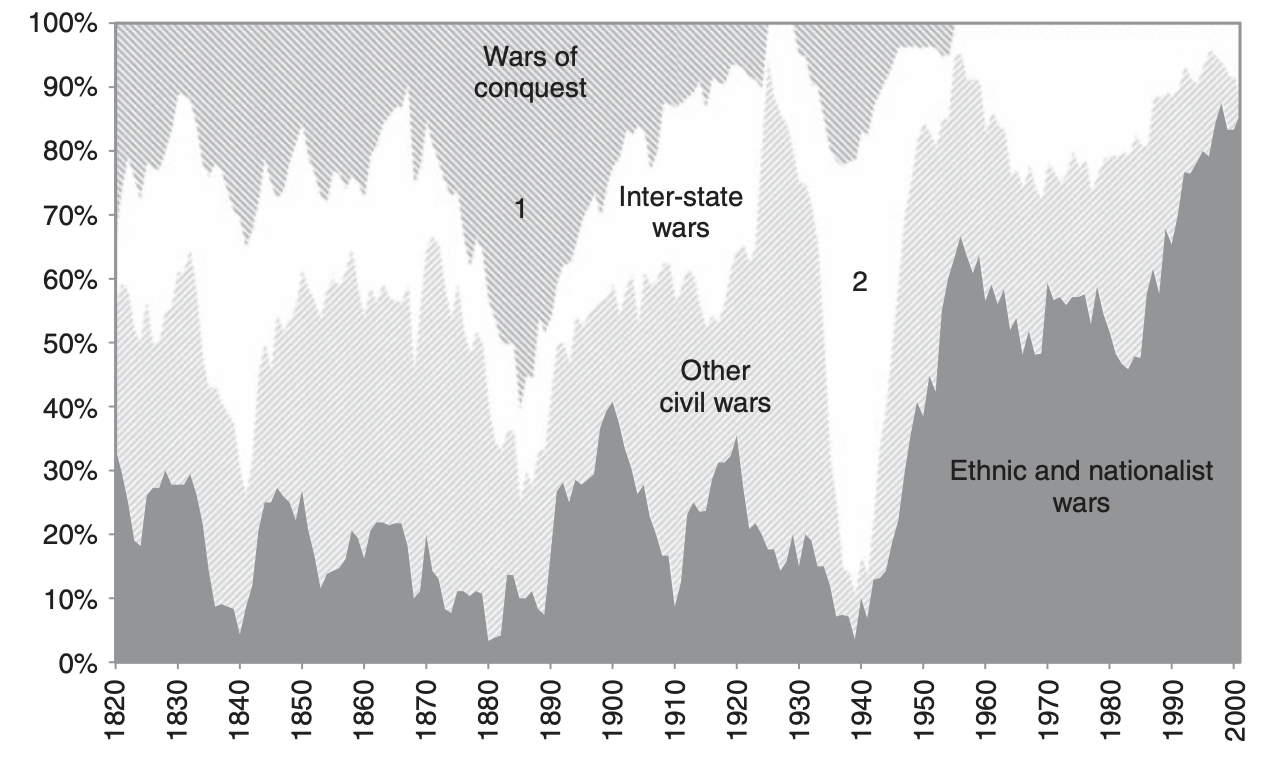
In his book Waves of War, the sociologist Andreas Wimmer analyzes the shift over the last 200 years from a world of empires, kingdoms, city states, and tribal confederacies into a world in which the nation-state has become the hegemonic form of statehood. This shift, which was institutionalized in the League of Nations “gradually forced state elites and political challengers alike to adopt nationalism as the universally accepted template of political legitimacy.”15 As his study demonstrates, ethnonationalism motivates an increasing number of wars in the modern world, shaping conflicts between states as well as within them. Nationalist ideologies fuel interstate wars through competing claims of territorial sovereignty, but they also destabilize multiethnic societies from within.
At the domestic level, such conflicts intensify when ethnic or racial minorities are excluded from participation in national political or economic life. When a state grounds its legitimacy in ideals of democracy and equality but continues to withhold access to political power or public goods from certain groups, it undermines the very principles on which it rests. The contradiction between professed equality and practiced exclusion reveals the hypocrisy of the regime, fueling the determination of marginalized groups to seek recognition and inclusion within the national framework. When such recognition is repeatedly denied, these grievances can escalate into broader challenges to the political order itself, as excluded actors begin to contest who has the right to rule and, in some cases, even to reconfigure the institutional structure of the state in a revolutionary war.
Today we are witnessing—in the insurgency for George Floyd, in the student protests for Gaza, and in the anti-ICE mobilizations of 2025—precisely such conflicts unfold within the US. The Republican party is trying to ensure that allegiance to whiteness is the main index of one’s access to resources and dignity in the United States, in a process Wimmer describes as “ethnic closure.” Americans are by no means genuflecting, but they also lack clarity around the ultimate prospects offered by protest—no matter how dignified, righteous, and necessary such protest may be in a world that has truly become ungovernable.
There is, no doubt, a steadily growing, enduring resistance movement in the United States which can be traced back to the riots responding to the murder of Oscar Grant in 2009. That said movement cannot be named or attributed any clear politics, that it is not “organized” according to left-wing standards and is too heterogeneous to be reduced to a framework of representational politics does little to detract from the movement’s political actuality, which is hardly inconsequential, even if it is inadequate for what lies ahead. Its status as less-than-ideal tells us much about the nature of ideals but very little about communism. Still, many leftists will comment with relish on the shortcomings of this amorphous movement, disavow its efficacy altogether for failing to meet the aforementioned criteria, while still others will have no idea whatsoever what is being referred to by “this amorphous movement.” In the face of their personal uncertainty over what role they should play in the world, such lofty idealists tend to situate themselves as standing over and against the world in order to preserve their sense of virtue; a vain, subjective attitude which, we can say with Hegel, “understands very well how to pass judgement on what is substantial, but has lost the ability to take hold of it.”16 Such people will surely find the claim that Trump’s second presidency is premised on counterrevolution to be somewhat jarring.
I contend that the resistance against ICE represents the highest stage of this movement, without conceding that its previous iterations, like the George Floyd Rebellion, or the protests for Gaza, can be credibly framed as failures. The intense criminality and rioting in 2020 was a necessary and proportionate response to the specific kind of dispossession at play in the moment. The riot peaked in 2020 in the US, and was subsequently sublated into higher forms of proletarian activity, like those we see taking shape against ICE today. The current iteration of the movement represents a qualitative leap forward in terms of hyper-local, neighborhood defense, with long-term organizations like tenants unions playing a central role in this struggle in Los Angeles. So there are plenty of reasons to celebrate. Still, this moment, too, will find its limit, which will not make this moment a failure, only something finite which must be infinitized with one more effort.
Today the system of nation states once led by the United States finds itself reeling. As international politics becomes more turbulent, new waves of nationalism are emerging in a desperate bid to stabilize the pandemonium unleashed by the collapsing international order. Capitalism’s uneven development is fueling volatile ethnic tensions, as seen in the UK and Spain where rising immigration, economic insecurity, and media-driven moral panics around Muslim and South Asian communities have produced fertile ground for far-right movements; these conflicts reveal that the contradictions of capitalist expansion can no longer be contained by the rhetoric or institutions of liberal multiculturalism, and will have to be confronted politically. The nation state can no longer evade the problems of international politics—any politics oriented around the nation-state are today either reactionary or obsolete.
In the twentieth century, the American empire defined itself through a single task: the annihilation of communism and the discrediting of any politics that held aloft the banner of humanity. With the decline of the American empire, perhaps some political force can reemerge to reinvigorate such a politics. What is lacking are forms of association capable of cutting across the wreckage left by globalization. In such a context, we can imagine something like what Kojève called a Latin Empire—which he imagined including large parts of the Middle East, for “Arab Islam and Latin Catholicism have been united in opposition”17 with such oppositions being dialectically overcome in a new transnational political unity based on elective affinities between forms of life. The art of leisure and the cultivation of a particular “sweetness of life” would be defining traits of this (explicitly non-imperialist) Latin Empire, preparing the ground for a multipolar world after the decline of the American empire and its protestant work ethic. In that sense, we can only welcome the spread of Latino pride throughout Southern California.