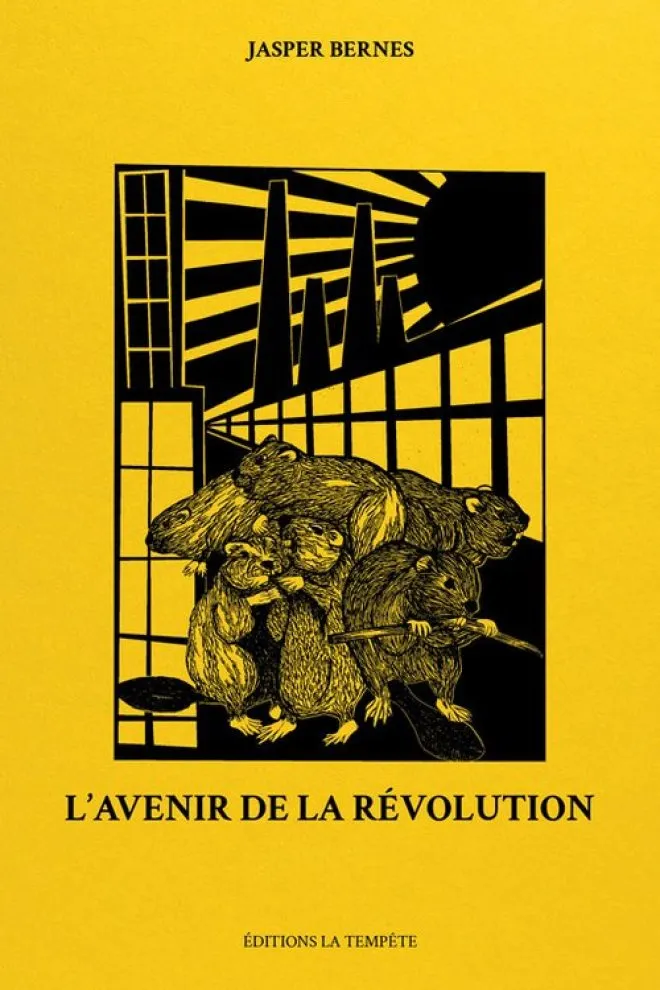
From Jasper Bernes, L’avenir de la révolution. Horizons communistes, de la Commune de Paris au soulèvement George Floyd (La Tempête 2026)
It is something of a commonplace that revolutionaries have little to learn from past revolutions. Our opportunities, if they exist at all, lie in the terrible present and not the horrible past. Retracing the paths of past revolutions in the present, we can only find our path blocked, surely, for capitalism has learned well from its victories and our defeats, forging new manacles from the old alloys of class struggle. Capitalism has falsified the revolutionary practices of the past by adapting to them, restructuring the labor-process and reorganizing the circuits of accumulation in order to vastly weaken class struggle at the point of production and call into question any revolutionary strategy based upon the gradual empowerment of the working class. Our prospects in the twenty-first century are therefore different than they were in the nineteenth and twentieth.
And yet many aspects of capitalism and therefore our struggle against it remain the same. There is an invariant character to capitalist structure, from which we can derive certain invariants of revolutionary struggle. It remains as true today as it was in Marx’s time, for example, that in order to expropriate the wealth of capitalist society and distribute it freely one must first suspend if not annul the armed power of the state. Every revolution in history attests to this fact. In the work that follows I attempt to disclose what is eternal about the project of communist revolution against capitalism and class society—what will have needed to happen. In doing so, I hope to make it easier to identify those features of future revolutions which are contingent, variable, to be discovered by future revolutionary struggle against capitalism itself.
In this manner my book represents a contribution to the discourse on the invariance of the communist movement initiated by Amadeo Bordiga, and developed by many of his readers. In writing to me about this translation, my editors at La Tempête noted the lack of any engagement with Bordiga’s most influential exponent, Jacques Camatte. This is indeed a significant gap, and I had originally planned to write a short chapter on Italy in the 1970s, the movement of 1977, Camatte, and his Italian collaborators, such as Giorgio Cesarano, but could not fit it into the minimal word count allotted by my editors. I set these topics to the side in part because, although Camatte and his writings in Invariance are an important background to the confrontation between a theory of communization and a theory of the workers’ council after 1968, particularly through the attention they give to the German Revolution and the KAPD, Camatte quickly abandons the concept of revolution altogether and elaborates a theory of runaway capitalism that has broken free of the law of value and the proletariat altogether.
Camatte therefore draws very different conclusions from ‘68 than the writers I do discuss, such as Gilles Dauvé, whose later account of the German Revolution with Denis Authier I use because it is superior to Camatte’s and more sensitive to the actual historical conditions. By 1974, when Dauvé and François Martin’s Eclipse and Reemergence of the Communist Movement was published in English, based on articles they had written for Mouvement Communiste, Camatte was already operating on quite different principles than Dauvé and his associates and, in fact, had rejected any meaningful notion of invariance insofar as he rejected revolution. What was necessary after ‘68 was an anthropological “inversion,” a turning away not only from capitalism but an errancy inherent in the human species since its emergence, an errancy which capitalism has perfected but did not originate. We must leave the world, Camatte tells us, through a collective act of will and a non-conflictual affirmation of our common being with all of nature. These are the words of a saint. Unfortunately, we are all sinners long ago condemned to hell.
Camatte therefore offers what I will call a communism of immanence that must be contrasted with the communism of transcendence, of rupture and revolution, that I develop in this book. Such immanent communisms have been a constant throughout the history of the workers’ movement and socialism—syndicalism first and foremost, which proposed the continuous growth of revolutionary workers’ associations as the fundamental determinant of revolution, but also social democracy, which sought to cement working-class power in the institutions of the state. Communisms of immanence always depend upon a theory of tendency, discovering in the development of capitalism the development of a force capable of overcoming it. In Camatte’s case, this tendential theory was elaborated from his encounter, through Roger Dangeville and Maximilien Rubel, with a then un-translated draft chapter from Marx’s Capital, “The Immediate Results of the Process of Production.” From this text and its elaboration upon the difference between capital’s formal and real subsumption of the labor-process, Camatte is able to theorize capitalism’s total victory after 1945, having subsumed and reorganized according to its own principles not only the labor process but human muscle, nerve, and brain entire. Camatte shares this revelation with a whole generation of writers, particularly Antonio Negri, who discovered in this “missing manuscript” and also the newly published and translated Grundrisse a theory adequate to a transformed capitalism in which the old determinants of class struggle—value, the wage, living labor, the collective worker—have been transformed and capital takes life itself, humanity, or society as its object.
In my book, I mostly set to the side such questions of tendency and periodization in order to disclose, as I say, what remains eternal about revolution against class society, in order that we might better understand what has not. Ultimately, tendential theory—a theory of the development of class struggle and accumulation in the present—must be joined with what I call heuristic theory. I identify Marx’s “value-form” as the heart of his heuristic theory of communism: an attempt to specify what capitalism is, and therefore how it might be destroyed. But the value-form can only operate through the “law of value,” through value in motion, through accumulation, which is everywhere crisis-ridden, geographically dispersed, and complex. Here Marx is of limited utility, as surely he would agree. The very fact of capitalism’s persistence testifies to an absence within Marx’s tendential theory, and so often the best theory of this type departs from Marx by way of Marx in order to figure out not only what he missed but also what he could not foresee. Camatte and others use Marx’s concepts to leave Marx and rewrite his theory of value, class, and accumulation in terms adequate to a new arrangement of forces. I do not agree, however, with Camatte or with Negri when they say that value has been superseded and that capitalism is no longer regulated by the distribution of surplus value extracted from productive labor. In fact, the weakening of capital accumulation over the last fifty years demonstrates that far from having subsumed life and nature entire, capitalism now confronts severe limits to the process of accumulation both internal and external, even as vast resources for accumulation, whether human or material, remain. Already with only half the earth inhabited we see earth systems breaking down quickly as accumulation slows, topping out. Life is in excess of capitalism, if we must speak that way. Rather than being subsumed by capital, vast swathes of the global proletariat remain excluded from labor-markets even as they depend upon product markets and money. This contradicts Camatte’s notion that capitalism has succeeded in generalizing wage labor, rendering it a universal condition. This is not to say that nothing is different—in fact, throughout my book I rely on a tendential concept that Camatte shares with the originators of soi-disant communization theory: the death of the workers’ movement and of the worker’s identity as worker, which eliminates the possibility of a working class for-itself even as it extends and generalizes the class in-itself. But here we must distinguish between the proletariat, those who are dispossessed, who lack reserves, and the working class itself, whose productive activity measures and limits value. The proletariat expands even as the working-class and its value-generating labor-power contracts. But because what matters for planetary boundaries is not the rate of growth but the mass of capital and human inhabitation—even as capitalist growth and population growth slow, tending toward zero, planetary boundaries are trespassed irreparably, with delayed yet largely inalterable consequences. The parasite begins to die before it has devoured its host entire.
Camatte’s communism of immanence finds its objective correlative in Italy of the 1960s and 1970s. Many contemporary communisms of immanence derive in in one way or another from operaismo and the broader “area of autonomy” in Italy during its insurrectionary decade, though contemporary anarchism in some of its modalities also operates with an immanentist orientation. In the Italian movements, we see indexed the entire tactical repertoire of our latter-day movements—occupation, blockade, festival-riot, assembly—but what is especially striking is how little the concept or theme of revolution plays any role at all, except perhaps as subjective intensifier. Within the theory of Mario Tronti, Toni Negri, Sergio Bologna and other key exponents, revolution is not an object but the result of a continual process of proletarian self-affirmation, experimentation, and construction. The factories are occupied but there is no call to take them over, to expropriate them. Among the armed groups and the anarchists, revolution is discussed, but what is meant is insurrection, the first condition of the revolution, the defeat of the armed power of the state. It seems safe to say that the increasing separation of the armed groups from the social content of the movement itself lay connected to this absence of revolutionary vision.
Absent such possibilities for overcoming, for transcendence, social movements “invert,” taking their own life processes, their own becoming, as their raison d’etre. In this we see what Camatte describes as the anthropological dimension to revolution, a reaction against capitalism’s biological and psychological domination, easily visible in most uprisings of the last sixty years, These are revolts of life itself against its exhaustion and degradation, revolts of a humanity “robbed of movement, speech, and imagination,” as Camatte writes in 1977, underlining the significance of May ’68 for the Italian movement.1 They testify to indignity, to lives that do not matter, to social death and exclusion. They make joy itself their measure. But they do so surrounded by the guns of the state, which murder them, in the wastelands abandoned by capital, where they die, and so they must fight, pace Camatte, and fight well.
1977 was less a direct turn toward the anthropological than an attempt by a movement that had been forced into the margins to weaponize its own subcultural existence. Movement within movement, coming at the end of a long sequence of struggles stretching back to ’68, the events of that year were a reaction against the subcultural turn which the movement had taken and in particular to the collapse of operaismo and the workerist strategy, its notion of proletarian affirmation through the wage and refusal of work rendered null and void by unemployment and inflation during the downturn of the late 1970s. In the new social centers where the new movement formed from the remnants of the organized groups like Lotta Continua and Potere Operaio, refusal was less a choice than a condition. As one significant factor in the movement wrote, this recognition was clearest in the Parco Lambro rock music festival of 1976, organized in the collaboration with many of the Milanese autonomist groups: “We rolled around for four days in a sea of garbage with the oppressive sun beating down and a muddy rain descending at night, with insects in our sleeping bags and all those sickening plastic plates.”2 There the “separatist movement” of unemployed youth and dropouts was “faced with society for what it is: solitude, violence and material poverty, multiplied by 100,000.” Franco “Bifo” Berardi continues:
The aggressiveness of this impotence was matched by the impotence of the aggression and all the tensions are released in the ghetto where expropriation is replaced with a spectacle of itself. In the meantime, others closed themselves up in their tents and rolled a spliff, complaining that they’d “come here to re-establish unity of body and soul and instead we just found violence here too.” All of the shit, misery and impotence laid down its ideology here, and the separatist movement ended up either in the separateness of isolation or unleashing aggression. (528)
Lacking an object or exit, impotent, the desire to separate from separation and unify turns on itself. The movement of ’77 was an attempt to vent this conflictuality yet retain the festival form—it was “our party against the metropolis,” as another commentator writes.3 Thus during the 1976 winter holidays, the Milanese movement that put on the rock festival turned its energies toward an attack on haute bourgeois culture, declaring war on the Scala theater and forcing the police to defend a production of Othello with thousands of officers. Thus was the stage set for ’77 in which it was hard to tell what was opera and what was not.
Take as example the magazine La Rivoluzione, produced by Bifo and others involved in Radio Alice and A/traverso, two important vectors for the movement in Bologna and nationally. Bifo recalls “laughing out loud” at the “Mao-dadaist” collage he and his comrades made from newspaper headlines and the Chairman’s phrases and used as a front page banner: “Finally the sky falls to earth / The Revolution is right, possible, necessary.”4 For Bifo, apparently, this was a joke, a move from “irony to hyperbole” which only cops and journalists could take seriously. We ourselves cannot take this account seriously, however, since it is written after the repression of the movement and marked by the latent violence of the state, who did attempt to imprison everyone involved, limiting what former participants could say in writing. In any case, it is clear many people could distinguish poorly between rhetoric and reality, especially after the killing of Franco Lorusso in Bologna in March. The days of action that followed were massive, with armed crowds exchanging gunfire with units of carabiniere. Was it time for revolution? Or was this simply display? Everywhere the question of the mass leap into open armed struggle pressed itself. As Franco Tommeri and Paolo Pozzi recall of the movement in Milan on March 12 following the killing of Lorusso, the mood was hardly joyous. They write of “long, bitter faces” with “guns under the long jackets” marching “though a completely empty, fear-struck city-centre looking for targets,” seeking vengeance.5 Brought up short in front of the police prefecture, delegates from the various autonomist groups discussed whether to lay siege to the building. The authors’ group, Rosso, proposed instead a symbolic outlet for their real antagonism which the others accepted after some grumbling. The march then went to headquarters of the bosses’ association in Milan.
We let off everything we had at that empty glass building, Molotovs by the dozens, pistol shots and rifle rounds. The windows of the bosses’ house came down with glee. “Burn baby, burn!” we heard inside ourselves. And then we ran.
This proletarian opera of bloodless violence—surely the equal of La Scala—is an interesting emblem of the movement which, in its turn toward the cultural, often found itself in the realm of communication and representation, of the symbolic, or what Giorgio Cesarano, Camatte’s most important interlocutor, called the “fictive,” linking Guy Debord’s theory of the spectacle to Marx’s theory of fictitious capital. The brilliant proto-punk typography of A/traverso and the delirious counternarration of Radio Alice are the best examples of this, but they emerge, one must remember, as a consequence of repression and retreat, of a movement evicted from the universities and shot at in the streets. The turn to the airwaves was in some way as desperate as the turn to armed struggle. In the face of the repression that came crashing down after the non-insurrection of March, all that could be done was to organize an international conference and to mobilize support from afar.
What Camatte identifies as a strength of contemporary movements is also, then, as he acknowledges, part of their impotence. Lacking clear aims (or lacking revolutionary aims), these movements turn inward, taking their own life as their object and thereby posing deep questions about human becoming against and within capital. For Endnotes, following Camatte on this point, the cycle of “non-revolutions” and “non-movements “which defined the 2010s has produced “revolutionaries without a revolution”—the cultivation of a reflexive revolutionary subjectivity in the absence of revolutionary objects.6 At the base of these non-movements is a desire for human community, Endnotes argues, as much as a desire to destroy the things of this world; as a result, since the 1970s movements often have posited their own life, their own existence, as their end, just as Camatte predicted. These movements gather to speak of lives devalued, debased, degraded and disenchanted, and to symbolize their renovation. They call for dignity, recognition. Such a desire for community expresses itself today largely through “identity politics,” which Endnotes follows Camatte—and Giorgio Cesarano—in seeing not simply as a diversion from the real, underlying questions of class but as the basis for an incipient communist anthropology and, I would argue, a new revolutionary ethics, since this is largely what the content of “identity politics” means, a kind of antipolitics that reduces everything to a question of ethics, of the communist conduct of life.
Could some organization compose these involuting energies, Endnotes asks? They do not specify, however, whether that would be toward the end of cultivating a new humanity or revolution itself or whether the one implies the other. This identifies a scission within Bordiga’s theory of revolution, both transcendent and immanent. The Bordigist party is the revolution, directly organizing communism and abolishing the state. As the revolution grows, so too does the party. From the beginning, the party is a structure of anti-individualism, a social brain in which one must live as a communist even when communism doesn’t exist. Here we see the origin of Camatte’s anthropology in which, although he rejects the gangsterism of formal parties, he still speaks of a constellation of groups of communists. But how can one live as a communist among others living as communists, without communism? Camatte’s answer is to “maintain a network of personal contacts with people having realized (or in the process of doing so) the highest degree of theoretical knowledge: antifollowerism, antipedagogy; the party in its historical sense is not a school.”7 This “union” of revolutionaries would not be a groupuscule—or racket—seeking to reproduce itself and compete in the realm of radical theory. But what would it be? What do revolutionaries do in the absence of revolution, aside from maintain their own radiant websites and tend to their orchards?
In the end, of course, the development of revolution and the development of revolutionaries is one and the same. One cannot maintain a revolutionary subjectivity without revolution for very long. Nor can the revolution survive without revolutionaries, without conscious commitment to the revolution. Ultimately, the division between communism of immanence and communism of transcendence, between heuristic and tendential theory, is a false one. “In the long run,” as I write, “what will have succeeded is as likely to be the patient work of generations as the quick work of ecstatic weeks. Movements of years and movements of months converge during revolutionary days.” The George Floyd Uprising was, for example, both unprecedented and novel and at same time part of a long history of antipolice uprisings in the US stretching back to Los Angeles in 1992, and from there, back to the late 1960s. New flowers sprout where the old have decayed. It is true therefore that communism will require the cultivation of a new anthropology, a new ethics, a transvaluation of all values that takes the indeterminacy of the human species in its metabolism with nature as its object and establishes new conditions of equilibrium within the organic and inorganic webs of life. But here one must be careful where one speaks, at least in English, or in California, where false prophets of reconciliation abound. As Camatte knows, here one must simply walk the path. Revolutionary ethics, revolutionary spirituality, can only be demonstrated and not described.8
To be a revolutionary without revolution is also, it must be added, a terrible curse, one that has driven many to madness and to deaths of despair. In the search for human community, we often discover our own inhumanity, our degradation and debasement. Just as in 1977, movements today confront their participants with social and human questions for which they have no answer. They are, as I have written elsewhere, a “negative prefiguration” revealing to us the squalor and misery and violence in which we live just as clearly as the Parco Lambro festival did.9 This is why transcendence, rupture, break, and crisis remain their very life-blood, for only in the opening of new channels with new resources and capacities can they hope to sustain and transform themselves, to meet the tremendous need and desire held back by the state and capitalism. Everywhere our era seeks out revolution, even if it knows not what it means, even if it is mere fantasy or fiction, even if it calls it apocalypse or catastrophe. Rather than attempting to swim against the current, it seems better to assume some possibility of success and clarify these revolutionary aims. We cannot simply quit this world and walk into the forests, the hills. We are ensnared, entangled, dependent upon globe-spanning supply chains and technical systems. In order to leave this world we must dismantle and reconstruct it. We must hack our way out of the monster from inside its guts, using its own bones as our weapons.
None of this invalidates the questions Camatte asks, even if our answers must be different. Human being at the level of the individual and the species is, indeed, the object of communist revolution, which cannot avoid some minimal humanism if it affirms that all is common, that everything belongs to everybody. But we must be careful rummaging among the remains of our prehistoric ancestors and taking our indications from human paleontology, a field whose main conclusion seems to be that we do not know and likely never will know what humans have been, all material and symbolic culture having returned to dust. We can only draw firm conclusions about what humans may have been by discovering what they can be. We can only pose questions about the being of human being, about the determination and indeterminacy of the human species in relation to other apes and all of nature, once we have abolished what is specific to class society, and what now as it has for thousands of years forecloses a whole series of experiments in common humanity that would constitute the content of communism.
Any book on revolution addressed to revolutionaries is bound either to lie or to disappoint. I do not offer a means toward the end of revolution, a trick that revolutionaries can apply in order to bring about revolution, a novel organizational structure that might seed capitalism with its own destruction. In writing about what will have needed to happen, I must leave unanswered the most important questions of how it can, how starting from the present struggle might become revolutionary. How can “the proletariat – acting strictly as a class of the capitalist mode of production, in its contradiction with capital within this mode of production – abolish capital, therefore all classes and therefore itself; that is to say, produce communism?”10 That is the question, but its answers cannot be found in the pages of this book or any book at all, for they must emerge from class struggle itself and ultimately from what is unpredictable and unknowable about human action and therefore class struggle. What we can find of these answers before they are posed and solved by the actions of millions are premonitions, glimpses, hints, speculations. My book does not and cannot offer a program for revolutionary organization because, like Camatte, I believe that communist organizations formed under capitalism face an insoluble dilemma—either they conform to the legal, economic, and social structures of capitalism, aiming for success within the capitalist mode of production; or they commit themselves to an immediate project of revolutionary agitation which brings down upon their head the full repressive force of the state before they are strong enough to withstand such an assault. Even organizations that maintain explicitly revolutionary aims and keep their powder dry may find themselves unable to transform quickly enough to meet a revolutionary conjuncture. Revolutionary organization therefore usually occurs against the existing organizations of the class, through fracture, rupture, and rift, emerging in a moment of crisis. To pay attention, to gather information, to speculate and experiment, to map class struggle and the complex enchainments of the means of production—none of this is sufficient, but it may, in hindsight, have been necessary. Between what will have needed to happen and what is to be done there will always be a gap which words alone cannot bridge. There we must leap.
The question of organization also brings us back to the theory of tendency set to the side by my book. One reason I chose not to offer a tendential theory in this book and to reckon with the ongoing restructuring of capitalism and class struggle is that I believe we are in a period of transition with regard to the structures of the past fifty years whose full contours—political-economic, bio-ecological, cultural, spiritual—are still coming into shape and will be altered by the emergence of the first truly serious consequences of climate change in coming years and decades. 2020 (where my book ends) will likely be seen as a pivotal year in future histories, inaugurating a long period of inflation and high interest rates that fundamentally shifted the orientation of the global economy, particularly through the emergence of new forms of economic nationalism and political fascism. Whether or not we will return to deflation and devaluation of labor and goods is an open question. In the meantime, an emergent cycle of struggles brewing on the periphery of the world-system—in Indonesia, Nepal, Madagascar—anticipates the possibility of a larger wave of struggles particular to this decade, its conditions, and particularly its youth. The point of tendential theory is to identify and anticipate crisis tendencies within capitalism, insofar as these provide the basis for a revolutionary breakdown in the capacity of the state for organized violence and the emergence of a struggle against and not simply within capitalism. This is useful not because it can predict the future but because it can clarify and help amplify struggles as they emerge. In a future work, I hope to return to the tendential theory I pursued prior to The Future of Revolution and offer some indications about the direction of capitalism in the face of ecological and anthropological crisis. No theory of invariance without a theory of variance, no transcendence without immanence.
October 2025
Oakland