[T]he difference between a true thought and a lie consists in the fact that a thinker is logically necessary for the lie but not for the true thought. Nobody need think the true thought: it awaits the advent of the thinker who achieves significance through the true thought. The lie and the thinker are inseparable. The thinker is of no consequence to the truth, but the truth is logically necessary to the thinker. His significance depends on whether or not he will entertain the thought, but the thought remains unaltered. In contrast, the lie gains existence by virtue of the epistemologically prior existence of the liar. The only thoughts to which a thinker is absolutely essential are lies. Descartes’s tacit assumption that thoughts presuppose a thinker is valid only for the lie.1 Wilfred Bion, possibly the most cited author in psychoanalytic literature after Freud, is a somewhat extraordinary figure in the history of psychoanalysis. He revolutionised the understanding of groups through a psychoanalytically informed theory, and then transformed psychoanalysis itself through his theory of thinking. We find both these theories of relevance to what we are and what we do. Before exploring these theories it is worth saying something about the social context and individual that produced them.
Bion was born in 1897 in India into an upper middle-class Anglo-Indian family. His father was a civil engineer directing the construction of railways and irrigation canals. The nature of his father’s work meant that the young Bion absorbed more Indian culture than most colonialist children. A key figure in his upbringing was his Indian nanny or ayah 2 who may have been the source of a certain Eastern philosophical feel to some of his later ideas. In a form of abuse the English upper classes do to their children, he was sent to boarding school in England at the age of 8. He never saw India or his beloved ayah again. He was then further traumatised by his experience as a tank commander in WW1. While others saw him as behaving heroically, with both France and Britain awarding him medals, he described himself as having died on the road to Amiens.3 After the war he studied history before becoming a doctor, psychiatrist, and then a psychotherapist at the Tavistock Clinic. In this capacity he was a therapist to Samuel Beckett for two years, prompting much later speculation on their influence on each other. Dissatisfied with the eclectic form of therapy he had received and been taught, in 1938 he started a training analysis with John Rickman. With the start of WW2, they broke this off to work together as army psychiatrists.4
Bion and Rickman became part of the Tavistock “Invisible College” in the army. This was a time of widespread sympathies with “socialism” among the British intelligentsia and the Tavistock group was no exception.5 Experimentation with the possibilities of groups was the order of the day. They were strongly influenced by Kurt Lewin’s field theory.6 Rickman was also an important conduit for the idea of “leaderless groups”. During WW1, while Bion had joined the army and played the role of war hero, Rickman—a Quaker—had been a conscientious objector and gone to Russia as an ambulance driver and relief worker. In 1918, he witnessed the revolution in the countryside. Observing the peasant village council, or “Mir”, at work, Rickman noted: “the village formed a leaderless group, and the bond which held the members together was that they shared a common ideal”.7
Bion was instrumental in developing a new way of selecting officers. The method he pioneered involved putting candidates together in a “leaderless group” and observing how leadership spontaneously emerged when a group was set tasks. Later in the war Bion and Rickman created what is recognised as one of the first therapeutic communities at the Northfield military psychiatric hospital. This involved giving the patients autonomy to form their own groups to aid their rehabilitation. The army High Command were disturbed by the experiment and closed it down after six weeks but it blazed a trail for others to continue such work. After the war, and on the basis of his wartime reputation, the Tavistock Clinic asked Bion to pioneer the use of groups for therapeutic purposes. The patients and staff composing the groups expected him to lead as an expert. To their frustration Bion’s approach was instead to encourage the participants to examine the tensions within the group, including the wish for him to take charge. Bion theorised his experiences in a series of papers later collected as Experiences in Groups.8 While Bion himself did not pursue this work these ideas became foundational for a method of research and experiential training and development in groups known as the Tavistock or Group Relations approach.9
A theory of groups
Bion’s key idea was that all groups operate simultaneously in two ways, displaying two different mentalities. On the one hand, every group is what Bion calls a “work group”. This is what the group consciously thinks it is about. It also refers to the mentality, attitude, and actions that reflect this purpose.10 The connection of the members in a work group is one of cooperation, where members draw on and develop their skills, capacities, and maturity out of a shared sense of purpose. For Bion, the work group is “in however embryonic a form, scientific”11 because in pursuing their activity, whatever it is, its members probe reality, seek knowledge, learn from experience, and thus change and develop.However, groups do not always operate in such a transparent, rational, and straightforward way. Groups often also display a mentality and activity that operates on a less conscious level that pulls in a different direction. Puzzling and often obstructive to the group’s conscious aim, Bion found that this mentality and activity coheres and makes sense once we start to see the group as assuming it meets for something more primitive or “basic” than its consciously imagined purpose. He termed this aspect the “basic assumption group”.
Bion identified three such basic assumptions, which he linked with primitive emotional drives: dependency, fight-flight, and pairing. These group-states each give rise to a different kind of leadership, which may or may not correspond with any acknowledged or unacknowledged leadership of the work group activity.12
Under the “dependency” basic assumption, the group acts as if it meets to receive everything it needs — wisdom, knowledge, guidance, etc. — from one member. Under the “fight-flight” basic assumption, the group acts as if its purpose is to fight or escape from a perceived enemy. The threat may be external or internal, clearly or poorly defined. Close to panic, the group is particularly hostile to thinking, but will follow anyone who seems to offer an immediate way of dealing with the threat, whether this is by attacking or running away from the enemy. In the “pairing” basic assumption, the group orients itself patiently to the interaction of two people (or perhaps two sub-groups). There is a mood of hopeful anticipation, a sense that the group will be saved, with the underlying assumption being that through the pair the group is going to give birth to something great, perhaps a new idea or new way to do things.13
An essential point for Bion is that the work group and basic assumption group do not apply to separate groups, but to forms of activity present in every group and every participant simultaneously, with sometimes one and sometimes the other aspect dominating. If the work group aspect is dominant, the group gets on with its task; if the basic assumption aspect is dominant, the group behaves defensively. Groups can be seen to be influenced by a certain basic assumption for a long time, at other times a rapid oscillation between the different basic assumptions can be observed. Basic assumptions may at times have a negligible effect on, or even be compatible with work group activity,14 but at other times the basic assumption group interferes with or substitutes itself for the work activity. At times when stress circulates through the group, this mentality may come for extended periods to dominate the group in ways that can be compared to psychosis.15
How might such ideas apply to the “political” or “revolutionary” group? As was alluded to in the introduction, one of the problems with the idea of a “work group” orientated to revolution or communism is that this is clearly not a practical object for willed groups in the present. Thus the idea suggested in Bion’s group theory of “keeping on task” is particularly difficult for a willed group when the tasks it orientates to — communism or revolution — will actually not be its product but rather a product of spontaneous (i.e. determined 16 ) group processes at a class and societal level.
Bion suggested that the idea that a group acts consistently in the manner of the work group is “an idealised construct” or even a “group phantasy”. This seems particularly true of groups nominally committed to the idea of revolution or communism. We all know that other stuff goes on in such groups. Whether it is routinised activity that no one really believes in, competition with other groups, or internal dramas and intrigues, there is much that goes on that has little to do with making progress in terms of what participants imagine to be their work group function. Observing basic assumption behaviour in such groups is not hard: there is the common enough dependency phenomenon of a group having an — often unacknowledged — leading member or guru who the others consistently look to for guidance (even if at the same time this may involve regularly being disappointed by what is delivered). Fight/flight behaviour can be seen in the hostile and competitive relations such groups often have with each other, and in the internal splits they are prone to. One might also see an affinity with the pairing basic assumption when a group is dominated by a messianic hope.
The notion of a fundamental assumption that the group must be preserved also seems apparent and glossed as the necessity for political organisation (or for “the party”). Political groups also seem particularly prone to times when strange, often disturbing and unpleasant things happen “between individuals, in factions and sometimes throughout the group” persisting “sometimes to the point of the demise of the project, more often to the point of a split or expulsion”.17 But we should not limit our recognition of these behaviours to formalized political groups — all kinds of networks, scenes and milieus that people operate in can display such behaviors as well.
Analysing what is going on in a group is not just a matter of applying basic assumptions. It is possible, for example, to see basic assumptions at play in the two case studies with which we began; however, the analysis we borrowed from Hoggett in the previous section indicates that any specific group difficulty will require not just identifying basic assumptions but imaginative exploration of what precisely is going on in any given case.
A seemingly simple lesson from Bion’s work is that when operating in groups we can attempt to bring into focus both the work aspect of the group, its aim or purpose, and the less conscious aspects of what is happening that interfere with this. Alongside its work group activity, the group may make, to use Bion’s phrase, the study of its tensions a group task. Are the energies of the group focused on its agreed task or are they being dissipated in something else? This may involve not suppressing the processes that are interfering but exploring them. At times — and such times are inevitable — when the work group is no longer dominant, collective awareness can be brought to it. This may, however, be difficult and require courage from its participants. Those who ask the group to examine itself often become the target of group hostility. Bion argued that when strange things are happening in a group, everyone is affected, and the best one can do is retain a capacity to “think under fire”.
Bion is often taken as having a largely negative view on groups. This is because the approach he took to leading groups brought out the strange and disturbing things that can occur within them. By producing stress and anxiety in participants, Bionian groups bring into prominence the unconscious and defensive basic-assumption aspects of group functioning. Bion’s point was that we all carry these capacities with us. Groups, just as they allow us to achieve possibilities we can’t attain on our own, can also bring out some of our less appealing, even psychotic, qualities. He thought, however, that in the long run “despite the influence of the basic assumptions”18 the work group was triumphant.19
Indeed far from upholding the individual against the irrationality of the group, there is in Bion an insistence that group-ness is fundamental to the individual, as he puts it:
The individual is, and always has been, a member of a group, even if his membership consists in behaving in such a way that reality is given to an idea that he does not belong to a group at all. The individual is a group animal at war, both with the group and with those aspects of his personality that constitute his “groupishness”.20
Drawing on this, Wolfenstein argues powerfully that the whole idea of the individual as “a self conceived outside of society and essentially constituted from the inside out” is a group phantasy.21 Difficult experiences with groups may encourage taking refuge in this defensive phantasy, but it is a delusion.
The “scientific character” that Bion attributes generically to the work group aspect of any group takes on particular significance for a group oriented to theorizing the communist overcoming of capitalism. In this case, thinking — developing “insight and understanding” — is fundamental to what “we” are about; at least it is what we like to think we are about. Though not entirely separate from any engagement we may have in struggles, it is thinking, understanding, and theorising experience that offers itself to us as a task worth pursuing. At the same time, such a task is not a straightforward one. The object of enquiry — capitalist society — is not something that stands over and against the enquirer but is rather a dynamic process of the composition and decomposition of social relations through crisis and struggle that includes the enquirer within it. Capitalism is not out there, it traverses us, it is us. As Wolfenstein puts it, in both psychoanalysis and the theory of social revolution: “We are the problem we are trying to solve”.22 To be aware of what is going on is painful. Outside of struggles there are no easy benchmarks to judge if one’s work group activity is having results, nor does such enquiry make one’s life easy. Indeed it is perhaps the difficulties of this task, which involves going against all the obviousness of bourgeois society, that give rise to some of the pseudo-answers and pathologies that particularly afflict such groups.
It is relatively easy to identify how basic assumptions may interfere with the group orientated to revolutionary change, but what, in the absence of revolution, might its work consist in? If we are going to say that we have a task of trying to think, then it is worth examining the second period of Bion’s work which has informed our understanding: his theory of thinking.
Towards a Theory of Thinking: the Kleinian Development
While others enthusiastically took up the ideas on groups that Bion had developed, he was not particularly satisfied with them.23 Finishing a training analysis with Melanie Klein, he went on from the early 1950s to practice individual psychoanalysis and in particular to work with psychotic patients. It was out of this work that his most significant contribution to psychoanalysis would emerge — the theory of thinking.24Bion’s theory of thinking only makes sense in relation to the Kleinian development in psychoanalysis, and its key concepts of projective identification and the paranoid-schizoid and depressive positions. For this reason, and because we find such concepts are independently of value to understanding ourselves and the world, it is worth outlining them here.
Drawing on an earlier discussion of mania and depression by Karl Abraham and Freud, and her own pioneering work with children, Klein postulated an affinity between early infantile states of mind and those encountered in psychosis. She described two fundamental ways of relating to the world, which she termed the paranoid-schizoid and depressive positions, and the movement between them as the key task of development. Klein thus displaced the Freudian focus on the oedipal drama, around the fifth year, by a concern for more primitive levels of mental functioning, which emerge sequentially in the infant’s first year, but which she thought continue to play a role throughout life.
Klein contended that the infant, in its first few months, has a dominating anxiety of being annihilated, and defends itself against this by a process of projective identification. Projective identification is an unconscious phantasy of taking things in and spitting things out which feels real and has real effects on the developing ego. This involves a splitting of its experience into that of either wholly good and or wholly bad objects. The infant coheres its first sense of self through identification with and love for its introjected good object, which it needs to keep separate from its “bad” feelings of hatred and destructiveness which it puts into the bad object. The prototypical good object is the gratifying mother or good breast, the bad is the non-gratifying mother or bad breast. Klein thought the absence of the object, of the real breast, was “too much” for the youngest infant, and that in its phantasy it instead experiences the non-breast as a concrete “bad breast”, which it tries to get rid of or evacuate through what she called projective identification. In a recurrent struggle to lessen its dominant anxiety, a cycle of splitting, projection, and introjection ensues. The projective identification of the paranoid-schizoid position is thus what one does to one’s difficult experience when one is unable to think about it. If not excessive, this projective identification fulfils a developmental function, allowing an eventual shift to the depressive position.
The depressive position involves a more realistic and integrated picture of the world, in which the ambivalence of one’s objects and one’s feelings towards them begins to be tolerable. The infant recognises that the good and bad perceptions of the maternal object, which it has previously kept rigidly apart, refer to a whole object, an other person. It thus recognises that the bad (absent) breast which it has intensely hated is actually the same object as the good breast which it has loved. As a result, the main form of anxiety shifts from fear of one’s own imminent annihilation to concern for this object: the person upon which the individual depends and which it is not able to control through mechanisms of projective identification, as it previously phantasised it could. The dawning awareness of the reality of self and others, and of the impact of one’s actions on those others, is painful and subject to retreat back towards the paranoid schizoid position.
Importantly for Klein, transition between these positions, though occurring for the first time around the middle of the first year, is not to be understood as a once-and-for-all achievement, but as a continuously active process. The paranoid schizoid position is not so much a stage that is left behind, but more a distinct way of apprehending reality and organising experience which continues to play a role throughout a person’s life. The attainment of the depressive position then, is neither smooth nor certain; it continues throughout childhood and indeed can be considered a lifelong developmental task.
The understanding of the positions as two fundamental modes of organizing and processing experience, different ways of relating to the world, each generating its own quality of being, means that whether or not one is persuaded by the Kleinian speculation about the psychic world of the infant, it is possible to accept the positions on other grounds: namely one’s own observation of oneself and others.25
Splitting of good and bad, an idealisation of the good object(s) and denigration of (the) bad object(s), in which thoughts and oneself seem to be un-integrated or dis-integrating — this is the paranoid-schizoid position. Recognition of the ambivalence of self, of others, and of the situation, in which one’s thoughts and perceptions are more integrated, expresses the realism of the depressive position. If the depressive position is hopefully where we more normally operate from, we all will have encountered the paranoid-schizoid state in ourselves, in others, and especially in collective life. We are all capable of moving into the paranoid-schizoid state of mind, especially if put under enough stress. The psychotic part of our personality exists alongside the non-psychotic part, and thus the shift into the paranoid-schizoid position is more a sideways than a backwards movement. If Freud showed us we are all neurotic, Kleinians shows us we are all psychotic.
From Working with Psychosis to the Theory of Thinking
Freud famously thought psychotics were unanalyzable. Bion was one of a small group of analysts who, fortified by the exploration of their own primitive mental functioning in their analyses with Klein, felt able to work with such patients.26 Puzzling over why such patients were so hard to understand, Bion identified what he called “attacks on linking” — attacks on the awareness of reality and the linking of objects necessary to thinking itself.27 Such attacks defend psychotics against the unbearable emotional truths in their lives. Working with such disordered forms of thinking (or what the psychotic did instead of thinking) led Bion into theorising what the normal person does when he or she thinks. As he stated later:It would be easy to say that the obvious thing to do with thoughts is to think them; it is more difficult to decide what such a statement means in fact. In practice the statement becomes more meaningful when it is possible to contrast what a psychotic personality does with thoughts instead of thinking them, and how much discipline and difficulty a measure of coherent thinking involves for anyone.28
Thinking is hard and can be painful — most of the time people do not really think, they reproduce ideas that are already circulating without any development of them. What we have found is that Bion’s theory of thinking offers us a way of helping make sense of what some of the obstacles are to such development. In this section we are asking readers to immerse themselves in rather difficult material whose importance and relevance may be hard to ascertain. We find it is worth it.
Getting a handle on Bion’s theory of thinking poses certain problems. One difficulty is that it is not really one theory, but a series of models of mental growth and development, and there are questions how each model relates to the others. Another difficulty is that, in Bion’s writings, in addition to introducing a series of new concepts, he often chooses to represent them with symbols and algebraic notation. The reader is faced with “K” and “-K” (“minus K”), for knowing and its opposite, “beta elements” (β), “alpha function” (Ψ), “alpha elements” (α), for the most basic mental functions,29 “pre-conceptions”, “realizations”, “conceptions”, for steadily more complex forms of proto-thoughts, “K>O” for a shift from knowing to becoming, “Ps⟷D”, for an oscillation between the paranoid-schizoid and depressive positions. Even the concrete-sounding metaphor of container and contained is sometimes represented by “♀” for container and “♂” for contained.30 Bion’s stated purpose in using such symbols was to avoid words already saturated with existing meanings and associations, so that readers are forced to themselves look for realizations of the ideas in their own thinking. The reader is then asked not to passively absorb the theory but to actually think themselves.
For our purposes we will not explain all of Bion’s terms and symbols in any depth, but just touch on ones which have come to have a particular significance for us:
K and -K Container and Contained Ps⟷D Mystic and Establishment
K and -K
Bion sees that in the individual and the group, there is both a drive towards thinking, learning, and development — which he terms “K” — and forces that are antithetical to thought and change, which he calls “minus K” or “-K”.31Bion distinguishes between possessing bits of knowledge and knowing as the function of a relationship. The former is a kind of “knowing about” that lends itself to controlling the object, the latter K involves “getting to know” an on-going link between subject and object, and links between one’s objects. In the Kleinian and “object relations” version of psychoanalysis before Bion, the main relations between self and objects were love and hate. With the notion of the K link, Bion elevated the drive to knowledge (K) to a level with love (L) and hate (H) as a fundamental affective emotional link between the subject and its objects. Just as “x L y” (or “x H y”) indicate a relation of love (or hate) between x and y, the phrase “x K y” indicates a relation or process in which “x is in a state of getting to know y and y is in a state of getting to be known by x”.32
For Bion, attempting to be in a relation of knowing (the K link or K) makes emotional demands. K involves a process of exploration which entails openness and risk; a process that is never completed and has a transformative effect on the knower as well. It requires tolerance of the pain and frustration of not-knowing, in the faith that if one has patience and perseveres, then sense will emerge, and transformation or mental growth will occur. However, Bion was quick to note that there exists an opposite process: the mind actively seeking not to know: minus K (-K). -K is not the same as not knowing, it is a state of avoidance of awareness of not knowing. In -K, instead of the pain and frustration of not knowing being tolerated, allowing it to be modified towards mental growth, it is evaded. To evade frustration is to evade knowing the object. Thus x -K y indicates that x is in an active (if unconscious) way attempting not to know y. Bion offered that -K can express itself in extreme ways, as he found in his psychotic patients, but also in much less obvious ways, as something we all engage in.
In terms of the earlier theory of groups, we can see the work group as oriented to K and the basic assumption group as expressing minus K. Minus K can take numerous forms, simply rejecting the new experience, asserting that one’s existing categories are adequate, substituting an assertion of right and wrong for determining what is actually the case or jumping to action without reflection. Such forms as these are all means to avoid recognising the need for new thinking and the benefit of learning from experience.
One of the most effective obstacles to knowing is the idea that one already knows. It is possible to use the mind to acquire more and more pieces of knowledge, but at the same time avoid any significant change. This is common in academia but is also present in the political sphere in the form of the hack who has read some books. The idea that one knows already, that existing categories and schemas make sense of experience, can be one of the most effective ways of evading the transformative relation of getting to know.
Morality as substitution for K
When there is an attempt to understand a subject, it is possible to short-circuit the process by shifting the issue to whether something is good or bad: morality substitutes for K.One notices such a move — where a moral attitude gets in the way of understanding — occurs fairly regularly in political discussion and controversies. To take two current examples: the white middle class character of Extinction Rebellion and its civil disobedience tactics are not just taken as a feature of the movement, limits to be explored, but as a reason to dismiss it.33 Or the right-wing views of many participants in the yellow vests movement is used to deny its proletarian nature. These are things that must be engaged with theoretically if one wants to understand, and practically if one wants to participate, but morality can be used to obviate the difficulty in properly understanding and engaging a phenomenon. To assert that something is bad is typically to claim to know it and to be separate from its badness.34 One doesn’t have to make the effort to understand its complexity, tensions and contradictions. It seems fairly clear that much of what gets seen as “identity politics” and “political correctness” is bound up with forms of moralism − the Establishment of good and bad, with good residing here and bad residing there − without trying to go deeper into the real sources and nature of domination. At the same time, the way some dismiss identity politics without trying to understand the stakes in any particular case of what gets ranged under this term can express an omniscience-claiming moral superiority and splitting of its own.
Bion developed the notation x K y and x -K y in a psychoanalytic context where the object, y, that x is attempting to know or avoid knowing is another person. At first glance the attempt to understand the social world would appear to be a very different task, and thus not involve the same difficulties. However, in both cases the object is not something inanimate to be known like a thing, it involves an emotionally charged experience, one in which the subject is totally implicated. Understanding capitalism is about understanding oneself, and understanding oneself requires understanding the socio-political world of which one is part.
There are good reasons to avoid knowing this world. With the idea of -K, the use of thinking against itself, Bion provides a fresh way of looking at what has often been seen through the idea of a pejorative conception of ideology. Indeed we might say that capitalist society is pervaded by -K in the sense of an attack on the linking between self and other in its fullest sense. In a world dominated by the capitalist mode of production, to properly understand ourselves requires grasping our relation to everyone and everything else. Yet capitalism necessarily produces a sense of ourselves as atomistic individuals, separate from the matrix out of which we emerge.35 To a significant extent, taking that illusion for granted (-K) is functional to survival within those social relations, even if that survival is existentially impoverished and in the long term places the survival of this and other species in question.
Not looking at what is going on in this world, not thinking about the unfolding catastrophe, is a major form of -K, and just as with the psychotic’s attacks on linking, it defends against an unbearable emotional truth. However, having an understanding of capitalism is no guarantee of an absence of -K. In the field in which we operate, we have certainly witnessed groups and individuals who seem to be engaged in resisting knowing things which threaten their identity and what they think they know. The challenge of course is to recognise such states in ourselves.
In the political world we encounter -K again and again. At the same time, struggles continue to show their capacity to surprise us. It is a common observation that in a situation of struggle and of new experience it is often the “politicos” with the rigidity of their existing expectations — their saturated pre-conceptions36 — who prove much less able to learn from the new experience than the fresher participants in a movement. At the same time, as a struggle recedes so does the rapid learning many participants showed during the movement. They seem to return to their older ways of thinking (ways that are more appropriate to the return to normality) and it is the politicos who are left with the task of attempting to explicitly assimilate the experience — something they may do well or not.
The most important period of struggles have of course been revolutions and revolutionary waves. The importance we have attributed to the German-Dutch council communist Left and the Italian “Bordigist” Left, and their influence on the French and Italian ultra lefts of the 1970s, has been that they represent some of the keenest attempts to assimilate respectively the experiences of the revolutionary waves at the end of WW1 and at the end of the 1960s.
The challenge is to relate to such ideas in an open and not dogmatic way, to not turn a way of making sense of experience into an overly restrictive framework.
Container and Contained
The relationship of container[♀] and contained [♂] is for Bion a flexible model or metaphor to describe how thinking occurs both within individuals and between them — in groups. Other theories of knowledge tend to assume that thoughts are the product of a prior process of thinking. Bion argues that rather than conceiving of thoughts as the product of a prior apparatus for thinking, the thinking apparatus is something that is developed to deal with thoughts. This container is built up gradually, largely from previous thoughts and in relation to other people’s thinking, which at first can do the job of containing for us.37The container/contained model of thinking emerged from Bion’s engagement with the phenomena of “projective identification” as theorised by Klein. Drawing on work with his highly disturbed patients, Bion sensed that they were communicating with him through projective identification. Bion’s leap was thus to see projective identification as sometimes having a healthy function. It was not necessarily just a way of getting rid of or evacuating a bad feeling by projecting it into another person, it could also be a form of primitive or embryonic communication. When the infant has an experience of bad feelings (pain of hunger or worse: an inchoate sense that it is dying), it acts in such a way as to make its carer feel the kind of feelings that the infant wants to be rid of.38 If this goes well, the mother takes on board the feeling, identifies what is wrong, and responds not only physically, with say, milk, but soothingly. At a mental level of mutual recognition shared by her and the infant, she has observed, processed, and given meaning, so as to transform39 the feeling that the infant is unable to deal with into something named and manageable. The infant deals with its fears − a part of itself − in phantasy by projecting them into the container of the mother’s breast, then again in phantasy by feeling it has re-introjected them in a modified, more tolerable form. The mother can be seen as a container − represented by ♀− in which another object (the feelings) — represented by ♂ — is placed.40 The mother is thus in a real sense thinking for the infant. Development occurs for Bion when the ♂♀ activity occurring between the infant and mother gradually builds up the infant’s capacity to tolerate frustration, allowing the child to “introject” its own ♂♀ apparatus. The infant gradually develops a capacity to contain more feelings and thoughts, that is, its thinking of thoughts becomes less dependent on others carrying this out in its stead.41 This apparatus for thinking is thus at the same time a containing of emotional experience and a transmuting of it into cognitive activity. For Bion, thinking is thus an internal apparatus (♀) for dealing with emotionally invested thoughts (♂) that we gradually build up, becoming capable of containing more experience and thoughts of increasing levels of abstraction while at first relying on an other’s apparatus (♀) to contain us.
While each person has, in a sense, their own thinking apparatus, an individual’s way of thinking is largely assimilated, adopted, and borrowed through engagement with others. We need to maintain relations with the apparatuses of others — we need first the maternal object, then a wider group — in order to grow and develop. That group does not have to be an actual group, but can include the thinking of others, living and dead, that we access in whatever way. Though we develop our own capacity to contain ourselves and our thinking, this is only relative. Ultimately, we constantly rely on others to contain ourselves and our thoughts. This other expands from the mother to the wider circles in which we are involved, including texts we read, discussions we have, and so on.
At a certain level, the communist group, in whatever way it exists, whether as an actual group or as the theory we adopt from reading or engaging with others, is an example of ♀ — a container or apparatus for thinking. Being able to “think for oneself” means that one has incorporated such an apparatus, but even then one constantly engages with “groups in the mind”, our thinking is always responding to and anticipating others’ utterances. Thinking happens through the linking or interpenetration of one element with another to produce a third, and these connections have an emotional aspect.
Bion contended that the more abstract and complex forms of thinking and theorising involving “concepts” that we become capable of as adults are built up from, and grounded in, linking operations carried out by the infant with more primitive kinds of thoughts he labelled “pre-conceptions” and “conceptions”. In the familiar and basic example, the infant’s inborn disposition to seek the breast is seen as a “pre-conception”, a state of expectation,42 which “mates” with an awareness of its realization (the presence of the breast) to form a “conception” of the breast. Once established, this conception can then act as a more developed pre-conception for further realizations of increasing complexity. Alternatively the pre-conception meets not with a realization but with the frustration of this expectation — its non-realization — and, if the infant is able to tolerate its frustration, the perception of the no-breast can transform into a thought of the breast. Thus from a process that started with some simple preconceptions around feeding, breathing, and excretion, the meeting of pre-conception with a realization (or negatively the failure of a pre-conception to meet a realization) produces conceptions that are then pre-conceptions for further realisations and conceptions in a hierarchical way that becomes increasingly abstract and generates, ultimately, the most sophisticated thinking, and finally even complex scientific hypotheses and theories.
This is what we are doing when we try to make sense of new developments and struggles. Is the new event a realization of an existing pre-conception, thus not challenging us to develop our theory, or is it something different, a non-realization of existing ideas requiring us to tolerate the frustration of not-knowing in hopes that a new thought will arrive?
Thinking, even in its most complex, rational, and abstract forms — “theories” — is rooted in experience, which in the first place is not cognitive but emotional. At each step, the functions of satisfaction and frustration play their part in furthering the developing apparatus for thinking. Tolerance of frustration, which at the adult level involves tolerance of doubt — tolerance of not knowing — is the emotional connective tissue in which mental growth occurs and such growth still has the emotional flavour of the original process.
From this perspective communist theory may be conceived of as an apparatus for thinking that has been built up through an ongoing relationship between the experience of capitalism and previous attempts to think about and make sense of it. Marx is a key figure here in taking some of the most sophisticated theories developed within the bourgeois frame — political economy and Hegelian idealism — and, by connecting them to the meaning of the proletarian class struggle, transforming them into a theoretical container for thinking the real movement towards communism. It was an extraordinary contribution, but key to such theory is the ability to use it to learn from and think about new experience, the ability to be surprised by the class struggle.
The acquiring of knowledge of history, theories, critique, etc. can be part of this process of K, but equally the acquiring of theoretical frameworks and facts can be about the production of an illusion of knowing that helps one avoid learning something new from experience. The idea that “I” or my “group” knows or has the answer undermines uncertainty and the questioning attitude from which alone new ideas can come.43 We can acquire knowledge to avoid learning from experience, as ideas can be used to evade the experience or to rationalize why the experience should not impinge on one’s existing paradigm.
In discussing the relation between Ricardo and the Ricardian school, Marx seemed to anticipate the difference between open (K) and dogmatic (-K) forms of thinking that he himself would inspire:
With the master what is new and significant develops vigorously amid the “manure” of contradictions out of the contradictory phenomena. The underlying contradictions themselves testify to the richness of the living foundation from which the theory itself developed. It is different with the disciple. His raw material is no longer reality, but the new theoretical form in which the master had sublimated it. It is in part the theoretical disagreement of opponents of the new theory and in part the often paradoxical relationship of this theory to reality which drive him to seek to refute his opponents and explain away reality. In doing so, he entangles himself in contradictions and with his attempt to solve these he demonstrates the beginning disintegration of the theory which he dogmatically espouses.44
This rejection of dogma in favour of being receptive to the living foundation from which theory emerges connects to what we have derived both from the idea of open Marxism and in terms of Bion’s theory of thinking. The “raw material” of reality is of course capitalist society and the struggles it engenders.
“Marxism”, in the sense of the theoretical approach that Marx with Engels can be seen to have arrived at in the mid 1840s, is unthinkable without the struggles of the proletariat of that time. Marx famously changed his views on the state in relation to the Paris Commune of 1871. Correspondence with Russian revolutionaries led him to immerse himself in trying to understand social conditions in their area and to question the linearity and determinism of his own earlier conception of capitalist development.45 The proletariat’s mass strikes and creation of soviets in the early 20th century produced the basis for the currents that theorised and tried to act on these developments and who formed a nucleus of opposition to WW1. The revolutionary wave that ended that war produced the intertwined revolution and counter revolution in Russia and the attempt to make sense of it and their own experiences by the German/Dutch and Italian Lefts. The revolutionary wave around ‘68, with its struggles against and beyond work, questioning all forms of identity, produced the idea of revolution as communisation.
Part of the difficulty in this is that learning from experience — being in a state of getting to know — involves the necessity of changing the apparatus with which one makes sense of the world — that is, changing oneself — and this can be perceived as a threat of catastrophic change. To make sense of this, Bion returned to the central Kleinian notion of the positions. As we have seen, with Klein, the depressive position involves a movement of integration from the non-integrated state of the paranoid-schizoid position. Bion posited oscillation between a kind of healthy version of the paranoid-schizoid position and the depressive position as an essential condition of thinking new thoughts, an oscillation he symbolized with the expression: “Ps⟷D”.
Ps⟷D
Bion argues that, “the capacity for learning depends throughout life” on the “ability to tolerate the paranoid-schizoid position, the depressive position, and the dynamic and continuing interaction between the two”,46 an interaction he represented as Ps⟷D.
As we have seen, for Bion growth in K — learning from experience — is not a merely cognitive or intellectual matter, but depends on an emotional climate composed of tolerance of frustration and uncertainty. While accumulating new pieces of knowledge within one’s existing framework is relatively easy, further growth or development, being open to new ideas to make sense of new experiences which do not fit into existing pre-conceptions requires that one allows one’s frame, what one thinks one knows, to be questioned.47 This questioning of one’s framework is a destruction or de-structuring of the existing thoughts and theories of which the thinking apparatus (♀) is composed. Growth in ♂ requires growth in ♀— an alteration in the container. This series of recombinations can be represented ♂n♀n. Growth in the apparatus (♀n) whether that of the individual or of the group requires that it is able to lose rigidity and even some integration. There is a process of breaking up of the integration — the D position — previously achieved. It is thus a limited return to a less stable and more fragmented paranoid-schizoid position (Ps) in the hope that a subsequent restructuring can allow the Depressive position to be regained at a higher level.48
Ps⟷D is then a process of integration, disintegration, and reintegration. There is no finality in this process, there is always an ongoing process of making sense of, or giving meaning to, experience, being open to further discoveries, and modifying what one thinks one knows through engagement with what Marx called the raw material of reality. Following Ronald Britton we can represent it like this:49
Ps(1) → D(1) → Ps(2) → D(2) → Ps(3) → D(3)... or Ps(n) → D(n) → ...Ps(n+1) → D(n+1)...
The arrows indicate a process of forward development and the Ps(n+1) is a normal, controlled or healthy form of the paranoid schizoid position that comes after the depressive position has been achieved. Ps(n+1) represents a state of taking on board new material — new experience, new ideas — that doesn’t fit into the state of integration one has previously reached in the hope that a higher state of integration D(n+1) is possible. But this is not guaranteed. When one enters the state of Ps(n+1) the D(n+1) that one is aiming for is not present, there is only a hope not an assurance that coherence and meaning will arrive. One is also relinquishing an achieved position (D), a state with a certain moral and cognitive confidence, for the incoherence and uncertainty of a less stable and more fragmented state. There is something persecuting in this. It involves accepting emotional discomfort and narcissistic loss. The individual or group is threatened with the prospect of a catastrophe. Thus the response to the Ps(n+1) state of having to deal with new material may be not to advance to some higher D position, but to retreat or regress to earlier forms of D which are no longer adequate.50
Instead of a forward (→), there is a backwards movement(←), a regression to an earlier and now inadequate state of D.51 The controlled Ps is lost and one regresses into pathological states of Ps and D which Britton represents as Ps(path) and D(path):52
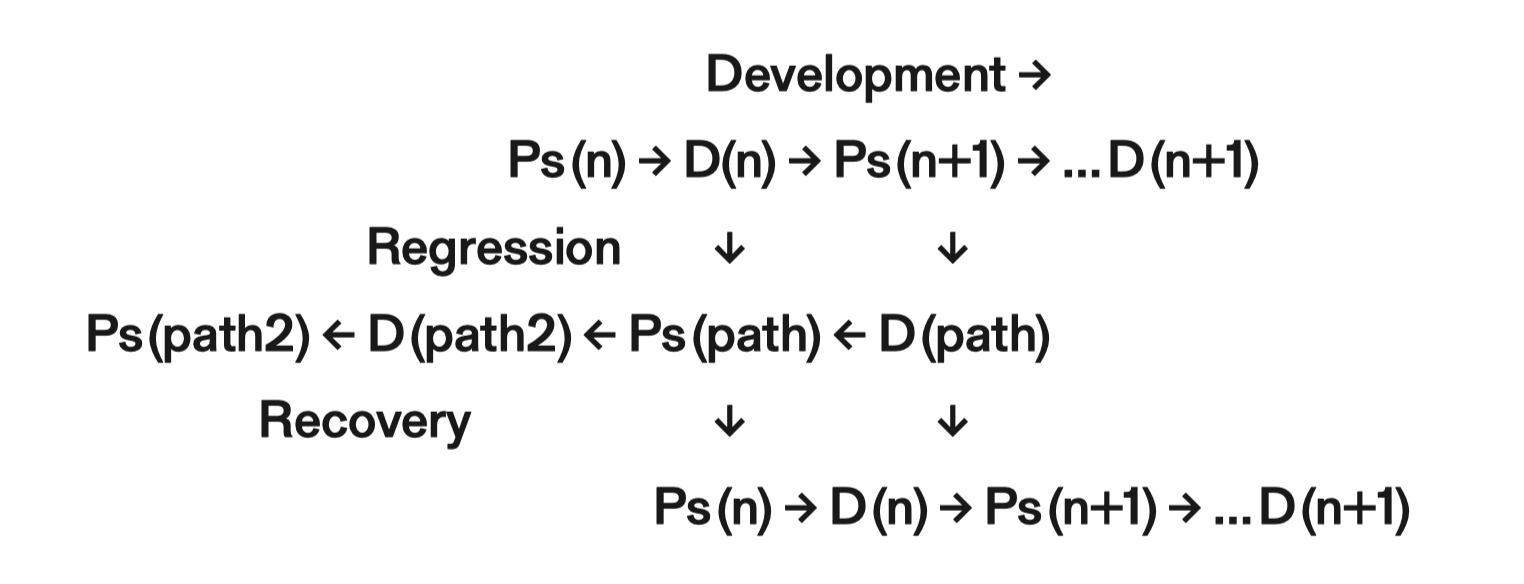
When an individual or a group encounters ideas or an experience that question their framework they have to tolerate the dispersal and threatened loss of meaning in the hope that a D(n+1) will emerge. A concrete example was the case of the Praxis Group. The group had developed a framework together over a period through reading together and engaging in struggles and movements. The battle over the new ideas resulted in a division of the group into those representing an Establishment and those inclined to engage with and partially accept the new ideas. This process, including the conflict, was potentially part of a forward development. However at a certain time the pain and discomfort of the loss of cohesive functioning became too much. The Ps(n+1) became a Ps(path) state where action instead of thinking was used to deal with the problem, by getting rid of the disruptive elements. The D state that was returned to can be seen as D(path) because it was not a new achievement involving loss of the old but a retreat to an earlier position which was now a defensive organisation excluding rather than incorporating the new material that was being grappled with in Ps(n+1). The frustration had been evaded rather than tolerated.53
Holding on to a state of integration and meaning that may be coherent but is no longer adequate is a feature of most political groups. Most of what presents itself as revolutionary or communist theory has been held on to “past its time”.
Political Ps
In the model we have been describing, the sense of controlled Ps moving towards the achievement of a new D involves a kind of wait-and-see attitude. Bion adopts Keats’s notion of “negative capability” to describe the necessary posture.54 It means being open to new experiences and new ideas, accepting that one doesn’t know and that opposing views might be correct. Ps(n+1) involves refraining from decision until one is able, perhaps through the emergence of a “selected fact”,55 to bring together and make order out of the chaos in a new whole.
A difference between the post depressive-position Ps(n+1) and the original infantile Ps or the regressed Ps(path) is that in Ps(n+1) one as much as possible does not engage in splitting. This is appropriate for the analyst who is calm and almost disinterested in his drive to understand but not to judge or even change the patient. Hoggett, drawing on Meltzer, suggests that there is a different and still healthy way that the paranoid schizoid mechanisms (including splitting) must be mobilised. When engaged in struggle reality is not a “given” which must be understood dispassionately but a process of becoming which must be engaged with. Acting on and in the world is sustained by a passion—“anger, grief, hope”—which is, as he notes, “based on a certain degree of splitting”.56 We cannot just be “in doubt and uncertainty”, which implies movement towards the maturity of the depressive position, for at times we must risk acting, at which point we abandon the openness to a new depressive position and commit ourselves to one course of action that excludes others. As Donald Meltzer suggests, at times the “irritable reaching after fact and reason” that Keats abjures is in fact required because:
splitting processes are necessary for the kind of decisions that make action in the outside world possible. Every decision involves the setting in motion of a single plan from among its alternatives; it is experimental involves risk, a certain ruthlessness towards oneself and others.57
This is another way of thinking about Ps and D. Those involved in politics even “radical (anti-)politics” have a propensity for the splitting into good and bad, friend and enemy, of the paranoid-schizoid position. Much of the unpleasant group stuff, the understanding of which in part motivates this text, reflects the proneness to the paranoid schizoid position within this space. The observation of this can be part of “pathologising the political”, but while it can certainly be pathological, the paranoid-schizoid mode may also perform a necessary and valuable role in the development of both individuals and groups.58
Hoggett points to a creative and experimental use of the paranoid-schizoid position, which can figure as more than a mere stage before a new depressive position takes hold. He points to the fact that a decision to act involves a suspension of doubt and openness towards other courses of action and perspectives. Indeed, while a claimed need for action is often used against thinking, it is also possible when one needs to act to instead “retreat into thought”. In action there is a risk, potential costs to oneself and others, and thus as Metzler suggests a certain ruthlessness towards both is required. The uncertainty and tolerance of doubt in one’s position is no longer functional. In periods of struggle this kind of creative use of the paranoid-schizoid position, this kind of certainty and commitment to one point of view, is necessary;59 but it needs to be tempered by moments of reflection and openness and a possibility of reviewing one’s course of action in relation to its results or lack thereof. When the dust clears, the point is to be ruthless with oneself about what the success or failure of any initiative one took could tell us about the nature of the struggle in which one was involved and the stance one has taken in relation to it. This is to move from a necessary period of active Ps back into controlled Ps and D.
Mystic and Establishment
One of the key concepts that we found in Hoggett which seemed to illuminate our two cases was the idea of the Establishment within the group. In the Praxis Group we described a conflict between an established orthodoxy within the group and new ideas. In the Theory Group we described a group functioning creatively without much of an Establishment but that this was unstable, leading to crises which eventually necessitated the creation of a sort of establishment.This use of the term “Establishment” derives from Bion. In a book published in 1970 he notes the way that the term Establishment has become used to describe that “body of persons within the State” who exercise power and responsibility and writes:
I propose to borrow this term to denote everything from the penumbra of associations generally evoked, to the predominating and ruling characteristics of an individual, and the characteristics of a ruling caste in a group (such as a psychoanalytical institute, or a nation or group of nations).60
Bion pairs this notion with another concept, that of the “mystic” a figure he says could interchangeably be termed the “genius” (or even “messiah”). There is, Bion writes,
an emotional pattern that repeats itself in history and in a variety of forms [...] of an explosive force within a restraining framework: For example the mystic in conflict with the Establishment; the new idea constrained within a formulation not intended to express it; the art form outmoded by new forces requiring representation.61
This pattern, like that of container and contained (which it is an example of), is a somewhat abstract one that can unsurprisingly be seen in all sorts of places. Bion was prompted to think about the mystic/Establishment pattern by his experience of the institutionalisation process of psychoanalysis.62 It seems useful to think about it in relation to the communist group.
The Establishment describes a conservative structure in the group (or the individual mind) composed of the containing force of old ideas. By “mystic” Bion has in mind the creative/disruptive force of new ideas (and those who express them). The ideas in question could be scientific, artistic, religious, political, psychoanalytic — whatever represents a profound break from existing dominant ideas and paradigms and opens a new way of thinking in any field. For Bion the mystic/genius can take the form of a specific individual or individuals, but it can also be seen as something less personal — the “flash of genius”, the moment of creative insight that any individual “should be ready to produce” at some time.63
Bion includes in the mystic/genius category such figures as Galileo, Newton, Freud, Shakespeare, and Marx, but also actual mystics: Jesus, Meister Eckhart, Isaac Luria. The common pattern is the way new ideas and those who represent them challenge the established conventions of the group in which they emerge. New ideas are perceived as disruptive (and even destructive) of the group; they can be perceived to threaten a catastrophe, but they are also necessary if the group is to develop. Bion think s it is a proper function of the Establishment to create an environment in which genius, whether it be the particularly gifted individual or the “flash of genius” that any of us can have from time to time, is able to emerge.
However, this function comes in tension with the Establishment’s other purpose which is “to find and provide a substitute for genius”.64 Because mystics or mystic flashes are in short supply, the Establishment makes up for their absence by promulgating “rules”, “dogmas”, and (scientific) “laws”, that allow knowledge to be had and to be conveyed without group members having to create it themselves. In creating and enforcing such rules the Establishment allows group members “a sense of participation in an experience from which they would otherwise feel forever excluded”. However, as Bion notes, the problem is that these rules (or dogmas) must at the same time maintain a continued supply of “genius”:
This cannot be ordered; but if it comes the Establishment must be able to stand the shock. Failing genius, and clearly it may not materialize for a very long period, the group must have its rules and a structure to preserve them.65
Bion suggests that relations between the mystic and the group can take three forms: parasitic, commensal, or symbiotic. The difficult relation of the three actual mystics Bion has mentioned to their religious Establishments shows these three forms in a clear light. In the parasitic relation, the relation is destructive: the creative new ideas are either crushed by the rigidity of the container or the container is blown apart by the power of the new ideas (Jesus crucified by establishment). In the commensal relation, the old and new ideas manage to exist alongside each other, but without really affecting growth in either (the Christian Establishment tolerates mystics like Eckhart without the church being changed by them). In the third relation — the symbiotic — Bion writes that “there is a confrontation and the result is growth-producing, though that growth may not be discerned without difficulty”66 (the Hasidic movement in relation to Rabbinical Judaism). He suggests that, as well as within the group, these shapes exist within the individual and can also be played out in the encounter between different individuals and groups. Just as a group may reject a new idea and the person who expresses it as something they are unable to contain, an individual may reject a new idea as something he or she is not able to bear. As with the development of thinking in general, we are dealing with something that can be intra-individual, inter-individual, intra-group and inter-group.
Though it might be tempting, it would make little sense, in relation to the communist groups (or even groups more generally) to simply take the side of the mystic/genius. The Establishment’s resistance to mystics and their dangerous ideas is necessary. One reason is that most new ideas are not better than the old, and some are destructive, which Bion evokes in the figure of the nihilist mystic. Even when there is something important in the new ideas, they need to be tested. It is the creative tension between new ideas and the old, the mystic and the Establishment, that may produce something worthwhile, while if the new impulse meets no resistance, it may dissipate itself in formless splurge.
Bion’s term “genius” may meet with scepticism in communist circles, as it appears to be a rather bourgeois individualist notion.67 However, the apparent tension between Bion’s concern for the fate of the individual thinker68 and a Marxian idea that ideas are produced by the class struggle is perhaps not so insurmountable. An important part of Bion’s understanding is that creative individuals do not produce their challenging ideas from their own minds, but instead create links that make sense of experience, giving expression to new ideas that have a social or transindividual source.
Moreover, Bion’s seemingly individualist concept of genius or mystic needs to be placed in the context of his profoundly non-individualist notion that true thoughts are not the product of the individual thinker but that, instead, the individual gains his significance by being able to entertain them. The genius for Bion is not someone who invents things from his own brain, but one who opens up to the ideas that are there to be expressed.
Yet breakthroughs to a revolutionary new way of approaching reality, opening a new field or problematic, are often linked to an individual.69 Bion’s reflections on these questions are prompted by Freud and the psychoanalytic establishment(s) created on the basis of his work. Marx would seem to be clearly, in Bion’s terms, another such genius/mystic, upon whose legacy a new Establishment or establishments have been produced. Interestingly, however, one of the few recorded remarks that Bion made on Marxism was that (at least as a theory) it had “approximately achieved”70 (along with Sufism!) doing without an establishment.
The idea of Marxism doing without an Establishment might seem odd. Hasn’t Marxism often been compared with religion in a negative sense? Wasn’t Kautsky referred to as the “pope of Marxism”? Didn’t the parties of the Second, Third and Fourth Internationals operate by way of an established orthodoxy with the same conformist modes of thinking and exclusion of heresies? Hasn’t doctrinal dispute often been settled by appeal to quotes from infallible scriptural authority? Marxism certainly seems to have had its own establishment(s), both in the sense of institutional authorities like parties and even states, but also in the less obvious sense of the rigidities of thought even those who see themselves as independent Marxists often fall foul of.71
Yet as we suggested in part II, Bion’s suggestion that the theory of Marxism has “approximately achieved” the avoidance of the Establishment also captures something. The critical impulse of the communist theory expressed by Marx — a thinking open to the “raw material of reality” — has never been entirely contained and stripped of meaning by the various worldviews, parties, schools, traditions, and orthodoxies that have been established in his name. Within, outside, and against these currents there have always been critical, heterodox forms of thinking that have clashed with the conformist use of Marx. Indeed communist theory has not been without its own supply of new genius, though the critical impulse of thinkers like Luxemburg, Pannekoek, Bordiga, Korsch, Lukacs, Pashukanis, Rubin, Bloch, Adorno, Debord and Camatte, and the fresh take on reality they provide, has often, in turn, been a basis for new establishments.72 Such thinkers are a product of their times (notably the two revolutionary waves that characterised the 20th century) and often they themselves fall back from their more interesting and revolutionary positions in the period of retreat.
To place Amadeo Bordiga in this line of mystics/geniuses might seem odd. After all, Bordiga himself insisted that he had not created anything new. He rejected “the banal idea that Marxism is a theory ‘undergoing a process of continuous historical elaboration’ that changes with the changing course of events and the lessons subsequently learned”, and instead asserted what he called the “Invariance of Marxism”.73 In the period after the defeat of the post WW1 revolutionary wave and the failure of WW2 to end in a similar wave, Bordiga saw his task and that of the group who gathered round him as essentially one of defending this doctrine until better times.74
While we have emphasised the need to be willing to change one’s framework, Bordiga railed against those who would change the Marxist framework too easily. Writing in the fifties, he divided the opponents of the “Marxist doctrine” into three broad groups: the deniers — the bourgeoisie for whom the market and commodity production are eternal; the falsifiers — the Stalinists and others who claim to be Marxist but practice a social democratic reformism; and the modernizers — those who still claim to be revolutionary but think the doctrine needs to be modified. He reserved some of his heaviest critique for the latter group with Cardan (Castoriadis) of Socialism or Barbarism being a frequent target. Thus just as he rejected those who would moderate Marxism by emphasising peaceful and democratic methods, he scorned those who claimed to still be revolutionary but saw a need to modernise the conception of capitalism by defining it, or at least its Eastern bloc variant, in terms of bureaucracy.75
Bordiga would thus appear to reject our emphasis on doubt, receptivity to the new, negative capability and theory as open or good conversation.76 Bordiga indeed seems not so much a mystic as the promoter of an Establishment, a rigid doctrine. What figures like Luxemburg, Pannekoek or Debord see as the creative discoveries of class struggle — the Paris Commune, the Soviets, modern forms of revolt etc. — are for Bordiga ways in which a renewal of the class struggle allows the theory to return “with affirmations reminiscent of its origins and its first integral expression”.77
But we know that claiming to fulfill the law and not abolish it is a venerable role for the mystic.
In Bordiga’s writings, along with statements of rigid tactical doctrine that seem on the surface not so different from (other) versions of Leninism,78 we find an extraordinary communist vision, including the rejection of self-management and a prescient grasp of capitalism as an ecological crisis. Bordiga’s thought expressed the high points of the post WW1 revolutionary wave and held it when most other Marxists capitulated one way or the other. He knew the difference between capitalism and communism, something that, with few exceptions, isn’t understood by social democrats, Marxist-Leninists, Trotskyists, democratic and libertarian socialists.79
Bordiga and his group kept something communist alive in a period of the defeat of the revolution, and they did so through a certain doctrinal rigidity This rigidity served a protective function. However, while Bordiga himself was able to develop theory within this shell, most of his followers were not. Their rigidity meant that they were largely unable to connect to the new revolutionary wave that rose in the 1960s.80 It was through the work of the quintessential communist mystic Jacques Camatte that the insights of Bordiga spread to the new movements which arose especially in France and in Italy.81 Yet by that time Camatte had been marked as a heretic among “Bordigists”.82
Camatte’s relationship to the Italian Left has similarities with Bion’s relationship to Kleinian psychoanalysis. The latter has been known, like Bordiga’s Marxism, for a certain rigidity or dogmatism. However, it was through and with this rigid Kleinian apparatus, which he made his own, that Bion developed his creative breakthroughs. Similarly it was through absorbing the intransigent Marxism of Bordiga that Camatte made his own leaps. The relationship between Bion and the Kleinian group was at least for a number of years probably a symbiotic one, but he found it necessary to escape the group in which he had at first been able to develop. Beyond the constraints of the groups that had produced them, both Camatte and Bion were able to produce more freely (with some wondering if their production became a bit too free).83
Despite Bion’s intriguing idea that communist theory (like Sufism) can approximately do without an establishment, we can see in these examples that groups and individuals — who are always part of groups if only the many groups we connect with in our minds — necessarily produce establishments as part of the limits and containment of their thinking. Often, such a container is adequate to get on with things. The point is, without seeking out novelty for itself, to be open to the expression of new things, which requires breaking or modifying such limits of our thinking.
An Ending not a Conclusion
By its nature this is a work in progress. As there must be for now be an ending, if not a conclusion, let us attempt to tie our threads together.Our starting point was that communism is and will be “the intense and unpredictable struggle for life on the part of the species”. If the communist group at one level is all those — millions even billions — who have been, are, or will be involved in that struggle, then that also includes us, right here, right now, feeling moved to be part of this struggle and to do what we can. This involves us connecting with small numbers of others to think about capitalism and its possible overcoming.
We are admittedly a bit unusual (“deviations” as Moss put it). For accidents of our personal history, we have, like Marx, found that the ideas of communism “which have conquered our intellect and taken possession of our minds, ideas to which reason has fettered our conscience, are chains from which one cannot free oneself without a broken heart: they are demons which human beings can vanquish only by submitting to them”.84
These ideas are not personal possessions but something impersonal, transmitted through the generations. Communist theory is an apparatus for thinking the experience of life dominated by capital and the movement beyond it. Some take up this apparatus, making it theirs for as long as they are able.85 They may, in the process, succeed in adding some new true thoughts, which increase the capacity of the apparatus in relation to the evolving experience that it attempts to contain. At its best this process is international and self correcting. We have suggested Gunn’s model of the “good conversation” for the way that it develops. In Gunn and Wilding’s more recent work we also identified a tantalising suggestion of what might link the conversations of the willed small groups we participate in and those that occur in the spontaneous group processes of revolution.
At a certain level, the communist group, in whatever way it exists, whether as an actual group or as the theory we adopt from reading or engaging with others, is an example of a container or apparatus for thinking. We always need others to talk to. At the same time, with our case studies of small group life we pointed at some of the problems that arise in this small world we inhabit. We expect that others have their own stories. Such tales reveal that attempts at good conversation often meet obstacles and tensions within the group. Dealing with such tensions can make severe emotional demands. While coming together with others is necessary and rewarding, the groups that we form often seem to involve swapping the pathological solitude of the Ego for the pathologies of small group life.86 This is understandable, because the group or collective in capitalist society is no less a part and product of capitalist society than the individuals of which it is composed.87 Reflection here can benefit from drawing on the theory of the unconscious, which can be understood not as something personal and individual but a social and transpersonal phenomenon. Groups bring out the unconscious and make it visible. A psychoanalytic take on groups and on thinking offered by Bion and others helps make sense of this process. our process.
The recurrent tension is between the universality of what we want and the particularity and limits of who we are as individuals and small groups. The stakes seem so different but at some level we sense that they are the same. The healthy impulse is to focus not on who we are as a group but simply on the tasks we set ourselves.88 However, the pathologies of communist groups can at times be more interesting than what such groups produce, because it tells us something about capitalist life itself.
We do not produce struggle or revolution, we are produced by it. This is why the periods of the most creative leaps in thinking have occurred at the time of revolutionary moments and waves (1848, 1871, 1917-21, 1968-71).
What Marx calls the “party of anarchy” makes its reappearance from time to time.89 Though those who produce Endnotes did not actively participate in the struggles of those years listed above, we, and the world we live in, were shaped by them, their measure of success and their defeat. These events and cycles of struggle have tended to be followed by much longer periods of more stable capitalist development and more limited struggles. The capitalism we face today learnt the lessons of those struggles and restructured itself accordingly. Thus, we do not need to pass on to the working class lessons from those years, for the relation with capital they live today contains all the lessons of history that they need.
We, however, find something useful in looking back. A large part of the communist theory we have inherited was a product of the encounter of a container — councilist, situationist, and “Bordigist” thought — with the “contained”, the new experience of the struggles of the last revolutionary wave and their defeat. Such theory was tested, and while some concluded that reality was guilty of not measuring up — the working class did not produce councils or join the(ir) party — others were able to transform the theory to better express what this wave and its defeat was telling us. The burst of theoretical development had largely concluded by the end of the 70s. However, just as with the small groups of “Bordigists” and council communists after the previous revolutionary wave, some of those who were turned communist by the revolutionary period did not go over to the counter revolution but rather theorised it and the restructuring that accompanied it.
We have been drawn to this theory, and we attempt to contribute to it. Our lives too have not been without their moments and cycles of struggle, such as the anti-globalisation movement at the turn of this century, the movement of the squares in 2011-2013 and what may be a new global wave unfolding at the time of writing. The instability of our times assures us that there will be plenty more.
We can imagine that some readers of Endnotes may at times have asked themselves: “Well that’s all well and good, but what do you propose we actually do?” The perceived alternative seems to be of “revolutionary intervention” or “attentism”,90 there is either a revolutionary communist way of relating to struggles or one should not be involved at all. Theorie Communiste provide us with a helpful way of cutting through this false alternative:
In the meantime, neither orphans of the labour movement, nor prophets of the communism to come, we participate in the class struggle as it is on a daily basis and as it produces theory.91
This idea that it is not we but the class struggle that produces theory reminds one of Bion. Of course this leaves a lot open — for example, what class struggle is participated in, and how is the theory being produced by the class struggle recognised.92
There is no revolutionary way of engaging in struggles unless of course those struggles are revolutionary. This does not mean one should not be involved in “non-revolutionary” struggles. However, one can only relate to struggles according to their limits. Being involved may help you to find those limits, allowing one to make sense of them in ways that non-participants cannot. However, involvement may also lead one to deny those limits, and to be only interested in ideas that support one’s own illusions. Illusions or myths are a necessary part of group life, allowing a creative escape from the given into the realm of the possible, of the ”not yet”, but at times dis-illusionment is also necessary for moving forward.
Openness is not just about being open to the ideas of self-identified communists and revolutionaries. We wish to be open to moments of genius wherever they may be found, in all forms of “scientific” thinking (in a broad and not reductive sense as a search for truth). Marx’s motto was “nothing human is alien to me” and it would be absurd for communists to limit their interests and concerns as if they “were workers specialised in a particular art instead of aiming at devoting themselves to the whole universe”.93
Communist theory has a universal significance. It expresses a will to life on the part of humanity against capital, a force it has created and continues to create which threatens its destruction. At the same time those trying consciously to think it are just individuals and small groups doing what we can.
A guiding thought for those engaged in such a task:
The group must be capable of maintaining the dominance of its own depressive attitude. This means, despite its sense of vision and grandiosity, retaining the capacity to keep a sense of perspective and, hence, knowing that what might be created will not be perfect but could be good enough.94