Reflections on October 17
French original published on October 22, 2026
This past October 17 went beyond many of our hopes. Although many of us no longer really dared to believe in such a upsurge, we were given one of those memorable days when time seems to flow differently. One year after the stinging failure of the “Bloquons tout” (“Let’s Block Everything”) mobilisation of September 10, confined to the narrow in-group of the “peuple de gauche” (“the Left’s people”), the outcome of the day seemed more than uncertain. Yet its relay in spheres beyond the usual suspects of protest-going public and, more importantly, the emergence of a high school movement at just the right moment managed to whip things up spectacularly, allowing that cold October Saturday to burst into history.
The high school mobilisation had begun right from the start of the school year in the overseas colonies, particularly Mayotte, then French Guiana, Martinique, Guadeloupe and Réunion, before it began in the Paris suburbs [“banlieues”] on September 17. Blockades, the form of predilection of high school mobilisations, quickly spread across the whole of mainland France (the “Hexagon”). Through the high school movement’s spectacular actions, the October 17 call gained momentum on social media and beyond, somewhere between a revival of the Yellow Vests’ imaginary and a potential outlet for venting anger at the government and the cost of living.1
In our last text, we looked at the pacification mechanisms put in place within the movement: paternalism, the institutionalisation of demands and calls for “convergence”. It seems today that some of them have been overtaken by Saturday’s mobilisation: the question of violence, which terrifies the bourgeoisie, has once again swept aside those who tried to set themselves up as spokespeople for a movement that is no longer solely concerned with the disinvestment in public services, but has taken on a more diffuse character revolving around the reproduction2 of labour-power in general.3
Police Rout
It will come as no news to anyone that what happened was unprecedented. Even if, sadly, we have not really left the contemporary era, we are talking about at least 3,000 shops looted or vandalised, as well as many public buildings attacked, even set on fire. Even more eloquent, the events blew apart the coercive spatial arrangement to which national days of action are traditionally confined, concentrated in a handful of metropolitan areas. Almost every city, large or medium-sized, was swept up in this wave of property damage and looting. In the vast majority of the repressive units deployed, officers were injured, some of them seriously. Everywhere, city centres were turned upside down: barricades built, bourgeois barricaded indoors, luxury stores stormed and goods handed out in the street with joy.
Beyond the tally and the spectacular actions of the rioters, we would miss the point of the day if we did not mention the euphoria that seized the crowd, turning the classic discourse of the social movement into a contest for the funniest Snapchat video. While a burning car serves as a barricade facing a line of CRS riot police pelted with stones non-stop for two hours, images circulate on social media of the prefecture in Caen being stormed, a police station ransacked in Marseille, the apartment of the Bordeaux prefect trashed, and, of course, the insipidious town hall of Limoges devoured by flames. While some stage themselves as cashiers in a supermarket being looted, others threaten a hairdresser that they will come back if he does not lower his prices. While a looter hunts for oats for his body building-style diet, the champagne bottles of a wrecked Nicolas wine shop [a French wine-store chain] are used to celebrate Verstappen-style. All this, and more, with no limit other than the rioters’ imagination, was taking place simultaneously, at the initiative of tens of thousands of individuals reinventing a way of interacting with a surrounding world that keeps their everyday lives in check.4
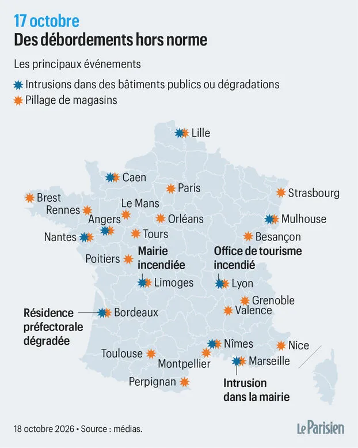
Can we say that what happened was unprecedented? In our last text, we pointed out that the most offensive forms of struggle look much more like those we saw in the riots following Nahel’s death than like the Yellow Vests’ mobilisations. Today, we can acknowledge these similarities, whether in the geographic breakout5 compared with 2005 or in the resort to looting. It is worth noting, however, that this spread of urban riots into city centres became widespread and blended with other practices and slogans. We also saw gatherings around seats of power and muscular dérives through wealthy neighbourhoods, more typical of the Yellow Vests.
What seems certain is that the intensity of the repression is unprecedented. In a single day, more than 1,800 arrests were made, a toll that rose to 2,300 the next day after the most braves decided to carry on the fighting. Following its bloody path, the police maimed a number of demonstrators across France, and probably killed two people in Paris over the weekend6 . In the first rulings, the State is already showing its firmness, handing down more and more unsuspended prison sentences and systematically ordering pre-trial detention at the end of immediate-appearance hearings [comparutions immédiates]. At the time of writing, 917 people have been brought before the courts, 174 of whom have been jailed7 . These figures are even slightly higher than in the crackdown on the riots that followed Nahel’s death, which had already reached a historic level.8
Once again, repression seems to serve as a lifebuoy for the Left, which, faced with the movement’s conscious embrace of violence, lets it renew its discourse of victimhood. The march had not even ended when Jean-Luc Mélenchon was already complaining about the kettling and the charges at Place de la République. He thus blames the government for every excess, but it seems clear to us that looting, destruction and fires are modes of action knowingly chosen by a section of the proletariat in struggle. The Left can weep over its lovely peaceful march; we would remind it that October 17 had not been promoted on social media as a walk in the park but as a “purge”. Anyone who went could only embrace the confrontational nature of what was going to unfold.
If we add the “revelations” concerning intelligence reports9 about La France insoumise (LFI) to these postures of victimhood, all the ingredients are now in place for concocting a new conspiracist discourse on the Left. Beyond the usual refrain about the so-called “casseurs” (“rioters”) who are supposedly undercover cops in disguise10 , many now seem to imagine that the police were not routed by mass actions, but that it was the State itself that organised the disorder. Yet while, at first glance, the figures suggested a weak police deployment11 , in the end it was nothing of the sort, particularly compared with other events. There is therefore no reason to believe that the State deliberately engineered a shortage of resources and under-mobilised the police, unless one thinks that the images of the capital in flames going around the world “suit the government’s interests very well”.
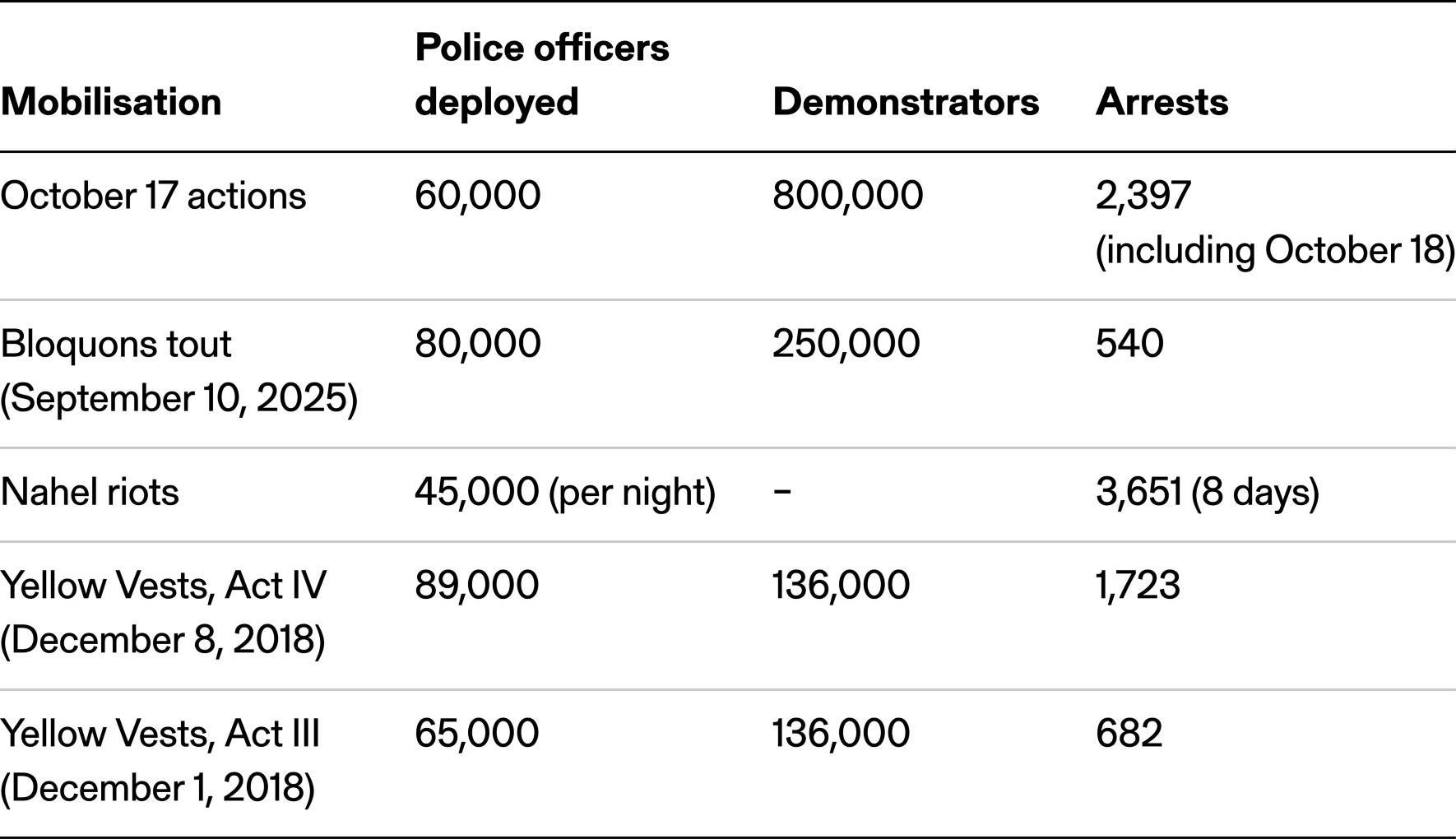
In spite of their combativeness, the Yellow Vests were defeated by the Philippe government, as was the movement against pension reform. More recently, the Bloquons tout mobilisation was a complete flop. The government had every reason to think that the high school movement was running out of steam, with blockades declining and wildcat demonstrations dwindling as the holidays approached. As for the remnants of the labour movement, their apathy has been demonstrated often enough. Was it not more plausible, then, that the government had succumbed to hubris12 ? We are not privy to the inner workings of the government, but we cannot take it for granted that the territorial intelligence services and the DGSI [Direction générale de la Sécurité intérieure – General Directorate for Internal Security] are infallible. If they claim to have been more or less accurate in their forecasts concerning the Paris metropolitan area13 and the mobilisation of the “ultra-left” [l’ultra-gauche], they admit to having underestimated the risk in other cases. All this shows just how unpredictable this spontaneity was, and how it worked against them. Moreover, the police had already been worn down by weeks of high school protests, which may have affected the number of officers immediately available.
Only a mind softened by rabid pacifism and the rhetoric of La France insoumise could imagine that the State would create the conditions for chaos in order to conceal demands. Why would the State want to appear overwhelmed in order to render invisible demands it can simply continue to ignore? Clearly, the leader of LFI is particularly afflicted, since he seems to think that all this commotion is about him14 . No one can believe that the State would have any interest in letting this happen when its political and financial credibility is under strain — more on this later.
As with the high school movement, it seems to us that this kind of discourse has only one aim: to make people forget that a riot like this is a major event in class struggle. Here again, the targets of looting leave no room for misunderstanding: luxury stores, gold-buying shops, but also supermarkets, clothing shops, tobacconists, restaurants, manga and video-game shops, etc. Taking commodities straight from the heap [“prise au tas”] makes it possible to overcome an impasse in the reproduction of the proletariat.
If, for many, attacks on “small shopkeepers” are unjustifiable and harm a movement that does not match their expectations, we must remind them that class struggle is a social war. In moments of confrontation such as these, when the armed force of the bourgeois State loses control of the streets that it and commodity rule over for the rest of the year, it is hardly surprising that the proletariat should seize what it is dispossessed of in its everyday life. Everything that can be looted goes, from the optician’s to Bershka by way of the neighbour’s Lycamobile shop. The fact that the proletariat does not limit itself to luxury stores or banks shows that, in such moments, the struggle against capital is not symbolic but immediate. It certainly still aims at the social reproduction of its own situation, but this time by taking whatever it wants. The State will give up nothing, and everyone is more or less aware of that. All that the struggle has to offer is what it produces in the course of the struggle itself; that is why the question of the “legitimacy” of looting in relation to the movement and to what it might convey to “public opinion” does not arise.
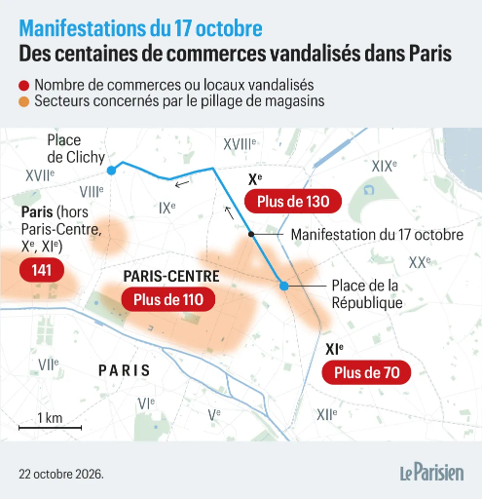
It is therefore clear that the police suffered a heavy defeat. In the case of Paris, which we know bestthe cops were outnumbered by a multitude of actions that stretched its operational front to the point of rupture. The policing operation was also physically suffocated by the sheer size of the crowds of demonstrators in the cops’ path. The police could not at once supervise the declared route leading to Place de Clichy, protect seats of power from possible incursions, hold an intense and uninterrupted confrontation for more than four hours around Place de la République, and chase dozens of groups across an area covering more than five arrondissements. Moreover, the police response cannot be considered separately in each city, since each was experiencing its own share of uprisings, limiting any redeployment of personnel and equipment.
Unity in Separation
Following our article on the high school student movement, Greek comrades from Antithesi sent us a critique, which we are sharing here:
The text by the Artifices collective that follows, presented here in a provisional translation, offers a pertinent critique of attempts to place school students’ struggles under tutelage and to portray those taking part solely as defenceless victims of repression. Solidarity requires recognising them as subjects of struggle, with initiatives and decisions of their own. We nevertheless consider it necessary to express certain disagreements with its analysis. These concern the notion of interclassism and the rigid separation between demands and revolt, but, more fundamentally, the conception of class implicit in the text.
Describing a school student movement as “interclassist by definition” takes for granted precisely what needs to be examined. Classes are treated as already constituted social categories, into which participants are sorted according to their backgrounds, educational attainment and prospects. Behind the contrast between students at vocational schools and those who retain access to higher education lies a sociological notion of the “middle class” and, by extension, of class in general. Differences in income, qualifications and social position are turned into class divisions without examining whether they correspond to different relations to capital. Access to university, however, does not remove the need to sell one’s labour-power. Nor do the profound inequalities within the proletariat in themselves prove the existence of different classes.
The problem cannot be resolved simply through a more precise sociological classification. In Marx’s critique, class is a category of the antagonistic social relation and of the struggle that develops within it. An objective position in the production and reproduction of social life constitutes a material condition of this antagonism; it is not, however, sufficient to account for class as a subject of struggle, nor does it predetermine how that class will act. Common class practice takes shape through conflicts, solidarity and attempts to overcome the divisions imposed by capital. The proletariat’s revolutionary potential lies in the negation of the relations that constitute it as a class, and thus in the abolition of the proletarian condition itself.
From this standpoint, the question “what does a postgraduate student have in common with a vocational school student?” turns an existing division into an insurmountable barrier. It overlooks both the dependence on capital they may share and the possibility of recognising and fighting against that dependence through struggle. Although the text acknowledges that there is no class “purity”, it ultimately tends to assign a predetermined political stance to each social category: revolt to the most excluded, demands and integration to the rest. The rejection of existing society thus appears almost as an inherent attribute of the most impoverished. Social position takes the place of an examination of the actual content of the struggle.
The same schematic approach runs through the separation between demands and revolt. The same people can demand more teachers, occupy their school and clash with the police. Demanding better educational conditions does not necessarily imply faith in meritocracy or upward social mobility. It may express proletarians’ refusal to accept a further deterioration in their lives. The fact that schools contribute to the reproduction of capitalist relations does not exhaust the meaning of what takes place within them.
Similarly, the claim that any partial improvement is now impossible turns a historical tendency into an absolute given. The narrowing scope for concessions does not prove the futility of every demand. Nor does revolt against the police in itself constitute a break with capitalist relations. Struggles over demands can be absorbed into the existing order or open up broader conflicts; uprisings, too, can spread, become isolated and exhaust themselves, or even take reactionary turns, as the historical experience of the past fifteen years has shown. When struggles move beyond their initial demands, they do so through the experiences and contradictions of fighting to meet real needs. Such a development cannot be secured by rejecting those demands in advance.
This is also why a critique of manipulation by political parties and trade unions does not justify dismissing every attempt to bring different struggles together. The coming together of school and university students, workers and unemployed people can be a process through which class is constituted, as they challenge the divisions between them in practice. The content of this process must be judged by whether those engaged in the struggle themselves determine its course on the basis of their needs. The question is how the struggle can broaden and turn against the relations that generate exploitation and divisions, without becoming subordinated to alternative projects for managing capitalism. Elevating one particular proletarian condition and one form of action into the sole bearers of radicalism rules out precisely this possibility.
Such a conception ends up reproducing, at the political level, the divisions imposed by capital. Those who do not fit the image of the impoverished insurgent are written off in advance as destined for integration into the existing order, while the possibility that they might become radicalised through common struggle is erased. The insurgents themselves are treated as a revolutionary subject only insofar as they remain separate from other proletarians and persist in the forms of action that the theory recognises as authentic. The denunciation of tutelage thus returns as theoretical tutelage: those engaged in struggle are judged according to whether they conform to the role assigned to them.
The crucial question raised at the end of Antithesi’s contribution is that of the modalities through which the class is constituted15 , and thus of the overcoming of the segmentations of the proletariat through and during the insurrection. We fully subscribe to this necessity. When we spoke of the counter-insurrectionary character of the so-called “convergence of struggles”, this was not an abstract or principled critique, but a concrete critique of the very content of the convergence as it was beginning to take shape.
In Paris, this was indeed the case during the October 17 mobilisation. Although everything took place on the same day, the various forms of action remained separate. The first separation was from the demonstration organised by the old labour movement, that is, the trade unions and left-wing parties. This took the form of a conventional march, in which one could immerge oneself without even noticing what was happening anywhere else. Meanwhile, clashes with the police and demonstrations outside any police control were taking place. It is also strikingly obvious that looting only became possible late in the afternoon16 , while wildcat demonstrations were trying to make their way to the Élysée.
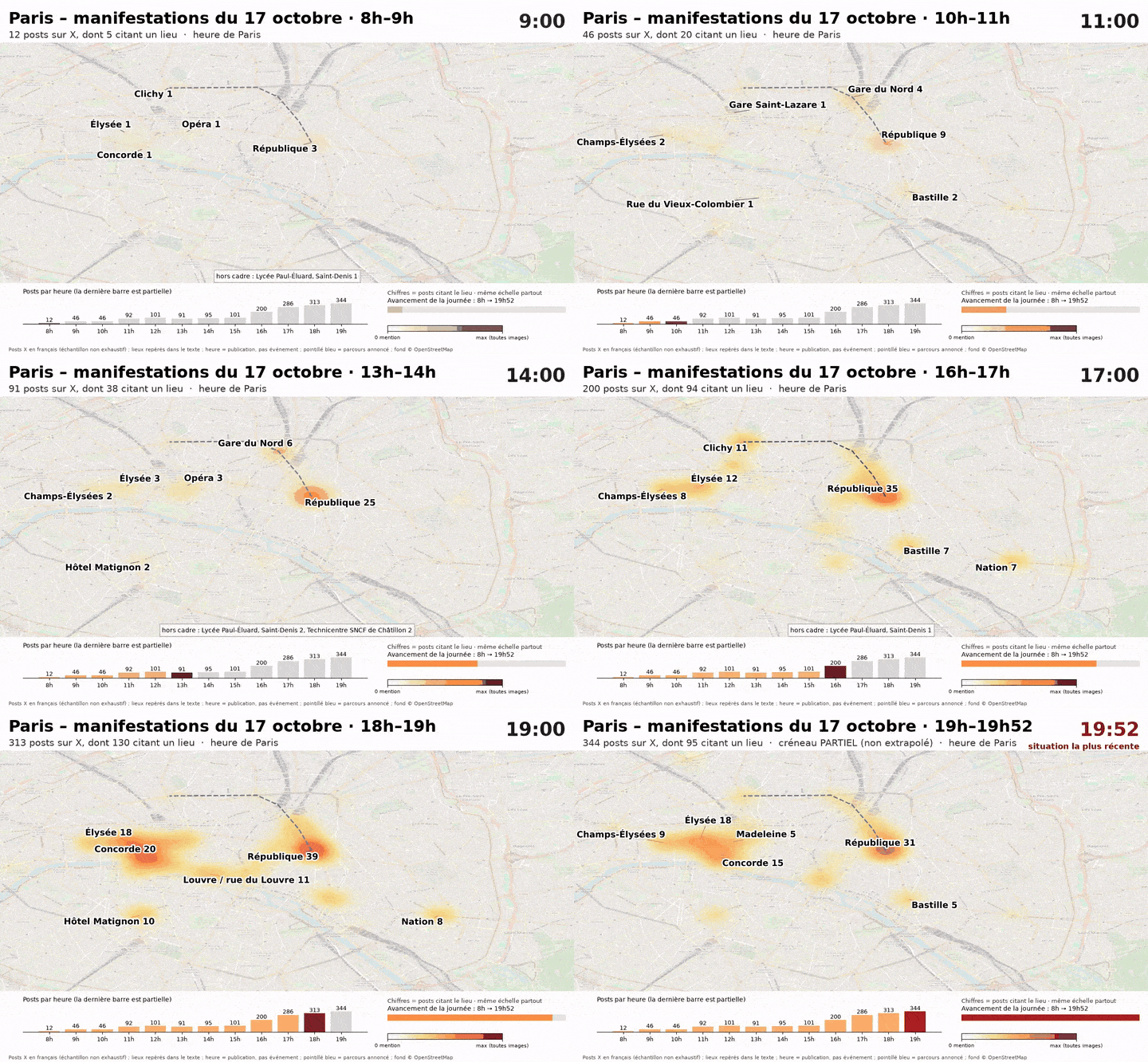
We could therefore ask another provocative question: on that day, what did a teacher marching from République to Place de Clichy have in common with a teenager from the banlieue who went home with a whole new wardrobe? We do not want to idealise a social position or even a practice — without denying ourselves a soft spot for the latter — but to understand how certain practices still reflect positions within the relations of production, even though they take place side by side. Convergence can be decreed on a day of mobilisation, but the constitution of the class through its crisis activity obeys a historical necessity.
To infer the constitution of a revolutionary subject from the coming together of various mobilisations or “angry” constituencies — just as it seems premature to think that the movement belongs to “the youth” or “Gen Z” — strikes us as somewhat premature and tends to obscure the class and race relations that are still at work in the mobilisation. Young people are largely mobilised as high school students from working-class neighbourhoods, an identity that cannot be reduced to that of the proletarian or the racialised person, still less to a simple addition of the two. Their situation is that of racialised proletarians, the two terms being inseparable in that their situation stems from the racialised restructuring of capital. These young people are fighting from the starting point of the impossibility of reproducing their existence under capitalism, as well as the illegitimacy and constant dehumanisation they face.
The movement is joined by historically more stable fractions of the proletariat whose reproduction was shaken by the 2008 crisis (the Yellow Vests, workers, etc.), and by high school and university students from the middle class whose prospects of entering the managerial strata are threatened (the core of the “cortège de tête” contingents for more than ten years now). Nevertheless, these different fractions do not fight in a homogeneous fashion, constantly reproducing their separation.
If we take looting as an example, our aim is of course not to assign this practice hermetically to one, and only one, fraction of the class. But we must note that looting is carried out by young people from working-class neighbourhoods, whether they are high school students or not. The fact that other fractions of the proletariat and the middle classes joyfully joined in the looting does not erase this separation. This is all the more true of the events of Sunday, October 18, when the former were, as in 2023, on their own. Meanwhile, the confrontations near the Élysée seemed to be driven much more by groups of high school students, in forms similar to those seen in the streets over the past few weeks: erecting barricades and running to avoid tear-gas grenades, without any real strategy for confronting the police or “storming the Élysée”. In short, the riotous melee brought more people together than decades of calls for convergence17 . We are no longer in 2005, when the whole of the Left dissociated itself from the riots, or in 2023, when support was expressed from a distance. But this unity remains, at this stage, embedded in the separation of capitalist categories18 . The repertoires of action and practices of the insurgents, within the same day and just a few streets apart — or even on the same square — coexist as much as they diverge. While a retrospective analysis with more material would make it possible to capture the full complexity of the riot, it seems at this point that the modes of action and the intensity of the proletariat's concrete activity largely map onto these segmentations. In response to these overwhelming street actions, the State is producing an increasingly authoritarian answer. But then why, faced with such uprisings, does the State not give in, if only crumbs?
An Impossible Demand
Some wanted to make this day a march allowing high school students to assert their demands peacefully19 . We saw that this could never have happened. But beyond the violence of October 17, the high school mobilisation achieved a qualitative leap by breaking out of the isolation it had been confined to for weeks. We would go further still: after a weekend like that, it seems to us possible that the desire to make demands has now become absolutely obsolete. Here again, we are not claiming that making demands implies adherence to bourgeois ideology, or that demands should be rejected by default, but trying to understand the level of reflexivity expressed by the class’s activity. In other words, Saturday’s explosion shows that a fraction of the proletariat has no illusions, or no longer has any, about a movement’s capacity to win concessions, including through forceful negotiation in the street. It therefore ends up taking what it needs. Looting is not a “last resort” for winning, unlike the clashes after the use of Article 49.3 to force through pension reform20 . It expresses the awareness that nothing can be obtained from a State running out of breath.
Three years after a massive, broadly peaceful movement spread over five months, during which the government had no difficulty ignoring the demands, denunciations of violence as a way of eclipsing the “real demands” ring hollow. But, conversely, hopes that clashes will tip the scales ring just as hollow, eight years after the defeat of the Yellow Vests. The question is not whether violence benefits demands or not, since the latter are anyway not taken into account by the State. If pacifist movements no longer get anything from the State, neither do riots — but at least there's the chance of grabbing a Stone Island jacket on the way.
Today, and probably since the 2008 crisis, this question seems to lead to a dead end: not only does capital have no interest in handing back part of its profits to the proletariat, but the State no longer has the capacity to do so either. Demands are impossible21 . This is particularly the case in recent months, with the sudden rise in yields on 10-year French government bonds22 , which have just crossed the 5% mark. It is widely known that the executive is obsessed with these figures. Its fear of no longer being able to finance the French debt is real, all the more so as the credit-rating agency Moody’s is due to deliver its sovereign debt rating this Friday evening, October 2323 . Combined with the repercussions of inter-capitalist wars on food and energy prices24 , the cocktail is now explosive for the State’s room for manoeuvre. It is no longer merely that “the State cannot do everything25 ” — it seems that, increasingly, it can no longer do anything at all. If it still manages the bulk of the reproduction of entire sections of the population, it does so by sheer effort and by cutting back wherever it can.
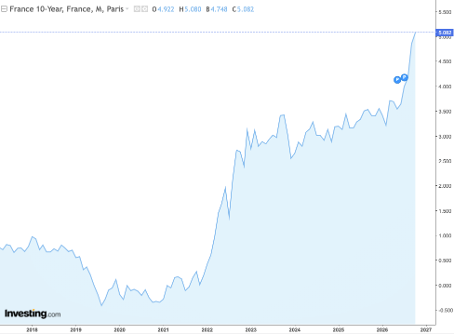
Under these circumstances, the government cannot afford to appear to concede even a crumb. Even the big aid plan drawn up by Bercy (the Finance Ministry), supposedly meant to help the poor little shopkeepers, actually boils down to an interest-free loan of up to €50,000, meagre short-time work schemes and limited aid for very small businesses (TPE) 26 .Compared with the subsidies granted during the Covid-19 crisis — deployed at a world scale — at a time when interest rates were close to 0%, this gives a further clue to what is at stake for the government. The Paris police prefecture even went so far as to ask shopkeepers to hire private security guards to protect their businesses27 , thereby acknowledging its powerlessness and its willingness to shift part of the cost of maintaining public order directly onto private individuals28 .
It is all the more revealing in that shopping accounts for a large share of the economy in city centres, especially in Paris, where tourism is crucial. Far from the spending spree that the announcement of Macron’s address had held out to them, the measures for shopkeepers are an attempt to save face and at the same time testify to the country’s difficult budgetary position.
Along the same lines, rumours have it that Macron was about to declare a state of emergency but reportedly backed away at the last moment, possibly for fear of the markets’ reaction. The targeted curfew measures also seem relatively weak compared with the violence of the executive’s law-and-order rhetoric. Given the gravity displayed by State representatives, are they afraid of losing control again? While no single causal link can be drawn between the debt crisis and each government action, it seems important to us to underline that connection.
October 24: The Beginning of the Crash?
We will not risk ourselves into making predictions about what will happen this Saturday, our thinking being dynamic, subject to the unpredictability of revolts. The situation may well continue to escalate, but this time there will be no element of surprise, and the authorities will undoubtedly make their best to reassert their authority. In view of the judicial repression now beginning to fall upon the first defendants brought to court, it is all the more important to recall that video footage is being exploited by the State in increasingly sophisticated ways. We must therefore make sure that people do not foolishly put themselves in danger, and that everyone understands that journalists are not our friends.
That said, faced with this repression, which seeks only to destroy lives and the unity that was, at least partially, achieved during these riots, we must realise that the only way out is either defeat or permanent escalation29 . Only a qualitative extension of what is happening can render policing and its legal-police apparatus ineffective. They do not have enough cells to lock up all the rebels; not enough cops to defend shopkeepers and their police stations; not enough magistrates to try an entire section of the proletariat that would give itself over to urban insurrection.
Several questions arise in light of the lessons we draw from October 17. To what extent could putting 80,000 or 90,000 police officers on a war footing change the situation? What about the arrival of the military to relieve police units of static surveillance duties30 ? We have seen that stretching the policing frontline between looting and wildcat demonstrations posed an enormous difficulty for the law enforcement. Will that still be possible? In terms of the movement’s composition, to what extent might discourse about violence and looting dry up the commitment of certain fractions of the middle and upper classes? Regarding the content of the mobilisation, to what extent might negative activity — the refusal to make demands — continue to spread? Finally, and more fundamentally, to what extent can the movement move beyond the sphere of circulation to reach the point production and to raise the question of blocking it and transforming it?
Only history can answer all these questions. In the meantime, we can conclude by quoting the old man (the real one31 ) in The Eighteenth Brumaire: Hic Rhodus, hic salta!