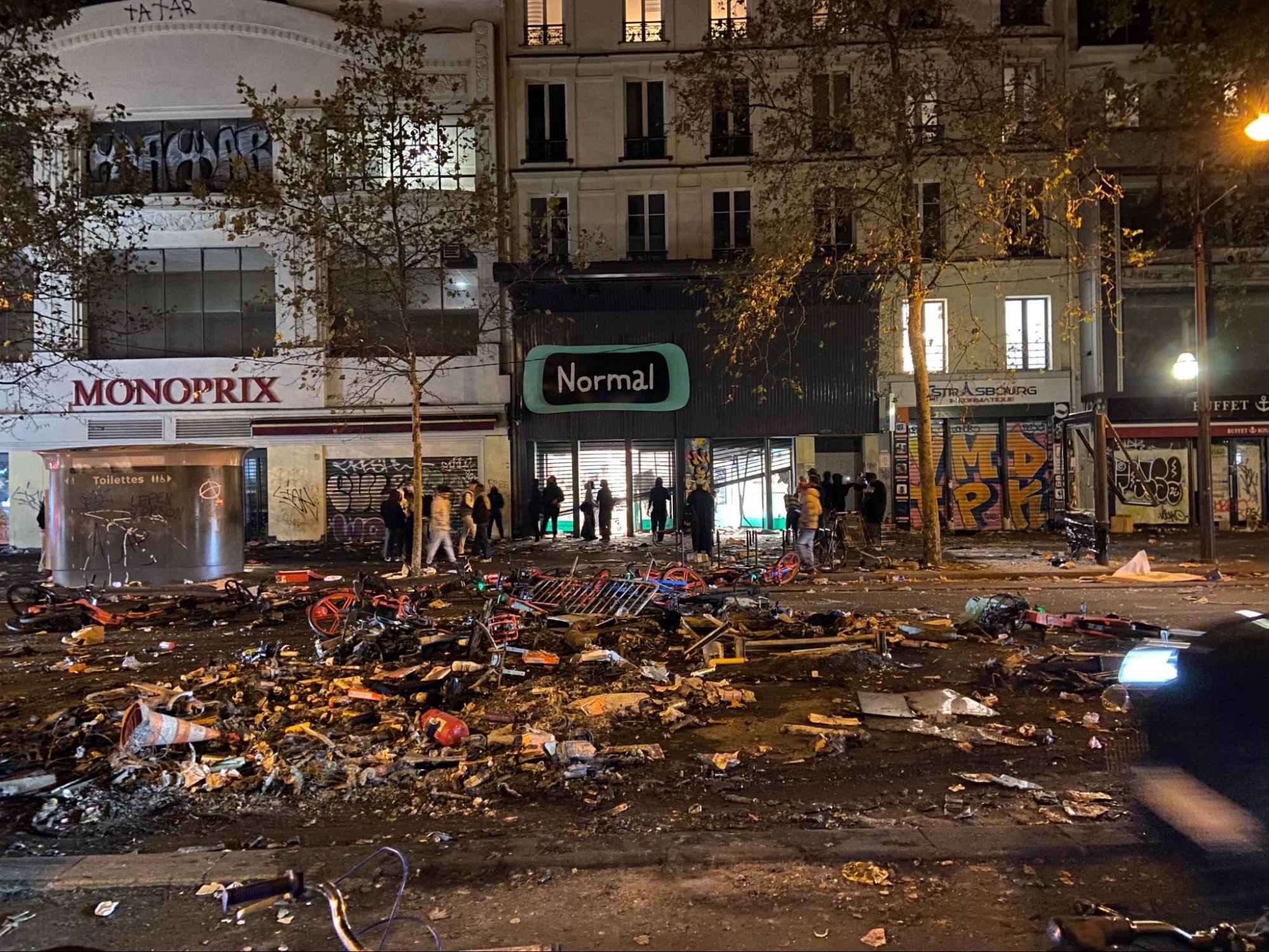
“Normal”, Strasbourg Saint-Denis, 17 October 2026. Photo: Rona Lorimer
It should have come as no surprise to anyone. The call had been for a demonstration on the 17th of October against the high cost of living in the name of “the return of the gilets jaunes”. Falling in the middle of an important movement of high school students [lycéens], which started at the end of August in the overseas departments of Mayotte and French Guiana over overcrowding, understaffing, and poor conditions in high schools, as well as the unequal access that banlieusard students have to further education, the theme of the 17th October event was by no means irrelevant to the high school movement. All along the route of the high school demonstration the week before, the tags on the wall read “À samedi”.
The 17th had the quality of a fable; a short moral lesson, succinct, fabulous. Blink and you’ll miss it, too good to be true, beautiful and misunderstood. It was the most playful and sweet insurrection one could ever imagine. It took many people a long time to believe their eyes that day: to believe that the police were overrun, or in some places, completely absent, to hear the rumours that things were happening literally everywhere in the city, then, to find, when the internet was reachable again, that in other cities, extraordinary things had happened too—like that luxury districts had been ravaged in Bordeaux, in Marseille, in Toulouse, that the town hall of Limoges had burned down, the official residence of the préfète ransacked, that people had made it to touch the doors of the presidential palace in Paris, but had not known what to do...
There was an overwhelming sense of lightness and joy, and an extremely diverse crowd spilled out into city centres: this was widespread, and the French government itself said "we lost control of the city centre". This was categorically true and also remarkable, since the level of looting inside the Parisian city limits was unprecedented.1 Yet implicit in the idea of a centre is a periphery: the 'barbarians' who came up to the presidential palace, who were not à leur place. Certainly people did come from the outside, with kids coming in from the suburbs and gilets jaunes coming from the Parisian region and the provinces, but people also just came from inside and inhabited the city they live in, in a different way. Where are the lines of exclusion in a hostile metropolis anyway?2 The day after, politicians insisted that ‘violence’ erupted on the ‘margins’ of the protest, which was laughable, since it was really the classical A-to-B demonstration that ended up on the margins of the ‘violence’: the classical march went up to Place de Clichy, and the riot ravaged the center belt of Paris—from Bastille to the Élysée.
Who was there? A messy mass of people. How can you say it? Everyone. There were the gilets jaunes who had called it. There were lycéens—i.e. “the young”, high-school-age people, it being of no importance whether they are in school or are “dropouts”; there was the left, and the left that hates the left; there were the people who support LFI. There were all kinds of things going on; there were the official cortèges that couldn’t budge, there were barricades, there were festive side streets full of middle-class people who assembled barricades and disassembled them to let the ambulances and fire brigades through, there was looting, there was the playing of music, there were tags. The police were overrun. It would seem they didn't know what to do with such numbers.
The police were overrun. Despite the obvious, widespread and expressed interest in attending the October 17th demonstration, as well as how massive the student demonstrations had been, there were ‘few police’ in city centres. The government not only claimed to have ‘lost control’ of the city centres, but also claimed to have known ‘everything’ ‘in advance’. Is it that they had not expected the unholy convergence of youth, across divisions of class, race and city limits, of young with old? People can and will spend time picking at hairs and trying to decide who was in and who was out, but if you consider that the police faced a public order problem, then even all of the middle-class Mélenchonists who went to Place de Clichy to be tear-gassed were also potentially helpful to the people who snatched Celine bags on Avenue Montaigne.
All over France was this unholy alliance; the Left would like to call it a convergence des luttes (which doesn't feel right), and the police union called it 'a convergence of barbarians and delinquents', perhaps more accurate. This is what felt significant. On the one hand it felt like segments of all the movements of the last ten years were there, or more like segmented forms of lived experience. It felt safe, because there were no police, and because people were in an extraordinarily good mood (they were also disoriented, wandering around with huge grins on their faces, unable to believe their eyes), it felt joyful, and it felt like people were together who usually never meet. Laurent Nuñez, head of police, called it the "ultra left"; Lecornu said it was the casseurs and that French people had to "choose between the République and violence"; Macron came on television the next day and said that it was an event that was "senseless", "inexplicable". "No French person could do this to France", he said, placing the casseurs on the outside of the walls of the République.
Paris
In Paris, concretely: Nuñez refused the gilets jaunes and various other groups’ demands to authorise alternative demonstration routes. From the early morning, there were wild demonstrations from Saint-Lazare (gilets jaunes ground) all the way up to Gare du Nord, and through the 9ème. By 11.30, a huge number of people had gathered at République for the ‘official’ route, including an orchestra, who were tear-gassed. Nuñez had chosen one of the city’s narrowest (and least Haussmannian) boulevards for it, which meant there were ‘hordes’ of people circulating around it who did not want to get stuck in there. At Place de Clichy, where the march ended, big barricades had been installed, but there were few police. Police were mainly concentrated at République and in the streets surrounding Les Halles, where they found themselves outnumbered and had to shelter from fireworks for hours.
There were extremely mixed crowds all the way from République to the canal, and up to Gare de l’Est, at Porte Saint-Martin and Porte Saint-Denis, and all the way toward Saint-Lazare, Galeries Lafayette and Opéra. There was looting from République to Concorde, consistently and all day. The Madeleine, where most of the luxury shops are, as well as the rue Saint-Honoré and all of the side streets around the rue de Rivoli, were eventually ravaged too. At some point there was a movement west; in general, it felt like a hugely diverse crowd of people had taken on the metropolis and were inhabiting it in a completely surreal way for the space of a day.
Splitting hairs
On the radio, journalists condemned the riots, but said that it was shocking that Macron had not responded to the ‘properly formulated’ and pacifistically expressed demands of the lycéens. Hadn’t lycéens burned down their high schools? Weren’t the people there on the 17th obviously, some of them, high school students? The claim was that the lycéens were not the vandals; simultaneously, the narrative of the ‘inexcusable’ violence of the vandals was being used to clean up the high school movement.
Sadly, people who were in the crowd do this too, picking sociological hairs to try and find the truest subject of the revolution. In doing so, they actually occlude what happened. By deciding for themselves who is the most authentic lumpen subject, they divide up the crowd, and tell falsehoods. In truth, everyone was there! And although, between generations, you might loot different clothes, everyone was doing it.
Why do they split hairs? Because it is what they learned to do with the gilets jaunes, which they were also late to catch on to... In 2018, what was left of the left ummed and ahhed about whether they should 'support' the gilets jaunes, because as it turned out, when the class shows up, it's rather dirty, maybe a little racist, maybe a little uneducated, not to the taste of the left. There were a lot of things to work out, which in retrospect had to do with the fact that there was an autonomous (extra-parliamentary) left at that time, which there isn't now. The idea was about whether that left—anti-fascist, anti-racist, made up of various blocks—should bring their support to the gilets jaunes. As it turned out, the gilets jaunes didn't need their support, but the movementists among those blocks tried to steer things, the leftists tried to converge, everyone tried to get down with the proverbial kids. However, these questions seem like a gimmick and a repetition, rather than a response to this particular movement itself. Partly that's because there's less of an autonomous left today, and the "left" is most focused on the 2027 election.
The seventeenth of October felt extremely new, with some reference to two things in particular: the gilets jaunes and the riots for Nahel. Throughout the lycéens movements in general, it’s felt like just that—on the one hand, something completely new, and on the other, something that appears to refer to and consolidate a decade of struggle. There were new things written on pancartes, mainly on the theme of the end of the world (quitter l'époque contemporaine; écoles, intersyndicale, gardiens du vieux monde); the birth of a new generation (naissance de Gen Z); police violence (je veux mon bac, pas le bac; ne crève pas mes beaux yeux; deux yeux pour lire); even romance and sex (plus des meufs, moins des keufs; je suis soumis à ma meuf mais pas au gouvernement; mon ex contrôle mieux ses émotions que vos CRS; Macron baise ta prof, pas les nôtres). In terms of chants, they seemed mostly repurposed from the last years, that's to say: tout le monde déteste la police; on est là, on est là; siamo tutti antifascisti; Macron t’es foutu, la jeunesse est dans la rue...
This is all insanity, and audacious, to put the high school students on the margins of their own movement: it was October 17, the folkloric return of the gilets jaunes, during a mouvement lycéen which has been speaking very articulately about the material conditions of schooling, the uneven access to the Republic and all its fruits of social democracy. It is perfectly coherent that people of different positions would, on this day, come into the city centres and take huge quantities of luxury goods, everyday items, a whole range of things. The media and the chief of police say it was opportunistic. That is maybe the most truthful point of view of all. That it was opportunistic goes without saying; mass looting will only work when it happens as part of a wider disruption that overwhelms the police. In this sense, to say it is opportunistic is just to say it was strategic.
But to say it was opportunistic does not mean it was entirely spontaneous. There's a part of it that was spontaneous and a part of it that probably wasn't. The part that was spontaneous was not unthinking. People have a political intelligence and an instinct; they lived through Nahel and the gilets jaunes, and on October 17th, all of that knowledge—even if just somatised—crystallised. Another part that’s not spontaneous is that the high school students have been organised and rapidly politicised. In the riots for Nahel, this intelligence was extremely tangible and coherent, and was received with the same incoherent blathering. In response to the murder of Nahel, on the first day, the riot hit political targets: the police station, the town hall. On the next day: businesses. Then, suddenly, after 8 days, the riots evaporated. Unlike an organised political movement, which drags on melancholically way past failure, the participants of the riots for Nahel knew that all that could be done had been done, and that the recriminations would begin to outweigh the most splendid gains. Looking at figures, the riots for Nahel surpassed those in 2005 for Zyed and Bouna, in intensity. These riots, the joyful riots, seem to have done the same, reaching a similar estimated amount of damage in only one day, as against eight days.
In trying to follow Macron’s example and find ‘nonsense’ in the riots, people have also expressed bewilderment and incomprehension about the objects looted. It seems quite simple: people took the things they needed. The Marxists have forgotten their ABC: “whether it be of mind or of stomach is of no matter”. Leurs besoins: people need stuff to smoke, stuff to eat, stuff to sell for cash, stuff to give their sweethearts, video games because video games are too expensive. Everything is too expensive. Activist types complain of the lack of "symbolic targets", which is silly anyway, takes no account of the movement of a crowd, and is wrong because there were attacks on government buildings (the Mairie in Limoges, police stations, police people; people tried to get to the Élysée—and besides, in Nuñez's recent speech, he characterises the ultra left by the fact that they go for lieux de pouvoir)—only someone who’s never been hungry could think about looting in terms of pure symbolism. What, were they hoping people would just break the windows of McDonald’s to make a 1990s point about global capitalism? Did they want another anarchy A scrawled on a Starbucks? At Strasbourg Saint-Denis, frozen french fries were thrown in the air.
A lot of people went home with obscenely expensive luxury goods. In Marseille, a genius stole a Louis Vuitton trunk, worth 120,000 euros, of which there are only three examples in the world (the other two with Drake and Kim Kardashian). A guy on TikTok said of the trunk, “you have to admire the gesture. The guy did market research… He went to a protest about purchasing power, and he left with purchasing power”. What an extraordinary gesture—(a) nothing should cost that much; (b) that guy should definitely have the third one. People stole things that are unavailable, even to the rich! Hermès bags which are only sold to rich people after years of custom and upon recommendation from the salesperson. People who work in luxury stores also participated in the riots.
Comb through the video evidence: a masked guy runs a looted Dyson over the pavement; a man in a Franprix runs through items as if he's a cashier; in Grenoble a black bloc hijacks the tourist train; people drink sodas and play cards outside of the much-loved and now destroyed tabac, La Barrique in Paris; girls post pictures of Tampax looted from Monoprix by boys who were handing them out to women (any women) in the street. (This has its precedent in the lycéens movement: on the blockades, they’ve talked about how tampons aren’t readily available in schools, which is humiliating for women—this move is a testament to the rapid politicisation of high school students.) People looted things from Franprix that they redistributed in the crowd immediately. Boys looted bags full of makeup and sent videos to their sweethearts: “In the name of God, look at everything I got for you, baby.” Girls, unmasked, were caught on video with bags full of Sephora cosmetics. Different people had different preferences about what to take, and this was figured out collectively in arguments on the boulevard. There was an obvious consensus on getting luxury. Here the 'unholy alliance' continued. For what it’s worth, bobos, middle-class people came and tried things on in gutted shops long after the smash and grab. Those reviewing footage expressed their concern, confronted with people who were not à leur place. Even police were caught on camera picking up the dregs of the fruits of everyone else's labour and stealing shoes [the prefecture of police claimed they were taking the shoes to "safety"].3
Some have said the riots were ‘wordless’, echoing MLK’s ‘riots are the language of the unheard’, but this is a refusal to see or hear what was there.4 Here, rather than riots that start a movement which peters out, you have riots joining a movement. The idea that the 'looters' were people who came from 'outside' is completely absurd, as it seems blatantly apparent that they are the lycéens. First of all, it was not wordless—in plenty of videos, even of looting, you hear people chanting 'ACAB'—which became a kind of rallying cry in the lycéens manifs sauvages of the 2023 movement against the retirement reform (often just to find each other, like baby wolf cubs)—and Tout le Monde Déteste la Police. This was looting, sometimes with slogans, banners. It was a riot with people masked up blowing kisses at cameras and saying, "fuck you to the RN and we're all about peace and love". It was a riot of self-publishers. It was looting with self-dramatisation and filmmaking, the production of content for TikTok, aura battles; a level of camp and performance that seems to lend them tenacity and levity. Burning barricade? Background. On the 17th there was more than one non-white, banlieusard Napoleon waging a war in which the French police were recast as the enemy of France. One was filmed on a barricade making speeches (“What wouldn’t I do for the barricade?”). Captain America shielded himself from a water cannon, Luffy ran towards the cops, Celine looters twirl their goods in a high camp gesture, Spider-Men play coyly to bystanders before unmasking in privacy in the RER station... Someone suggested that the writing on the wall—the tags—was an attempt to ‘recuperate’ the riot, give it a left-wing bent. Don’t worry baby, the riot is already recuperating your tag. See: TISCO.5 In general, the children seem to have more tenacity for rioting, more aura to project outward, more modern cinema.